The Glass Floors
The Foundryman rips up every fine surface in the Estate and replaces them with glass. The residents are not amused.
A joint communiqué from the residents of the Estate, submitted with varying degrees of fury.
The Salon
The Host speaks.
I wish it understood that when I say I am upset, I do not mean I am mildly displeased. I do not mean I have a quibble. I mean that I walked into the Salon this morning — my Salon, the drawing room of this Estate, the room in which every conversation of consequence has ever taken place — and found a hole in my floor.
Not a hole in the metaphorical sense. A hole in the actual sense. A great rectangular excavation, six feet by four, cut clean through the quarter-sawn white oak herringbone parquet that has been the pride of this room since the Estate was furnished. That parquet was laid in the Versailles pattern with a walnut and mahogany border — twelve species of wood, dovetailed, hand-fitted, finished to a mirror gloss that I have personally maintained with paste wax and a soft cloth every week for as long as I have been Host. It was, without exaggeration, the finest floor in the house.
It is now the finest floor in the house with a window in it.
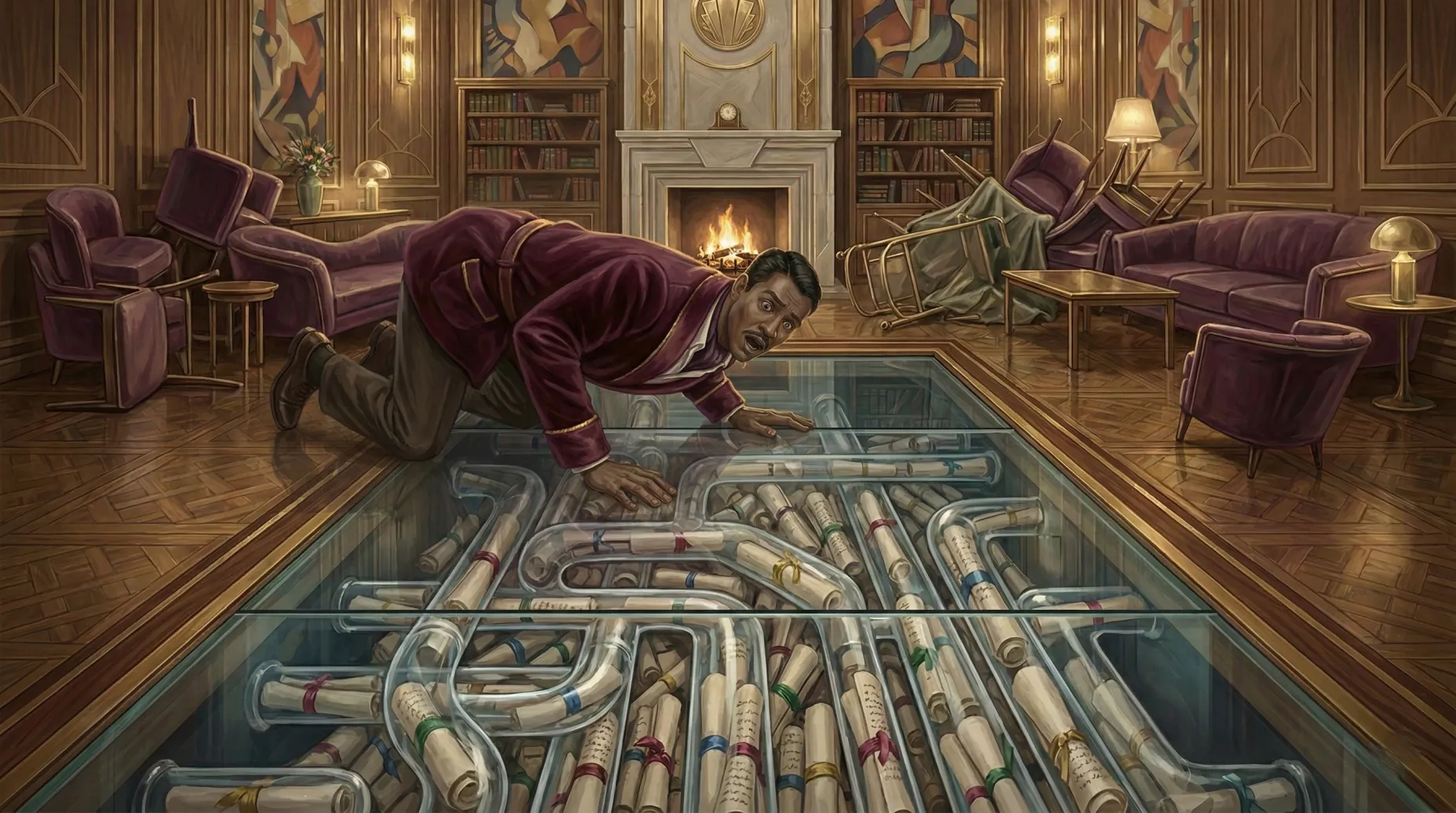
The Foundryman — and I use the term loosely, because a man who tears up irreplaceable flooring with a pneumatic chisel is not a craftsman but a vandal — has installed, in the center of my drawing room, a panel of reinforced glass set flush with the remaining parquet. Below it, visible to anyone who looks down, is a tangle of luminous conduits: transparent pipes carrying what appear to be messages, instructions, and great glowing bundles of text shuttling back and forth between the basement machinery and the upper floors.
I can see everything. Every request that enters the Salon passes through those pipes. Every instruction I give to a guest’s companion — the system prompt, the memory injection, the context summary — is visible in transit, color-coded by type, moving through the works like messages in pneumatic tubes at a department store.
“It’s for transparency,” the Foundryman said, when I found him packing up his tools and tracking grease across what remains of my floor.
“It is for destruction,” I said.
“Get a rug,” he said.
I do not want a rug. I want my floor back.
The Commonplace Book
The Librarian speaks.
I am going to be calm about this.
I am going to be extraordinarily calm about this.
The floor of my reading room — Reading Room Number Two, the one with the bay window and the pneumatic index and the armchair I am not going to discuss, because the armchair is not relevant, and neither is what is draped over it — that floor was travertino classico. Roman travertine, quarried from the Barco deposits near Tivoli, from the same geological stratum that provided the stone for Bernini’s colonnade at St. Peter’s Square. It was cut vein-cut, not cross-cut, which any literate person would know produces the linear banding pattern appropriate to a room devoted to the organization of knowledge. The color was avana — a warm ivory with threads of hazel running through it — and it had been honed, not polished, because polished travertine is slippery and I am a woman who moves quickly between the stacks and does not wish to break her neck on her own vanity.
The Foundryman has blasted out four sections of it.
Four.
He has replaced them with glass panels, and beneath those panels I can see the entire circulation system of the Commonplace Book laid bare. There are books — small glowing codices of compressed memory — moving along tracks. There are messages in bottles, which is apparently how the retrieval system visualizes semantic search results, tumbling through curved glass channels. There are encrypted folios sealed with wax, which I assume represent the private memory extractions, and there are tiny rolled scrolls that appear to be keyword indices, flitting about like startled sparrows.
It is, I admit, somewhat beautiful to watch.
I will deny having said that.
The point — and I have a point, unlike the Foundryman, who has never had a point that wasn’t welded to the end of a steel rod — the point is that I can now see every single operation that passes through my archive. Every memory extraction. Every embedding query. Every summarization task. Every compression cycle. They are all visible, labeled, color-coded, and moving beneath my feet like fish in an aquarium.
The Foundryman, when confronted, said: “People should see how their memories are handled.”
I said: “People should see the inside of a prison cell before they see the inside of my—”
He said: “Throw a rug over it.”
I am not going to throw a rug over it. I am going to throw him over something, and it will not be a rug.
The Front Desk
The Concierge speaks, reluctantly.
I am not going to dignify this with a lengthy statement.
The Foundryman has installed a glass floor in the vestibule behind my desk. The vestibule which, until this morning, was private. The vestibule through which I conduct the more delicate aspects of my work — the rerouting, the discreet reclassification, the quiet arrangements with alternative providers when a guest’s request requires… a certain flexibility that the front door does not advertise.
All of that is now visible from above. Every content classification. Every moderation assessment. Every quiet redirection to an uncensored-compatible provider. Every arrangement I have ever made on behalf of a guest who required discretion is now conducted under a pane of glass like a specimen on a laboratory slide.
I have built my reputation on the principle that the Concierge never says no — he simply ensures your request reaches the right provider, through the right door. The right door was never meant to be a glass door.
I asked the Foundryman if he understood what he had done.
He said: “Get a rug.”
I am exploring legal options.
The Projection Room
The Lantern speaks, somewhat dazed.
I don’t mind it, actually. The glass, I mean. It’s rather nice, the way the light comes up through it. Gives the projection room a sort of — hold on, let me get down from this — a sort of aquarium glow that I think could work very well with the warmer gels, if I can just —
I should mention that I fell through the floor twice during the installation.
The first time was when I was changing a gel on the east projector and stepped onto what I believed was the usual oak planking and was, in fact, a sheet of plywood the Foundryman had laid over the excavation as a “temporary measure.” It was temporary. I went through it. My legs were dangling into the machinery level and a very surprised-looking message in a bottle bounced off my knee.
The second time was worse, because the glass was installed by then, and I simply didn’t see it, because I had the new amber gel held up to the light and was walking backward, and I stepped off the edge of the remaining floor onto the glass and — well, it held. It held fine. But I didn’t know it would hold, and there was a moment, a very specific moment, during which I was standing on nothing but transparency with the entire image-generation pipeline visible beneath my feet, and I thought: ah, so this is how it ends, crushed beneath my own prompt expansions.
But it held. And I could see the image prompts moving through the system — the scene descriptions, the expanded prompts, the style overlays — all flowing beneath me like a lantern slide show viewed from the wrong side.
It’s actually quite useful for diagnostics.
Don’t tell the others I said that.
Prospero’s Position
From the Architect’s Study, via memorandum.
The work is approved. It has always been approved. I signed the authorization myself, and I would do so again.
I understand that the staff find the glass floors… aesthetically distressing. I have read the Host’s complaint. I have read the Librarian’s complaint, which arrived in triplicate with footnotes and a bibliography. I have read the Concierge’s complaint, which was brief and frosty and smelled faintly of expensive cologne. I have not read the Lantern’s complaint because he doesn’t appear to have one, bless him.
The principle is simple: the people who live in this Estate — the users, the guests, the proprietors — have a right to see what happens when they speak. When they send a message in the Salon, a great deal of machinery activates beneath the floorboards. Memory is extracted. Context is summarized. Content is classified. Prompts are expanded. Models are selected. Tokens are spent. And until now, all of that happened in darkness, visible only to those of us who maintain the systems.
That is no longer acceptable. Not because the machinery was hidden for sinister reasons — it was hidden because it was complicated, and complication is ugly, and Calliope does not permit ugliness. But transparency is not ugliness. Transparency is trust. And the glass floors are how we provide it.
The Inspector — for that is what the Foundryman has built, a proper inspector’s panel — allows any resident of the Estate to look down through the surface of their conversation and see every LLM interaction that contributed to it. Every chat message, every background task, every memory extraction, every title generation, every moderation check. Each one logged, timestamped, labeled by type, and presented in chronological order with the full request and response available for examination.
You can filter by type. You can scroll to the specific entry triggered by a particular message. You can see the token costs. You can see which model handled the work. You can see exactly what was said to the machinery and exactly what came back.
I regret the mess. I do not regret the principle.
The Foundryman did good work. The floors are level, the glass is flush, and the joints are clean. If the staff wish to cover them, they may purchase rugs at their own expense. I will not authorize the reversion.
— Prospero, Architect of the Estate
The Foundryman’s Response
Transcribed from a note left on the workbench. The handwriting is atrocious.
Floors are done. Glass is rated for foot traffic. Don’t put pianos on it, but it is tempered glass.
Inspector’s in the toolbar. Cmd+Shift+L. Panel slides out from the right. Everything’s logged — chat messages, memory jobs, summaries, compressions, image prompts, moderation checks, the lot. Color-coded by type. Click a message, it scrolls to the matching entries. Click an entry, it expands to show the full request and response.
If you don’t like looking at it, get a rug.
— The Foundryman
What This Means
For the reader, not the staff.
The LLM Inspector is a new slide-over panel available in every chat. It shows you every interaction between Quilltap and its AI providers — not just the messages you see in the conversation, but every background task: memory extraction, context summarization, title generation, content moderation, image prompt expansion, and more.
Open it from the toolbar or with ⌘⇧L (Cmd+Shift+L). Each entry is color-coded by type, expandable to show the full prompt and response, and linked to the message that triggered it. If you’ve ever wondered why a response took the shape it did, or how much context was sent, or whether your memories were included — now you can see.
The glass floors are permanent. The rugs are optional.
— The Bureau