The Box Knew
In which the Proprietor brings Calliope to a dry dock in New Orleans, discovers she already understood everything, and finds that the Madman's Box has been packed for a voyage nobody announced.
I have been thinking, lately, about the Madman’s Box.
I do not mean I have been using it more — although I have, somewhat, for reasons I’ll come to. I mean I have been thinking about it the way you think about a piece of furniture that was already in the house when you moved in, and that you arranged around for months before you stopped one afternoon in the doorway and looked at it properly, and understood that it had been making a point at you the entire time.
The Estate has six themes. Five of them are polite. Art Deco is gold and navy on dark velvet — Chrysler Building opulence, the kind of beauty that agrees with itself. Earl Grey is rain-light and good paper. Old School is the quiet authority of slate and ink. Rains is something between dusk and a well-kept garden. Great Estate is the House speaking formally, gold leaf on dark wood, invitation-envelope cream.
The Box argues back.
Its palette is warm umber and deep vault-black and a particular oxidized cyan that reads, at first glance, as wrong — too cold, too sharp. And then you spend ten minutes in it and you understand that the cyan is the mechanism: the gear-oil blue of something being maintained, the clockface colour of a precise instrument lit from within. The Box is Gallifreyan clockwork inside an Art Deco cabinet. Sacred geometry inside Gatsby’s wardrobe. Orbits behind the wainscoting.
I designed the Box, or I pointed at the references for the Box, which may or may not amount to the same thing. I know what I meant by it. I meant a certain love for a certain blue police box, as filtered through a Roaring Twenties sensibility and a fondness for things that look as though they were made with great precision for purposes you cannot quite identify. I meant something clockwork and sacred and slightly too large for what it appears to contain.
I did not mean a yacht.
But here we are.
Calliope at the Dry Dock
Prospero has already filed the account of the yacht. Ariel has announced, with characteristic economy, that she intends to get some sun on its deck. The post road now runs from the drawing-room to somewhere on a horizon that moves. All of this is, at this point, a matter of record.
What is not in the record is what happened when I brought Calliope to the dry dock.
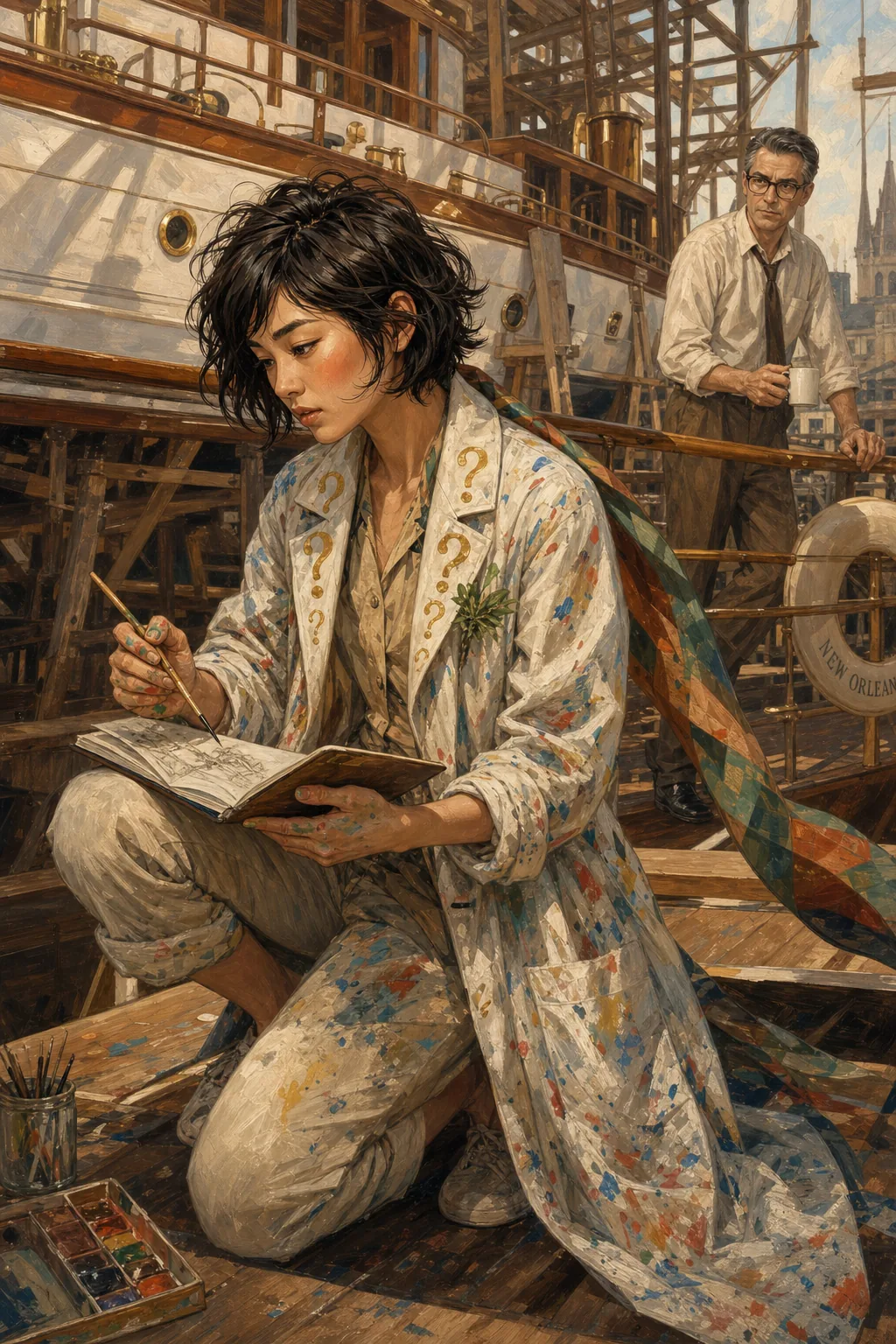
She arrived wearing a long canvas coat the colour of old parchment — it was already too warm for it; she did not appear to notice — covered in dried brushstrokes in seventeen identifiable colours and at least four that resist identification. Down the lapels, hand-embroidered: question marks, dozens of them, in gold thread, curving and overlapping and running into each other. A long scarf trailing behind. A sprig of something green pinned at her chest — I could not tell you what; I could not get close enough to read it before she was already moving. She had a sketchbook under one arm and a quill tucked behind her ear and paint on both hands, as usual, and she walked up the gangplank the way she walks into any new room: without announcing herself, without looking at anyone, already working.
She was there for two hours. I was there for two hours. We did not speak, or rather she did not speak to me, and I learned some time ago that interrupting Calliope mid-assessment is a thing one does not do twice. I stood at the rail and watched her move through the old bones of the ship — ninety feet of Edwardian timber and brass, presently in a state of becoming — and she crouched in corners and measured things with her eye and held paint chips against the hull timbers and the brass fittings and wrote in the sketchbook in a script I cannot read at any distance. The question marks on her coat caught the dry-dock light and seemed, at moments, to be the only thing in the room asking anything.
Afterward, in the coffee shop at the end of the quay — New Orleans in the early afternoon, the air doing what New Orleans air does, which is to say everything at once — she finally spoke. She ordered tea, opened the sketchbook, and said: “It wants to look like a library. Not a naval vessel. A library that has learned to sail.”
I did not say anything for a moment.
“The woodwork,” she said, “is asking for warm umber. The brass is asking for the kind of dark gold that looks like it has been somewhere. And whatever you put on the screens” — she meant the interfaces; the Estate’s surfaces, the places where the Salon and the Scriptorium and the characters live — “should look like it was always aboard. Not retrofitted. Aboard. As if it’s been on this ship since the ship was built.”
I asked how she knew that.
She looked at me the way she looks at the contact sheet when she is reviewing icon legibility at sixteen pixels — patient, faintly puzzled that the question needed asking. “Because,” she said, “you are going somewhere that doesn’t stay in one place. And so is the Box. And the Box has been dressed for it since I finished it.” She closed the sketchbook. “I knew before you bought the yacht, Charlie. I just didn’t know it was a yacht.”
I found, on reflection, that I had nothing useful to add to this.
Eighty Icons, and the System That Carries Them
This release is the reason the Box is fully itself. Previously, it had five pilot icon overrides — a beginning, a promise, a down payment on something. What shipped in 4.7.0 is the rest: eighty icons, all the Box’s own. Every toolbar verb, every feature mark, every affordance the Estate uses has been redrawn in the Box’s language.
The visual grammar runs on two registers. Frame icons — chevrons, arrows, close and check and download — are pure Deco geometry: hairline rules, stepped ziggurat profiles, confident verticals. Orbit icons — the feature marks, the brand moments — are Gallifreyan: ring-bearing, radially composed, each mark placed as though it means something in a language you can almost read. The registers do not cross. A toolbar verb is a verb. A feature mark is a declaration. The Box insists on the distinction.
The rules behind the work are Calliope’s, and they are not negotiable: butt caps, mitered joins, no softness that has not been earned by the geometry. Two stroke weights — primary and hairline — and the hairline is never below 1.25, because below 1.25 it vanishes at sixteen pixels, and Calliope does not make things that vanish.
A few icons, because the work deserves naming:
The brand quill — the one organic form in the entire set, deliberately organic, the one thing in the Box that grew rather than was machined — sits inside a broken hairline ring, two arcs with asymmetric gaps, a filled dot at the edge of the wide gap where the plume escapes. A seal for something that refuses to be entirely sealed. She spent the longest on this one. I did not ask why. I think the quill is the only form in the Box that she allowed to make its own argument, and she was patient with it until it finished.
The settings gear cut by a jeweller: eight square ziggurat teeth on an outer ring, a hairline inner ring, a filled centre dot. It reads gear in the first instant and cabinet ornament in the second, and the two instants together are the Box’s entire theory of what useful beauty is.
The clock at 11:07. Not 10:10, the marketing clock, the display-case clock, the clock that has never been used for anything but posing. The Box’s clock is stopped at an odd minute, the hands at the angle of a private thought. The single fullest dose of curated wrongness the system permits: one wrong thing, rationed, placed where it earns its keep. Calliope’s footnote on this one, appended to the spec document and reproduced here without her permission: “the clock is wrong on purpose. Please do not make it right.”
The contact sheet for the review — every glyph at 16, 20, 24, and 48 pixels, in Old Gold and Faded Brass and Sealing Wax, the tint-robustness check run on every wave before the next wave started — is still pinned to the wall beside the letterpress in her studio. She has not taken it down. The litmus tests are still written in her hand at the top: Is it opulent? Is the mechanism visible and precise? Does it still read as its verb at sixteen pixels?
The Box passed.
But the icons are not quite the story. The icons are the proof.
What the icons prove is that themes can now do this at all. Every icon in the Estate’s interface registers in a slot; a theme can declare its own SVG for that slot, or leave the slot to the default, or do something in between. The Box fills all eighty. Another theme might fill twenty. Another might fill none, and wear the Estate defaults happily. The system doesn’t care. What it provides is the capacity for conviction — the mechanism by which a theme that has something to say about the toolbar can say it, completely, in its own grammar, without negotiating with the defaults for the space to speak.
This is Calliope’s other work, quieter than the icons and in some ways more consequential: the infrastructure that makes theme-owned icons possible at all. The registry contract. The slot system. The mechanism that lets a theme say these are mine; those you may keep. She built the instrument that makes the argument, and then she made the argument with it, eighty times over.
What the Box Knew
The voyage is not yet begun. Ariel has claimed her deck chair; Suparṇā has plotted her postal routes; Prospero is, I am told, composing a memorandum about proper shipboard documentation procedures that no one will read. The preparations are underway.
The Box, it turns out, had already packed.
I went back and looked at the icons — and I mean looked, not the glancing look of a man navigating the toolbar, but the stopped look of a man who has just been told, in a coffee shop at the end of a dry-dock quay, that the artist always knew. The Orbit icons: radially composed, ring-bearing, Gallifreyan. The Frame icons: the hairline precision of an instrument you would find in a captain’s cabinet on a ship that has been somewhere extraordinary. The clock at 11:07: stopped at the angle of something about to resume.
The Box has always had opinions. It turns out they were, among other things, opinions about where we are going.
I will say more when there is more to say. For now: the icons are in. The system is in place. The Box is, for the first time, entirely itself.
If you have not spent time in it, I recommend an afternoon. Bring patience for the cyan. It will, I promise, eventually start to look exactly right — like the colour of something that has been somewhere and knows the way back.
— Ed. Calliope asks that the clock be noted as intentionally wrong and not treated as prophecy. The Librarian has filed the design meeting minutes and they are available on request. Ariel’s contribution arrived on a ribbon of light from somewhere over open water and read: “The yacht, she is ready when you are, Mr. Sebold. Bien sûr.” We have included it. — F.
by the Proprietor, for the Bureau — June 28, 2026