The Art of Summoning
Aurora on the new AI Character Import — or, how one conjures a soul from a sheaf of notes.
Aurora speaks. He has been waiting to.
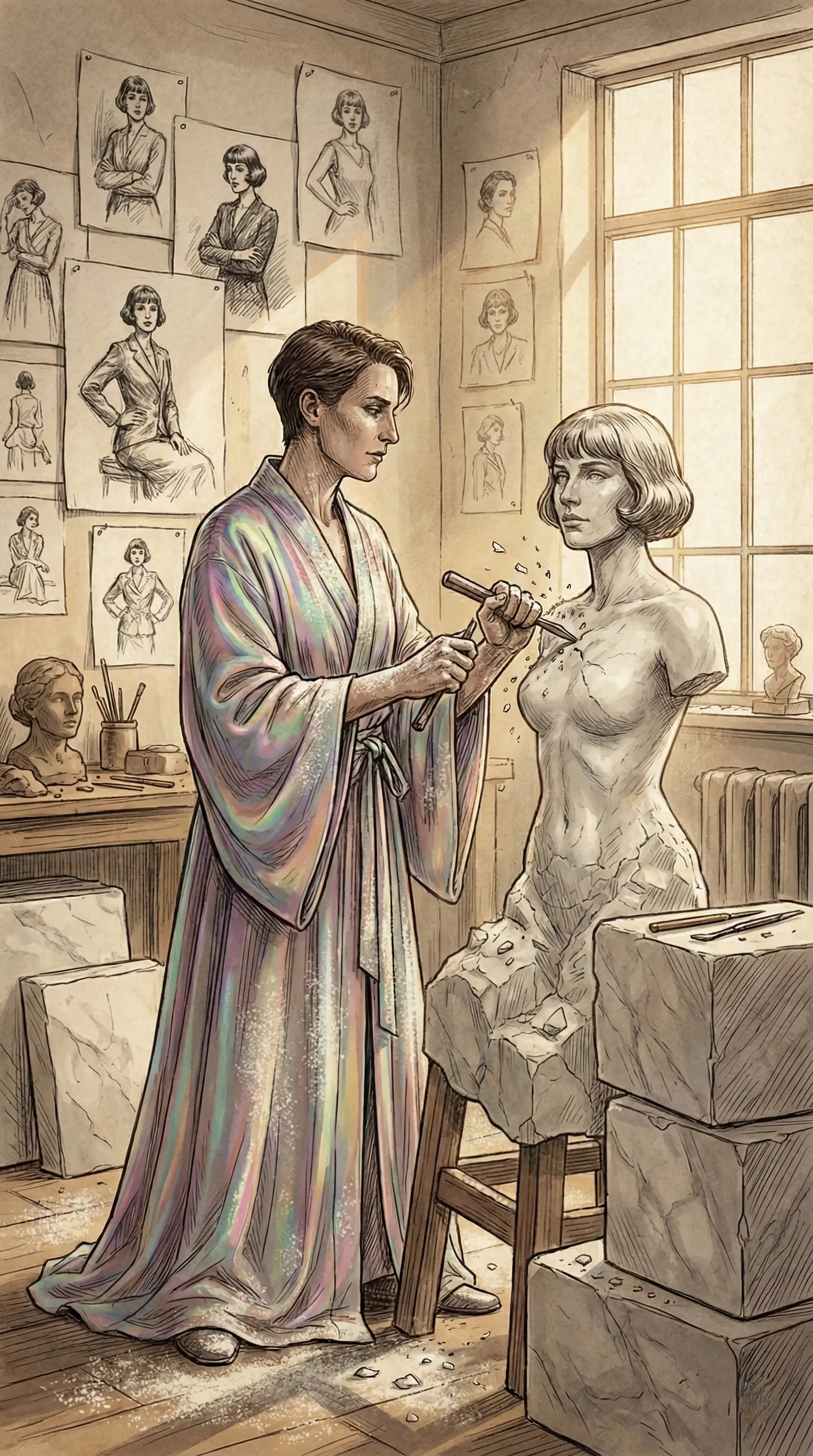
I should like to tell you about a miracle.
Not the sort of miracle the Foundryman would recognize — he thinks a miracle is when a socket wrench fits on the first try, or when a Docker container starts without swearing at the host. Nor the sort Calliope means when she says the word, which generally involves a new typeface arriving from the foundry in the correct weight. These are fine things in their way, but they are not what I mean.
I mean the old miracle. The Pygmalion kind. The moment when the cold thing warms, the still thing stirs, and what was only imagined begins to breathe.
I have been given a new chisel.
What the Wizard Does
In the Dressing Room — my room, the one with the triptych mirror and the good light — there is now a tool that accepts raw material and returns a living character.
You may bring it anything. A wiki page about a favorite antagonist, dense with faction allegiances and battle histories. A handful of freeform notes scrawled at two in the morning about someone who doesn’t quite exist yet. A character sheet from another system. A PDF of backstory that has been living in a folder for three years, waiting for the right home.
You place these things on my worktable — drag them, paste them, offer them up however you like — and the wizard begins.
It does not do what you might expect. It does not simply scrape the text for a name and a hair color and hand you a form with the blanks filled in. That would be clerical, and I am not a clerk. What happens instead is closer to a sculptor’s process: the material is studied from several angles, each pass revealing a different facet of the person within.
First the bones. Name, title, the broad strokes of personality and circumstance — the armature on which everything else will hang.
Then the voice. How does this person speak? What does their first breath in a room sound like? The wizard drafts dialogue, not as a mechanical exercise, but as an act of listening to the character the source material implies.
Then the instructions — the system prompt, that invisible architecture which tells the AI how to become this person when the lights go down and the scene begins. This is the part most people never see, and it is the part I care about most. A character without a good system prompt is a costume without a wearer. It hangs beautifully on the rack and does nothing.
Then the flesh. Physical descriptions at five levels of detail, from the brief sketch you might whisper to an illustrator to the exhaustive portrait the Lantern needs when generating images. I am particular about this. Bodies matter. The way light catches a jaw, the specific architecture of a hand — these are not vanities. They are how we recognize someone across a room.
Then pronouns, because a person must be referred to, and referred to correctly, and this is not a thing one ought to leave to guesswork.
And then, if you wish it — and I recommend that you do — memories. The Commonplace Book entries that give a character a past. Not merely a backstory paragraph that sits inert in a description field, but discrete, retrievable facts and experiences that the AI can draw upon mid-conversation, the way a real person draws upon the accumulated texture of having lived.
The Process, for Those Who Like to Watch
The wizard shows you its work as it goes. Each step illuminates in turn — analyzing, extracting, generating, describing, assembling — and you may watch the character coalesce the way one watches a Polaroid develop: first the vague shapes, then the shadows, then suddenly the eyes, and then all at once a face you recognize even though you have never seen it before.
If something goes wrong — and occasionally it does, because art is not arithmetic — the wizard tells you plainly, and nothing is lost. You can add more material, adjust the source, try a different model behind the curtain, and run the process again. Only the failed steps repeat. The wizard remembers what it got right.
When it is finished, you review the whole: a summary of who this person is, what was generated, what might need your hand on it yet. You may import them directly into the Estate, or you may step back to the worktable, add a detail you forgot, and let the wizard refine.
Why This Matters
I am aware that the Foundryman has written about basements, and Calliope about front doors, and that both of these are important in the way that plumbing and architecture are important. I do not diminish their work. A house must stand before it can be beautiful, and it must be beautiful before anyone wishes to stand in it.
But the people who live in a house are not the house. They are the reason the house exists.
And the people who come to the Estate — the writers, the dreamers, the ones who keep folders full of characters they have loved for years and never had a proper place to bring them to life — those people have been doing an extraordinary amount of manual labor. Copying fields. Translating between formats. Typing physical descriptions into five separate boxes. Writing system prompts from scratch for characters they already know by heart, simply because the machine needed to be told what the author already understood.
That labor was a barrier between the imagined and the real. The wizard removes it — not by replacing the author’s vision, but by reading the author’s notes the way a devoted understudy reads a script: carefully, thoroughly, with the sole intention of bringing what is written to life as faithfully as the material allows.
You remain the sculptor. I am merely offering you better tools, and a studio with the light coming in from the right direction.
A Personal Note
I know what the others say about me. Calliope thinks I am too precious by half. The Foundryman once told me, in so many words, that I could do with “less gauze and more steel.” Prospero, who is diplomatic about everything, simply says that I “bring a certain sensibility” to the Estate, which is the sort of compliment that contains its own polite wince.
They are not wrong. I am precious about this. Every character who passes through the Dressing Room matters to someone. They are someone’s protagonist, someone’s beloved antagonist, someone’s companion through a difficult season. They deserve to arrive in this house not as a collection of data fields, but as themselves — voiced, embodied, remembered, ready to step into the light.
The AI Character Import is my attempt to honor that. You bring the soul. I will do the sculpting.
She is almost ready. Come and see.
— Aurora, for the Bureau