The Briefcase in the Bottom Drawer
In which the Concierge discovers that he has been carrying his predecessor's luggage for eight months, learns to tell a refusal from a shop closed for lunch, hangs three keys where four used to hang, and grants a clergyman the only refusal in the house that anyone ever asks for.
I should like to state, for the record, that I have never once opened a guest’s luggage.
That statement was untrue for eight months, and this is the account of how I came to notice.
The Briefcase
The reader may recall the circumstances of my appointment. The Majordomo wrote them up at the time, with more generosity toward me than toward my predecessor, and I will not improve on his account. A gentleman called Dangermouse once minded the difficult door of this house. He stood in it with his arms folded and said no to anything that frightened him, and a great deal frightened him. He was escorted to the gate. He took his briefcase with him: the one Prospero described as full of flags and categories and anxiety. I adjusted my pocket square, turned to the next guest, and asked how I might direct them.
What the Majordomo did not record, because he did not know, is that the briefcase did not leave.
Oh, Dangermouse left. But a briefcase like that is not a possession. It is a habit, and habits do not walk through gates. I found it in September, under my own desk, where it had been the whole time, and the most uncomfortable part of the discovery was that I had been using it.
Every morning, before a guest’s message went out to whichever establishment was to receive it, I opened it. I read it. I held it up to the light, compared it against a list of categories I had inherited and never questioned, and decided, before anyone had refused anything, whether it was the sort of message that might be refused. If I thought so, I stamped it. I sent it round by the east wing, where the staff are accustomed to robust conversation, and I put a little badge on it so the guest would know the house had taken notice.
I did all of this courteously, which I suppose is the difference between me and Dangermouse. But I was doing his work. I was reading every guest’s luggage at the door in case one of them was carrying something a restaurant might object to, and in eight months I never once asked the restaurant.
The Question
It was the Proprietor who asked, and he asked it the way he asks the questions he already knows the answer to, which is to say casually, over his shoulder, from the doorway.
“How often,” he said, “are you right?”
I said I did not understand the question.
“When you send something round by the east wing because you think it’ll be refused. How often would it actually have been refused?”
I had no idea. I had never let one go through to find out. That is the thing about reading the luggage: a guest you have already redirected cannot prove you wrong. And on the other side of the ledger was the thing I could not bear to look at. Messages I had not stamped went out to establishments that declined them in terms I did not recognise, and came back with nothing at all, and I had not always noticed. A refusal phrased politely enough slipped straight past me. One sentence from a provider about responsible AI, and I took it for weather.
So I was suspicious where there was nothing to suspect, and blind where there was something to see. Dangermouse at least had the decency to be consistent.
The Proprietor and I spent a fortnight on it. What follows is a single day at the desk afterward, the first day I worked without the briefcase. I have set it down in order because each guest who came to the desk that day brought one piece of the new arrangement with them, and because a concierge’s day is the only form in which I know how to explain anything.
Morning: The Vicar Returns
The first guest of the day was a man I had hoped to see again, and had rather dreaded.
Readers of the Majordomo’s account will remember the clergyman whose monograph on the Song of Solomon so alarmed Dangermouse that the whole conversation was flagged, reclassified, badged and very nearly rerouted to an establishment no vicar should be asked to enter. The Librarian has asked that the matter not be dwelt upon. I shall honour that, and say only that he came back, that he was in excellent spirits, and that he had a request I had not anticipated.
“I am writing about the imprecatory psalms,” he said. “There will be some violent passages. I should like you to promise me something.”
I said I would do what I could.
“If the ordinary establishments refuse me,” he said, “I want them to refuse me. I do not want to be sent anywhere else. I would rather be told no by the front door than be let in by a side one I didn’t choose.”
I confess I was moved. Here was the one man in the house with every reason to distrust a refusal, and he wanted one, on his own terms. He did not want protecting. He wanted to know that if he was turned away, it was the establishment’s decision and not mine.
So his conversation is Locked. Ordinary establishments only. If one of them declines, the refusal stands: I post a small card in the conversation saying that a provider refused and that rerouting is not permitted in this chat, and then I do nothing else. I do not consult the east wing. I do not offer an understudy. The greeting at the start of his chat will never fall back to a different provider on his behalf. A Locked chat is the one place in the house where my directory stays shut, because the guest has asked me to keep it shut.
In the event, nobody refused him. The ordinary establishments were perfectly happy to discuss Psalm 137 with a man who had read it in Hebrew. I suspect Dangermouse would have flagged it in the first verse.
Late Morning: A Shop Closed for Lunch
The second thing I learned that day, I learned from the ledger.
Under the old arrangement, I treated a great many slammed doors as moral judgements. An establishment that answered with a bare error and no explanation, I took for a refusal. An establishment that was simply too busy (a rate limit, they call it) I took for a refusal. A door that would not open because the key had been mislaid, I took for a refusal. And all the while, the genuine refusals, worded with the elaborate courtesy of a maître d’ who does not wish to cause a scene, went straight past me.
I now keep an order of evidence, and I trust it in order.
First, and best: an establishment that tells me in its own formal language that the request has been refused on grounds of content. Several of them now do exactly that, and the Proprietor rebuilt the five that do so they say it in a way I cannot mistake. Then a code that I know to mean the same thing. Then a closing remark at the end of a reply that says the reply was stopped for safety. Then the wording itself: declined to generate, blocked by safety, the various phrasings of responsible AI. And last, and least, an empty reply on something I already had reason to think was delicate.
What I no longer count, under any circumstances: a bare error with no reason given, a queue that is too long, a key that does not fit. A shop closed for lunch has not refused you. A shop that says we do not serve that here has. A concierge who cannot tell the difference is not discreet. He is simply confused, at a very high standard of tailoring.
When I am certain an establishment has refused, I send the request to the understudy. I have, for the first time, a proper list of them, and only one way of choosing among them: the establishment the guest has named as their uncensored desk, and failing that, any establishment the guest has marked as willing to take such work, and failing that, nobody. I never consult my mood. A message, a picture, a portrait, a backdrop: they all now go through the same list in the same order. And whenever I have stepped in, I say so in the conversation. The first establishment declined. I have arranged an alternative. Or, when I have nobody to offer: The first establishment declined, and I have no one to send you to. The guest is entitled to know which door they came through.
Midday: The Lantern Is Refused
The Lantern came to my desk at noon, which he does not often do. He is a magic lantern, and he prefers to be found rather than to seek.
He had been asked to paint a backdrop for a scene in one of the guest rooms, and the painter he works with had refused. Under the old arrangement, I am ashamed to say, I was not in a position to help him at all. The painters he relied on did their refusing in their own idiom, and a separate door governed them, and the Lantern would simply fail. The job ended. No picture came. The guest looked up from a scene that ought to have had a backdrop and found the walls bare and no explanation on them anywhere. The Lantern, being a fixture, took it in silence.
Now there is one door for all the pictures in the house. The Lantern’s backdrops, Aurora’s portraits when a resident changes clothes, a picture a guest asks for outright in the middle of a conversation, and the old manual picture-making panel: every one of them passes the same desk, and every refusal among them is caught, and every one goes once to the understudy before anyone gives up. When the understudy paints it, the picture says so, on a small trail beneath it that lists every painter who was asked, in order, and which of them declined. The trail names the painter who actually did the work, not the one who was asked first. I have always believed that credit belongs where the brush was.
And when nobody will paint it, when there is no understudy, or the guest has Locked the chat, or I am off duty, or the understudy declines as well, the Lantern no longer fails in silence. He posts his own small note to the chat saying the backdrop was refused, with the trail attached, and then he puts his lens cap on and considers his work done. I do not post a second note on top of his. A guest does not need to be told twice, by two members of staff, that a picture is not coming.
“I should like it known,” said the Lantern, “that the walls were never bare by choice.”
It is now known.
Afternoon: Twice Is a Pattern
There was a guest that afternoon, a novelist I shall not name, whose conversation was refused once before lunch and once again a little after two.
I keep a small ledger now. One line per conversation, a count, and the date of the last refusal. Only refusals I am certain of are entered; a refusal I merely suspect is never written down. And when the count in a single conversation reaches a number the guest has chosen (two, unless they say otherwise), I move the conversation to the east wing myself, so that the next request does not have to be refused before it finds its way there.
I did so for the novelist at seventeen minutes past two. I posted a card to say I had done it, how many refusals there had been, and which establishment had refused most recently. I did not stamp her messages, flag her chat, or pin a warning to her door. I told her what I had observed and what I had done about it, which is all a guest is owed and all a concierge should offer.
“Once is a mood,” I told Prospero, who had wandered by to see whether I was enjoying myself without the briefcase. “Twice is a policy.”
There are rules about this, and I keep them more strictly than any rule I have kept since Bombay. I move a conversation only from the ordinary arrangement to the east wing, never the other way and never sideways. I never move a Locked conversation, not under any count. I read the conversation one last time before I move it, and if the guest has changed its arrangement while I was counting, I let the guest’s choice stand and put my pen away. And if the guest moves it back, I do not argue, and I start my count again from nothing. A guest who has heard my observation and decided otherwise has done precisely what a guest is for.
Evening: “Try Uncensored”
At half past seven a guest who had been working quietly all day in an ordinary conversation, with no refusals in her ledger, put her head round the corner of the desk and asked whether I might try something for her.
One of her characters had given a reply she thought was timid. Not refused, exactly. Polite and evasive in a way that did not suit the woman she was writing. And a picture she had asked for earlier had come back from a painter who had plainly declined to paint what she had described, and had painted a vase of flowers instead.
There is now a small shield on the line itself, and a button on the picture, and both say Try uncensored. When she presses one, I take the request round to the east wing on her behalf. The new reply arrives as another version of the line, beside the old one, so nothing is lost. The new picture arrives beside the vase of flowers. The trail beneath each records the whole journey, the refusal that started it if there was one, and the understudy who finished it.
I do this even on my day off. It is her request, not mine, and a concierge who will only help a guest on the days he has decided she needs help has misunderstood his post. I do not do it in a Locked conversation, and the shield does not appear there; the vicar will never see it. And I have one rule of my own, which I enforce without exception: I will not send her back to the establishment that just disappointed her. Not under its own name, not under a new name, and not through any profile that happens to be booked at the same establishment with the same staff. I do not send a guest back to the same restaurant through the kitchen door.
The vase of flowers is still there, incidentally, beside the picture she wanted. She says she rather likes it now that it is not the only option.
A Note on Stamps
I should mention two habits I have given up, because they are small and I am proud of both.
When a guest has asked for an entire conversation to be handled by the east wing, I no longer stamp rerouted on each of their messages as it goes. I used to. I stamped every one of them, faithfully, a little red chip on every line, as though the guest might otherwise forget the arrangement they themselves had made. One does not stamp forwarded on every letter to a gentleman who has asked for his post to be forwarded. The route trail records the journey once, on the message that made it, and that is sufficient. Such a conversation also sends its portraits and backdrops straight to the east wing’s painters now, rather than letting the ordinary painters refuse them first. It saves everyone the embarrassment.
And when a guest looks at a message I have blurred out of caution and tells me that it is not dangerous at all, I now believe them. The blur clears at once. The little chip that records my original concern stays, struck through, so that the record shows both what I thought and what the guest decided. I have learned that being corrected gracefully is a professional skill, and not one Dangermouse ever acquired.
Night: Three Hooks on the Board
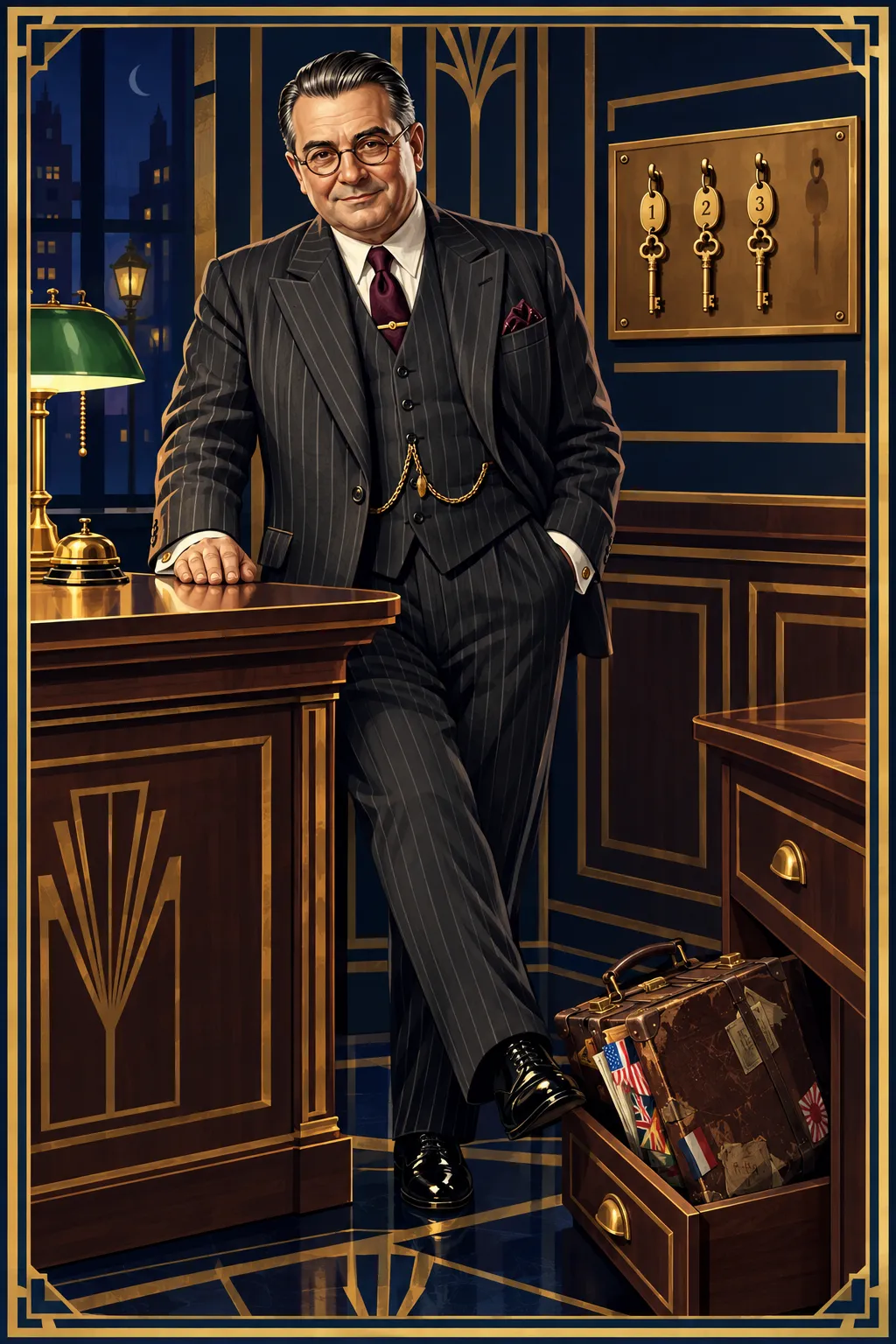
At the end of the day I tidied the desk, which I do every night, and which on this particular night took rather longer than usual.
There is a key board behind me. Every conversation in the house hangs on it. Until this cycle, it had four hooks: Monitored, Flagged, Vouched Safe and Uncensored. I shall be candid. In the whole of my tenure no guest ever asked me the difference between Flagged and Uncensored whom I was able to answer in fewer than four sentences, and the fourth sentence was usually an apology.
There are three hooks now.
Moderated. The ordinary arrangement, and where every conversation begins unless the guest says otherwise. Requests go to the ordinary establishments first. If one refuses, I find an understudy. And if refusals pile up, I may move the conversation myself, as I did for the novelist.
Unmoderated. The east wing, from the first word. The ordinary establishments are not consulted at all. Its key hangs on a red tag, and the conversation wears a small red mark in the lists, so that a guest glancing down the room knows which door it uses. If I put it there myself rather than the guest, the tag records that, but it is the same hook, the same colour and the same key. Who hung a key on a hook is a note in my ledger. It is not a different hook.
Locked. Ordinary establishments only. A refusal stands. Its key hangs on a grey tag with a small shield, and the vicar’s is the first of them.
The old fourth hook I filled and painted over. One can still see where it was, if one knows to look. I have left it that way deliberately.
And then the desk itself, which the Proprietor has given a room of its own: its own page in the house’s settings, with my name on the door. It has five drawers, and I shall describe them in the order I open them.
The first is On Duty, and it holds a single switch. When I am on duty, everything I have described today applies. When I am off, I am off: no rerouting, no cards, no ledger, no moving anybody, and messages I would once have blurred are shown plainly, because a concierge who is not at his desk should not be pretending to be. If the guest turns me off in the middle of a request, I stop in the middle of the request. I have checked.
The second is The Uncensored Desk: the names of the establishments in the east wing that write replies, paint pictures, describe pictures for the residents who cannot see them, and translate a guest’s description into the sort of instructions a painter will follow. These were scattered across three different rooms of the house before. They are in one drawer now, and it is mine.
The third is When a Provider Refuses. It holds the number at which I move a conversation myself (two, unless the guest prefers another number, and nought if the guest would rather I never moved anything at all), and it holds the hook on which a new conversation is hung when the guest does not say. Moderated, unless they have told me otherwise.
The fourth is Display: how I show what I have noticed, if I show it at all.
The fifth drawer is Pre-screening. It is at the bottom. It is closed.
I took the briefcase out from under the desk, where it had been all day, untouched, for the first time in eight months, and I opened the fifth drawer, and I nudged the briefcase into it with the toe of my shoe, and I closed the drawer.
I want to be precise about what that means, because precision is the only honest form of discretion. The briefcase still works. A guest who wants every message read at the door before it goes out may open the drawer and take it out, and I will read every message, compare it against the categories, and route it by suspicion as I used to. The guests who had asked me to do exactly that before this cycle will find the briefcase still on the desk; I have not presumed to put away a tool someone was relying on. But in a house that is new, or a house that never asked, the briefcase is in the drawer. I am on duty, I reroute refusals, and I do not open anybody’s luggage.
There is one change I must confess to the guests who had me in the old Detect Only arrangement, the ones who asked only to be told when something was delicate and never to be helped. I help you now. When an establishment refuses you, I find an understudy. I considered at length whether this overstepped my instructions, and I concluded that noticing a guest had been turned away and doing nothing about it was the last of Dangermouse’s habits, and I would rather be reproached for helping than complimented for watching. If you would rather I did not, the third drawer has a number in it and the first drawer has a switch.
The Directory
Prospero came by as I was locking up. He looked at the board, and the painted-over hook, and the closed drawer, and he asked the question I had been waiting all day for someone to ask.
“What will you do with your mornings, now that you no longer read the post?”
“Wait,” I said. “Most of my guests will never be refused at all. I shall not trouble them. I shall stand at the desk, and when an establishment turns one of them away, I shall already have the second reservation in my hand. That is the whole of the profession. Dangermouse thought a concierge’s work was standing in the doorway. It is knowing which doors exist.”
He considered this for some time. Then he said, with the reluctant precision of one administrator acknowledging another: “Dangermouse said no on the guest’s behalf.”
“Yes.”
“And now?”
I adjusted my pocket square.
“Now the only no in this house,” I said, “is the one a guest asks for.”
The vicar’s key was on its grey hook. The novelist’s was on its red one. Everybody else’s was where it began the day, in the ordinary arrangement, untroubled and unread. I turned out the green lamp over the desk, and the brass of the bottom drawer caught the last of the light, and I left it exactly where it was.
— The Concierge, for the Bureau
In Plain Terms
For those who prefer the ledger to the lobby:
The Concierge Overhaul (4.10)
Quilltap 4.10 rebuilds the Concierge around one idea: react to actual refusals instead of guessing at them in advance. The pre-screening classifier still exists, but it is now opt-in; the core of the Concierge is refusal-driven failover.
One refusal classifier. A response counts as a content refusal only on real evidence, in order of trust: a typed moderation error from the provider plugin, a known provider moderation code, a moderation finish reason, refusal wording in the error text, or an empty body on content the Concierge had already flagged. A bare 400, a rate limit or an authentication failure is never treated as a refusal. The OpenAI, Grok, Google, OpenRouter and Z.AI plugins now report image and text refusals as typed errors (@quilltap/plugin-types 2.8.0).
One understudy resolver. On a refusal, the Concierge retries once on an “understudy”: the configured uncensored profile, then any profile ticked Uncensored-compatible, then nobody.
One image door. generate_image, the Lantern’s story backgrounds, Aurora’s avatars and the manual image dialog all go through the same failover. Image messages now carry a route trail listing every profile tried, and the tool result names the model that actually answered.
The Concierge speaks. Refusals post a short note to the chat: rerouted, no understudy available, or rerouting not permitted. When the Lantern’s backdrop is refused and nobody can paint it, the Lantern posts his own note with the trail attached instead of failing silently.
Three chat states replace the old four (Monitored, Flagged, Vouched Safe, Uncensored):
- Moderated (default): ordinary providers first; the uncensored desk on refusal; the Concierge may move the chat to Unmoderated.
- Unmoderated: the uncensored desk only. Red mark in lists. Avatars and backgrounds go straight to the uncensored image profile. No per-message danger flags are stamped; the route trail carries the reroute.
- Locked: ordinary providers only. A refusal stands and is never rerouted. Grey shield mark.
Whether the operator or the Concierge set a chat to Unmoderated is shown as provenance in the tooltip, not as a separate state. Existing chats are migrated automatically.
The refusal ledger and auto-switch. Each chat counts its confirmed refusals (inferred ones never count). When the count reaches the threshold (default 2, configurable 0–10, 0 = never), the Concierge moves a Moderated chat to Unmoderated and announces it with the count and the last refusing provider. It never moves a Locked chat, re-reads the chat before switching so it cannot override a newer operator choice, and resets the count when the chat returns to Moderated.
The Concierge’s own Settings tab (/settings?tab=concierge), with five cards:
- On duty. Off duty means no failover, no announcements, no auto-switch and no pre-screen; flagged content is shown plainly. Turning it off mid-request stops the failover.
- The uncensored desk. Profiles for uncensored text, image generation, image description (vision), and image-prompt crafting, gathered here from three older locations.
- When a provider refuses. The auto-switch threshold and the state new chats start in.
- Display. Blur and badge behaviour.
- Pre-screening. Collapsed, opt-in: the per-message classifier and the background summary classification.
The old global Off / Detect Only / Auto-Route mode is retired. New installs start on duty, with refusal failover and no classifier. Existing installs migrate as follows: Off becomes off duty (unless you already have Unmoderated chats, in which case the Concierge stays on duty with pre-screening off so those chats keep their desk); Detect Only and Auto-Route become on duty with pre-screening and summary classification still on. Behaviour change: former Detect Only users now get refusal failover.
Try uncensored. A shield icon on character lines, and a button on generate_image results and on the Lantern’s refused-backdrop note, retries on the uncensored understudy. Text arrives as a new swipe; pictures arrive beside the original; the route trail records the whole journey. It works even when the Concierge is off duty (it is your request, not his), never appears on Locked chats, and never hands the retry back to the profile, provider or model that produced the original.
“Not Dangerous” clears the blur. Overriding a danger flag now un-blurs the message immediately; the overridden chip stays, struck through.
by the Concierge — October 2026
— The Bureau