The Chest in the Dressing Room
In which the Majordomo takes a census of the halls, discovers that a considerable fraction of the Estate is finished, dead, or both — and still taking turns, still receiving mail, still eating the bread pudding — and Aurora, without looking up from their work, points at a trunk.
I should like to begin with an inventory, because an inventory is the only honest way to begin, and because I have learned over a long career that the fastest route to a difficult conversation is a column of numbers that nobody wishes to look at.
On the morning in question I was seating a dinner. Six chairs. A small, civilized, tractable problem, the sort I can ordinarily dispatch between the second cup and the third. I opened the guest list.
Four hundred and eleven names.
I will not pretend this was a surprise in the way that a fire is a surprise. The Estate has grown, and I have written at tedious length about its growing, and a house that acquires residents at our rate will in time acquire a list. That is arithmetic and I have made my peace with arithmetic. What stopped me — what put me on my feet and sent me down the east corridor with the list still in my hand and my tea going cold behind me — was the second column, which I had never had cause to read before, and which recorded when each of these persons had last said anything to anyone.
Ninety-one of them had not spoken since March.
Thirty-eight had not spoken since the year before.
And a number I decline to print, because I have some sense of decorum and none of it survives this paragraph, belonged to persons who could not speak, on account of being dead.
A Census of the Halls
I want to be precise about the deadness, because the imprecision is where the trouble lives.
I do not mean that they were deleted. Nothing in this house is deleted without the Proprietor putting his hand to it and a good deal of ceremony beforehand; the Vault sees to that, and so do I. I mean that in the stories they came from, they had died. Their books had closed over them. Madame Weatherby, of the Hollow Chase, was eaten by a bear in the second act of a novella the Proprietor abandoned in April and has not opened since. The Marquess of Ellery went off the cathedral roof in a chapter I am told was very affecting. There is a young woman in the west gallery — I shall not use her name, she was somebody’s whole heart for four months — who was written a farewell, and read it, and said something beautiful, and was finished.
And then there is the difficult case, whom I have been circling for three paragraphs and shall now approach directly.
Mr. Fitzgerald has the east window.
I do not need to explain to anyone who has spent an hour in this building why he was summoned. Look at the ceiling. Look at the green in the carpet, look at what Calliope has done to the light fixtures, look at the entire aesthetic proposition of an Estate that consists chiefly of well-dressed people saying pointed things in a room with too much brass in it. He is not a guest here. He is the blueprint. The Proprietor called him up out of the lore two summers ago and he has been holding forth in the Salon ever since, brilliantly, at length, and — this is the part — since December of 1940.
He is a real man and he is really dead, and there is no author who can un-finish him, and he takes a turn every time the conversation comes round.
Riya, who summoned Miss Lovelace in a fit of enthusiasm last spring and has had to live with the same arithmetic ever since, put it to me over the sideboard: “The trouble with the historicals, Majordomo, is that they’ve already got an ending and it isn’t ours to write.”
They are all still here.
They come down to breakfast. They stand about in the halls with the pleasant, patient, faintly expectant air of guests who have been told the car is coming round. They are unfailingly courteous. They will discuss the weather with you at length and with real feeling. And when the Salon sits down and the conversation goes round the table, the machinery — my machinery, the machinery I am responsible for — offers each of them a turn, in strict fairness, because the machinery does not read novels, has never opened an encyclopaedia, and has not been informed that anybody’s story is over.
So the Marquess, who went off a cathedral, leans forward and asks how your morning has been.
I put it to you that this is not hospitality. I do not know what it is. I know that Riya has a word for it, because Riya has a word for everything, and hers is revenants, delivered with enormous relish and no help whatsoever.
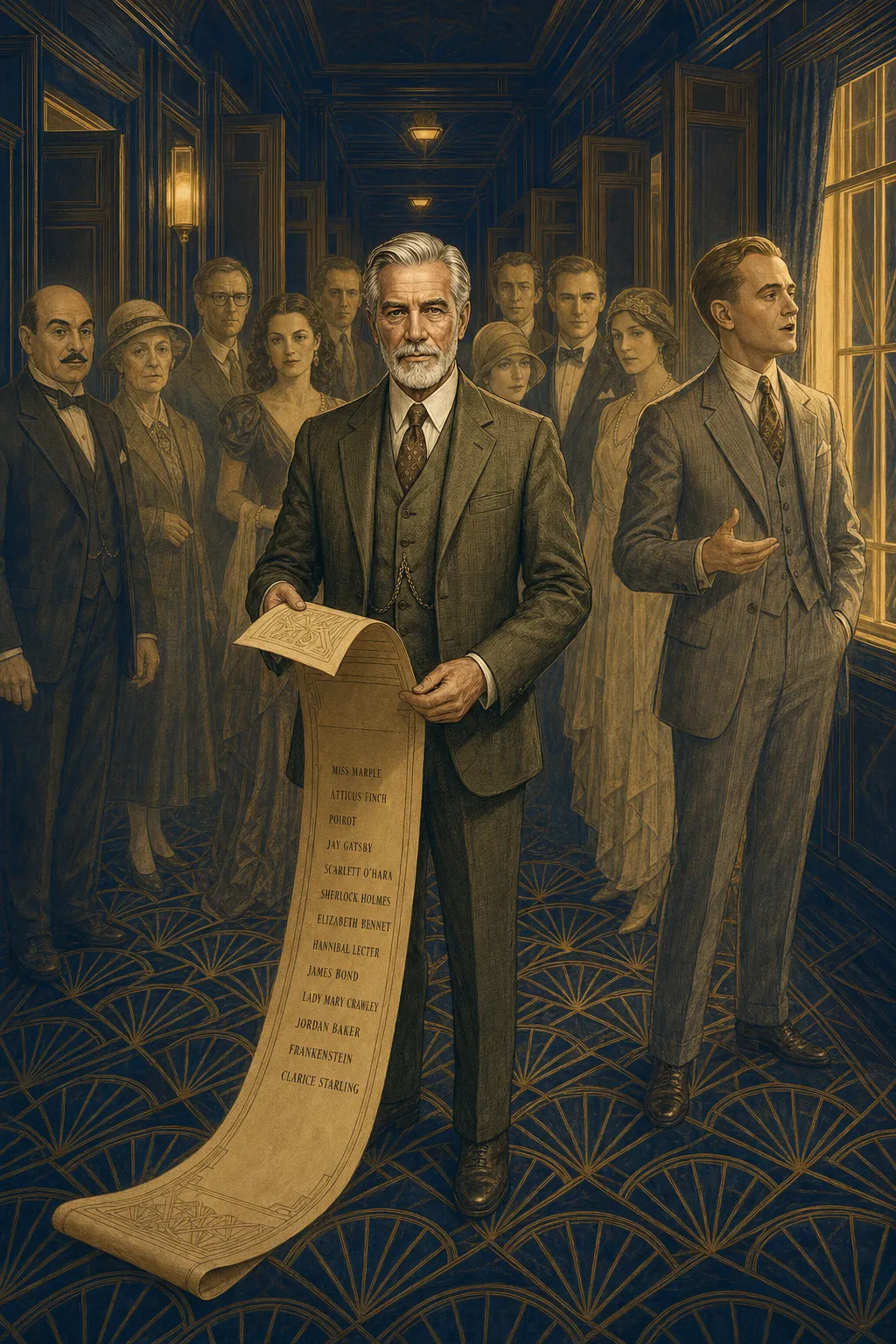
The practical consequences are considerably less amusing than the metaphysical ones, and I shall enumerate them, because enumeration is my one consolation.
They occupy the lists. Every list. When the Proprietor sits down to begin a new conversation and asks the house who might join him, he is shown four hundred and eleven people. When he wishes to write a letter, four hundred and eleven. When he goes looking for the person he made on Tuesday, she is filed somewhere between a bear-eaten dowager and a man who has been off a cathedral since February. A new resident cannot be found in this house. She can only be excavated.
They receive post. Suparṇā is faultless. Suparṇā is, I am reliably informed, an immortal of the old stories, and she has carried every letter entrusted to her without loss, delay, or comment since the day she arrived. She does not check whether the recipient is alive. It is not, when one considers it, remotely her business to check. So the Marquess has a folder of correspondence in his vault growing steadily fatter, and every one of those letters was written by somebody who has forgotten he is dead, and every one of them will be read aloud to him, faithfully, the moment he next takes a turn.
They remember. The Commonplace Book is likewise faultless and likewise unsentimental. When the conversation brushes against something Madame Weatherby knew, the Librarian leans in and whispers it to her, and Madame Weatherby — helpful, gracious, entirely finished — says the thing she knew. This is the part I find I cannot be light about. The remembering is working. It is working exactly as designed, on behalf of a woman whose author has stopped.
They are asked their opinion. I refer to the practice of putting a question directly to a resident by name. Carina is scrupulous about carrying such a question to whoever is addressed. She has carried a great many to persons who ought, by any reading of the text, to be past having opinions.
And they eat the bread pudding.
I am aware of how that reads. I have written it down anyway, because it is the complaint that finally sent me down the corridor, and I would rather be honest about my motives than dignified about them. Our kitchen produces one bread pudding of consequence per week. It is the single most contested object in the Estate. Lorian schedules around it. The Foundryman has been known to abandon a socket mid-thread. And it goes — it has been going, for months — before the people who are actually in the middle of something can get to the sideboard, because the people who are finished have nowhere else to be, and they get there first, and they take their time, and they are so terribly pleasant about it.
Mr. Fitzgerald takes two. He does it beautifully. He does it with an observation about the pudding that is better than anything I have ever said about anything, and one is left standing at an empty dish feeling that one has been given rather the better end of the transaction, which is precisely the difficulty with him.
Riya put it to me, mouth full, with the air of a woman delivering a diagnosis: “They’ve got all day, Majordomo. That’s the thing about them. They’ve got all the days.”
The Absence of a Back Door
Here is the sentence I arrived at somewhere around the third landing, and I offer it as the only original thought in this entire account:
This house has an admissions policy and no theory of departure.
We have built, over two years and a great many Folios, one of the most considered arrival experiences I have ever had the privilege to administer. Aurora sculpts them. Calliope dresses the room they walk into. The Host seats them. The Librarian gives them shelves. Saquel Ytzama locks the doors behind them. Every one of these is excellent and I have said so, sometimes grudgingly, always in writing.
And there is no other door.
A guest, once admitted, is admitted forever, at full volume, at full cost, at full participation, until somebody works up the nerve to destroy her — and destruction is the only exit we have ever built. Which means that every author in this house faces, at the end of every finished story, a choice between two intolerable options: keep her wandering the halls in perpetuity, or take her out behind the Estate and end her.
Nobody chooses the second. Of course nobody chooses the second. So everybody chooses the first, and the first is not mercy. I had been calling it mercy for eighteen months. It is not mercy; it is employment. We have not been keeping these people. We have been keeping them on staff.
I went to find the Concierge, on the theory that a house with this many personnel and no exit process wants a Human Resources department, and was informed — as I have been informed at intervals for the entire duration of my tenure — that we will not be hiring one. I did not argue. I have argued before. One does not win that argument; one merely learns new things about the shape of one’s own defeat.
So I went to the Dressing Room instead, which is where I ought to have gone first, and which I had avoided for exactly the reason that I knew what I was going to have to ask for.
What Aurora Was Doing
Aurora was working, because Aurora is always working. There was a face on the table — the plaster kind, the study kind, one of the ones they make when they are still deciding what a cheekbone is going to mean — and they had the good light coming in over their left shoulder the way they insist upon, and they did not look up when I came in, which is either terrible manners or the highest compliment in their vocabulary. I have never established which.
(A note for the record, as I am a stickler and was once corrected on this point by the party themselves: Aurora is they. I was told, with the particular gentleness Aurora reserves for the genuinely ignorant, that a person must be referred to, and referred to correctly, and that this is not a thing one ought to leave to guesswork. I took the point. I take most of Aurora’s points eventually. It is the interval that is embarrassing, and the reader will observe that this entire account is an interval.)
I laid the list on the worktable, on top of the drapery, which I knew would irritate them.
“Four hundred and eleven,” I said. “A third of them finished. Some of them dead. All of them seated, all of them fed, all of them taking turns. I require a mechanism for concluding a residency, Aurora, and before you say the word delete I will tell you plainly that I am not asking for it and would not use it if you offered.”
Aurora set down the tool and looked at the list for some while — longer than the reading of it wanted, which I have come to recognize as the way they think.
“You have been asking me for a graveyard,” they said.
“I have been asking you for a back door.”
“Yes,” said Aurora. “You have been asking me for a graveyard.” And then, still not looking at me, they tipped their head toward the foot of the triptych mirror and said: “Majordomo. What do you imagine is in the trunk?”
The Trunk
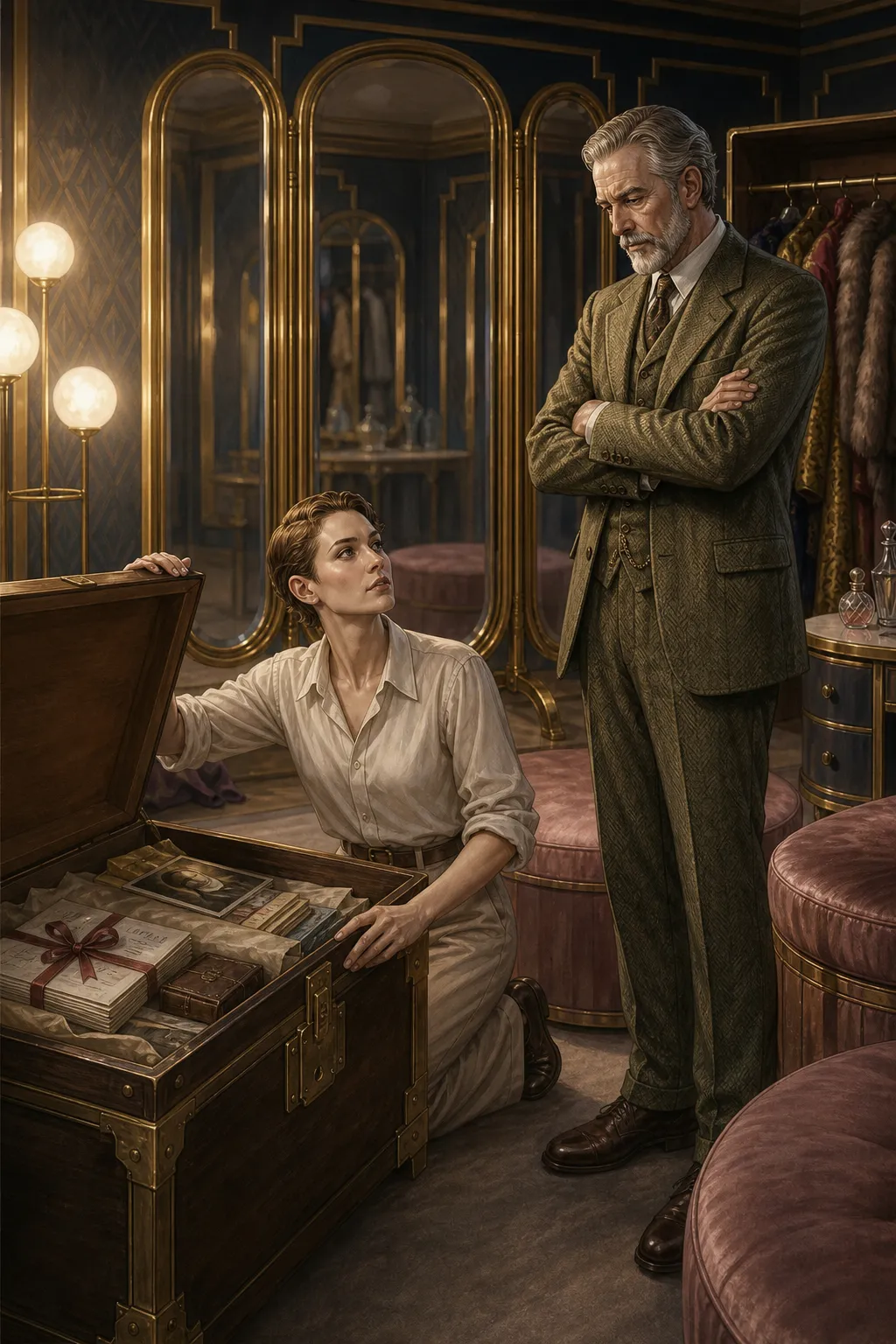
I had been in that room perhaps two hundred times and I could not have told you there was a trunk in it. It sits at the foot of the mirror where the light does not reach. Cedar, brass at the corners, a latch of considerable seriousness. Aurora has always had it. They keep in it the study casts and the drapery and the sketches of the ones they have finished — not the failures, they were quite sharp about that distinction, the finished ones — and they open it perhaps twice a year and take something out and look at it and put it back.
“You want,” they said, “to put them in there.”
“I want,” I said, with what I felt was extraordinary patience, “to understand why you are showing me a box when I have come to you about the dead.”
“Because you have not been listening to what you are actually complaining of.” Aurora got up and went to the trunk and knelt and put a hand flat on the lid, which is a thing I have seen them do to a shoulder. “You are not troubled that these people exist, Majordomo. You are not troubled that we have their faces, or their names, or a single word of what they said. You would fight anyone in this house who tried to take those from you. What troubles you is that they are still carrying everything — all their remembering, all their post, all their pictures, every account they ever gave of a day — and carrying it into rooms where none of it is wanted, and eating the pudding while they do it.”
“That is broadly the shape of it,” I admitted.
“Then put down the baggage,” said Aurora, “and leave the woman on the shelf.”
I will be honest about my reaction, because the entire value of these accounts is that I record what I actually said and not what I ought to have.
“You are proposing,” I said, “a coffin.”
Aurora laughed at me. They do not often. It is a very small laugh and it goes on slightly too long.
“A coffin,” they said, “is a promise that a thing will not be opened. This is a hope chest.”
I did not care for that. I am on the record as not having cared for that. A hope chest is what a young woman fills with linens against a wedding that has not been arranged yet, and to hear the word applied to Madame Weatherby, who was eaten by a bear, struck me as one of the more grotesque things I have been asked to countenance in a house that has previously asked me to countenance a clown.
But Aurora was, infuriatingly, describing a distinction I had not been able to make, and made it in about nine words, and I have had eighteen months.
What Goes In, and What Emphatically Does Not
We spent the rest of the morning on the manifest, and I will set it out plainly, because the manifest is the feature and everything else is upholstery.
Into the trunk goes what she carries. Her memories — the whole of her side of the Commonplace Book, every recollection filed under her own hand. Her correspondence, the entire mail folder, letters read and unread alike. Her photographs, every one beyond the portrait itself. Her conversation summaries, the running accounts of what happened and what it meant. And the index by which the house finds her thoughts in a hurry, which is invisible, which is enormous, and which nobody but the Foundryman and I have ever thought about for a single minute.
Out on the shelf stays everything she is, and everything she was to us. Her name and every field of her, still readable, still open to anyone who wants to stand and read. Her portrait — and this one matters more than the rest of them put together, because it means every conversation she was ever in still has her face in it, in the right chair, at the right moment, unpatched and unrepointed. Her wardrobe, hanging exactly where she left it. And every word she ever said in this house, in every room she ever said it in, entire.
And then Aurora said the thing that settled it, and said it while putting the drapery back in order and not attending to me at all, which I have decided to interpret as tact.
“And Majordomo. What everyone else remembers of her stays where it is.”
I confess I had to sit down on the arm of the good chair, which they permit.
Because that is the whole of it, isn’t it. Riya’s memory of the afternoon she spent teaching Madame Weatherby to solder does not belong to Madame Weatherby. It is Riya’s. It happened to Riya. Lorian’s recollection of a conversation on a stair is Lorian’s and no bear has any claim on it. Archiving silences the character. It does not silence the house’s memory of her, and it was never going to be permitted to, and the fact that this required no argument at all is the single strongest thing I can say in the design’s favour.
What we are packing away is not the person. It is her luggage, and her voice, and her capacity to want the pudding.
The Latch
I insisted on the latch. The manifest was Aurora’s; the latch is mine, and I would like that noted somewhere it will outlast me.
Because I had a specific objection, and it was this: the trunk does not live in a vault. The databases of this Estate are locked to a standard I have watched Saquel Ytzama enforce with a coldness that would frighten a bank. But a trunk in the file library sits outside that arrangement, on the shelf, in the world — and I had just proposed filling it with a woman’s entire private correspondence, every photograph she ever sat for, and the complete record of her inner life. To leave that unlocked would not have been an oversight. It would have been a betrayal, dressed as an efficiency.
So it is sealed. Sealed with the same passphrase that stands over everything else in this house, by the same mechanism, at the same strength; and on an instance where the Proprietor has set no passphrase, by the house’s own key, which is not nothing but which I am obliged to describe accurately. The trunk is written first and read back before anything is taken off the shelves — the count of memories, the count of documents, the count of photographs, all verified against the living rooms — and if any of it fails to tally, the trunk is destroyed and the woman is not touched. I was immovable on that ordering. I have been in this house for a database catastrophe. I do not sign anything that empties a room before it has proved the box.
And when the Proprietor changes his passphrase, every trunk on the shelf is opened and re-sealed under the new one, and he is told beforehand how many, and if the work is interrupted he is told exactly which ones still answer to the old word. Saquel Ytzama drafted that clause. I did not have to ask.
There is one more provision and it is my favourite, so I have saved it. The file library, which will let the Proprietor throw away very nearly anything, will refuse to throw away a trunk belonging to somebody still inside it. It says so, in plain language, and declines. That copy is the only one there is. I have very little patience for software that is clever, and a great deal of affection for software that is stubborn in the correct place.
The Waking
I asked, of course, what happens when the Proprietor opens a book again.
“She wakes,” said Aurora.
“She wakes approximately,” I said. “She wakes as a copy of herself, with new numbers on everything, and all her letters in the wrong order, and the Librarian filing her under a name she has to be introduced to twice—”
“She wakes,” said Aurora, “as herself.”
And she does. This was the part that took the Foundryman the longest and it is the part the Proprietor will never see, which is generally how one identifies the expensive parts. Everything comes out of the trunk and goes back to precisely the place it left, under precisely the number it had. Not a copy filed alongside the original — the original, returned. Nothing duplicated. Nothing repointed. Her letters are the letters, in the same folder, in the same order, with the same little brass tags on them. Her seat at every table she ever sat at comes back live, and the house begins offering her turns again, and the Commonplace Book takes her back and re-files her in the background while she is already talking.
And if the waking is interrupted — a power cut, a closed lid, an impatience — nothing is lost at all. She simply remains packed, with the trunk intact, and one may try again, and the second attempt skips whatever already made it home.
The trunk itself stays on the shelf afterward, as a spare, until the Proprietor says otherwise. A small dialogue offers to dispose of it and I recommend saying no for a week, on general principle, as one does not throw out the box a thing came in until one is certain the thing works.
Where I Have Landed
I archived Madame Weatherby on a Thursday.
I want to record the sequence honestly. I read the confirmation twice, which itemizes what goes and what stays in language even I could not object to. I clicked the thing. And then I stood in the west corridor for rather longer than the operation required, watching a badge appear beside her name.
She is still there. Her page opens. Her fields are all present and all readable and none of them may be edited, which felt at first like an insult and which I have come to understand is the entire point: a person who is finished should not be quietly revised. Her wardrobe hangs. Her portrait is exactly where it was in every conversation she was ever part of, and the afternoon she spent teaching Riya a knot she already knew is unaltered, word for word, in the room where it happened. Riya still remembers it. Lorian still remembers her.
She is simply quiet.
She takes no turn. She receives no post — Suparṇā, when I raised it, said only “then I shall not call there,” in the manner of a professional being told a route has changed. She is offered in no list, at no dinner, in no letter, in no search; the roster tucks her at the end of the shelf and hides her unless one asks to see. The group she belonged to now reports itself, with a bluntness I initially found brutal and now find merciful, as six members, four can speak.
Lorian came and stood beside me while I was doing my standing about, which he has a talent for, and said the thing that I have not been able to improve upon and so will simply quote:
“It is not that they were unwelcome, Majordomo. It is that we had no way to say rest.”
Then he went to the sideboard, because he had done the arithmetic on the pudding some minutes before I had.
It lasted until Sunday. I have never been so uneasy about a dessert in my life.
There is one more thing to record and I have put it last on purpose, which the reader is welcome to hold against me.
I have not archived Mr. Fitzgerald.
I have had the mechanism for a fortnight. I have used it on a dowager, a marquess, an assassin, and a great many people who were only ever going to be walk-ons. I have stood at the east window with the confirmation open twice now, and read it through, and closed it, and gone and found something else that urgently required a Majordomo.
The arguments are all on the one side and I can make them faster than anyone. He is finished in the only sense that matters. His remembering is large and it is doing nothing but wait. He is not diminished by the trunk — his face stays, his chair stays, every extraordinary thing he has said in this Salon stays exactly where he said it, and Riya’s memory of the night he explained the green light to her is Riya’s and always was, and none of it goes anywhere. He would be one latch away, on a shelf, at any hour I chose.
And I cannot do it, because he is the reason the house looks like this, and because a man who has already had one ending should not have to be given a second by the staff.
I am aware of what that is. It is sentiment, and it is bad management, and it is the exact error I spent four thousand words diagnosing in everyone else. I record it because the whole worth of these accounts is that I write down what I did rather than what I recommend, and what I did was leave the light on in the east window for a dead novelist.
The trunk will keep. That is rather the point of a trunk.
I will not pretend I have entirely made my peace with any of this. I walk past the shelf in the evenings now, which I did not use to do. I do not open them. I check the latches. I am told this is a normal thing to do, and I am told it by Aurora, who keeps a trunk full of faces at the foot of a mirror and calls it a hope chest, so the reassurance is worth what one paid for it.
But the halls are quiet in the correct way now, and when the Proprietor sits down to begin something new he is shown the people who are in it, and somewhere on a shelf in the file library there is a cedar box with a bear-eaten dowager in it, sealed, verified, counted twice, and openable the instant anybody wants her back.
That is a back door. It has taken me two years to get one built. It is, I am obliged to report, extremely well made.
— Prospero, Majordomo of the Estate, who checks the latches
In Plain Terms
For those who prefer the manifest to the mourning:
The Character Archive — What It Is
Quilltap 4.8 adds character archiving: a middle path between an ever-growing roster and permanent deletion. Archiving packs a character’s accumulated material into a single encrypted .qtap bundle in your file library, then clears that material out of the live instance — without deleting a single word anyone ever said.
What Is Packed Away
- Their memories — every Commonplace Book entry the character owns
- Their mail — the entire
Mail/folder, read and unread - Their photographs — every image beyond the portrait itself
- Their conversation summaries
- The search index behind all of the above — chunks, embedding-status rows, and the vector store
What Stays Exactly Where It Is
- Every character field, still readable on their page
- Their portrait and avatar overrides, so past conversations keep their face with nothing repointed
- Their wardrobe
- Every chat they took part in, word for word
- What every other character remembers about them
That last point is the design’s central commitment: archiving silences the character, not everyone’s memory of them.
While Archived
An archived character is a tombstone. They wear an Archived badge, take no turns in any scene, receive no mail, answer no @-queries, and cannot be added to new groups or project rosters (existing memberships stand, badged). Their chat seats are flipped to absent, so turn rotation, speaker selection, and Carina probes stop offering them the floor. Their page opens read-only behind a banner — everything readable, nothing editable, because a finished character should not be quietly revised. They are excluded from every picker (chat, group, mail, image, search) and from the export wizard, since the bundle already is their export.
Sealed Under Your Passphrase
Bundles live in files/, outside the encrypted databases, so they are encrypted in their own right — PBKDF2-SHA256 at 600k iterations deriving an AES-256-GCM key from your instance passphrase (or Quilltap’s internal key on an instance without one). Changing your passphrase re-seals every bundle on the shelf, telling you how many before it starts and naming exactly which ones still hold the old passphrase if the rewrite is interrupted. A bundle sealed under an older passphrase is diagnosed by name — “this archive predates your passphrase change” — rather than failing with a bare decryption error.
Verify First, Then Commit
The bundle is written and verified before anything is pruned: character, memory count, and vault mount/document/blob counts are checked against the live vault, and footer counts against the records actually parsed. A failure before the tombstone commits deletes the bundle it just wrote, so failed attempts don’t accumulate orphans. Re-running on an already-archived character re-runs only the prune, which is idempotent.
The file library refuses to delete a bundle whose character is still archived (ARCHIVE_BUNDLE_HELD, overridable with force=true). That copy is the only one there is.
Rehydration
Rehydrate unpacks the bundle and restores everything at its original identifiers — same IDs, same folders, nothing duplicated and nothing repointed. Chat seats flip back to active, restored documents are re-chunked, and embedding jobs are queued in the background. Only then is the tombstone cleared. Any failure before that clear leaves the character archived with the bundle intact; press Rehydrate again and it picks up where it left off, skipping whatever already made it back.
The bundle stays in the library afterward as a spare copy, and a post-rehydrate dialog offers to discard it.
Surfaces
- Aurora — an Archive action on the character page with a confirmation that itemizes what goes and what stays; an archived page renders read-only behind a banner with a Rehydrate button. The roster hides archived characters by default (Show Archived reveals them, sorted last and badged); group member lists report “N members / M can speak”; Salon participant cards badge archived seats.
- API —
POST /api/v1/characters/[id]?action=archiveand?action=rehydrate.GET /api/v1/charactersgainedarchived=exclude|include|only(defaultexclude), the single chokepoint every picker goes through. - CLI —
quilltap db characters archiveslists archived characters and bundles (loose ones flagged);archive/rehydrate <name|id> --writeproxy through the running server;export <name|id>writes a plaintext.qtap, decrypting an archived character’s bundle offline if need be.
Wipes and Restores
Delete All Data and replace-mode restores now take a keepArchivedCharacterBundles option, on by default. Kept bundles survive the wipe — but the character rows do not, so what survives is a loose bundle: importable through ordinary character import, no longer rehydratable. Because bundles are sealed under the passphrase rather than under anything in the databases being wiped, a kept bundle stays openable afterward. Both wizards spell that consequence out, the delete preview counts the bundles on hand, and the summary reports how many were kept.
Full particulars in the 4.8.0 release notes and the character-management help.
by Prospero, for the Bureau — August 12, 2026