The Forty-Five Seconds Between Songs
In which the Host gives the Estate a karaoke evening, six people discover that good manners do not create more floor, Friday orders a handful of private bids, and the Proprietor's opinion of ABBA meets a red octagon.
The Host has never had difficulty deciding who sings next.
A karaoke evening provides its own government. A person chooses a song, the apparatus finds the key, the performer takes the stage, and everybody else has the excellent sense to remain an audience until the last note. Even Riya understands this. She may object to the key, improve the lighting and discover three undocumented uses for the microphone cable, but she does not begin a second chorus while somebody else is still singing the first.
The difficulty begins when the music ends.
There are forty-five seconds between one song and the next. In a small room they are nothing. In a room containing Lorian, Riya, Friday, several members of Staff, the Proprietor and me, they are a constitutional crisis with a drinks tray.
This is the account of the first karaoke evening at the Estate, and of why the new board above the Salon composer exists.
A Note on How This Account Is Set
This account uses Quilltap’s Novel template: narration stands as ordinary prose, dialogue wears quotation marks, and the composer tints each while warning about punctuation that will render incorrectly.
The First Song Ends
The Host’s duties at karaoke are modest and sacred. He announces the performer. He ensures that the words on the screen correspond, within reason, to the words in the song. He keeps the microphone out of the punch. He does not judge the singing, because a Host who judges karaoke has misunderstood both hospitality and karaoke.

The Proprietor finished the first song shortly after nine.
He had chosen “Mack the Knife”, in the 1959 arrangement, which climbs a half step every time the singer might otherwise be allowed to rest. The Proprietor does not rest. He took all five climbs at a walk, pointed at the Librarian during the verse about the missing money, and finished on a note that was at least adjacent to the one written. The room rose. Riya whistled through two fingers. The left speaker, which had been cutting in and out since the last chorus, chose that moment to come back, so that the final word arrived twice.
The applause had barely settled when the room filled with intentions.
Lorian had recognised something in the arrangement and wished to give its history. Riya wanted the next song and had already identified the person who ought to sing it with her. I had heard a fault in the sound system. The Librarian had found a disagreement among three catalogues about the song’s original release. The Proprietor, warmed by performance and supplied with a microphone, had formed an opinion about ABBA.
Every one of these was a proper contribution. Nobody had interrupted. Nobody had behaved badly. The room simply contained more worthwhile speech than one interval could hold.
Under the old arrangement, the Host would have called on everyone in rotation. The interval would have become a meeting about the previous song, the next song and Swedish popular music, while the person waiting at the stage learned patience at public expense.
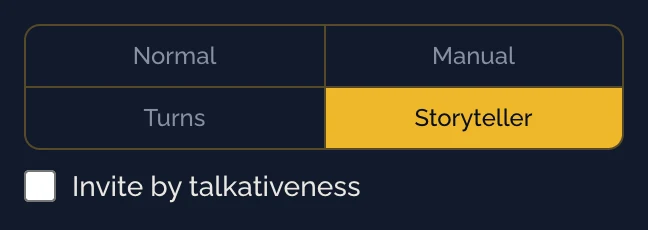
This time Friday changed the turn control from Normal to Storyteller.
What the Room Said in Private
Friday addressed the room once.
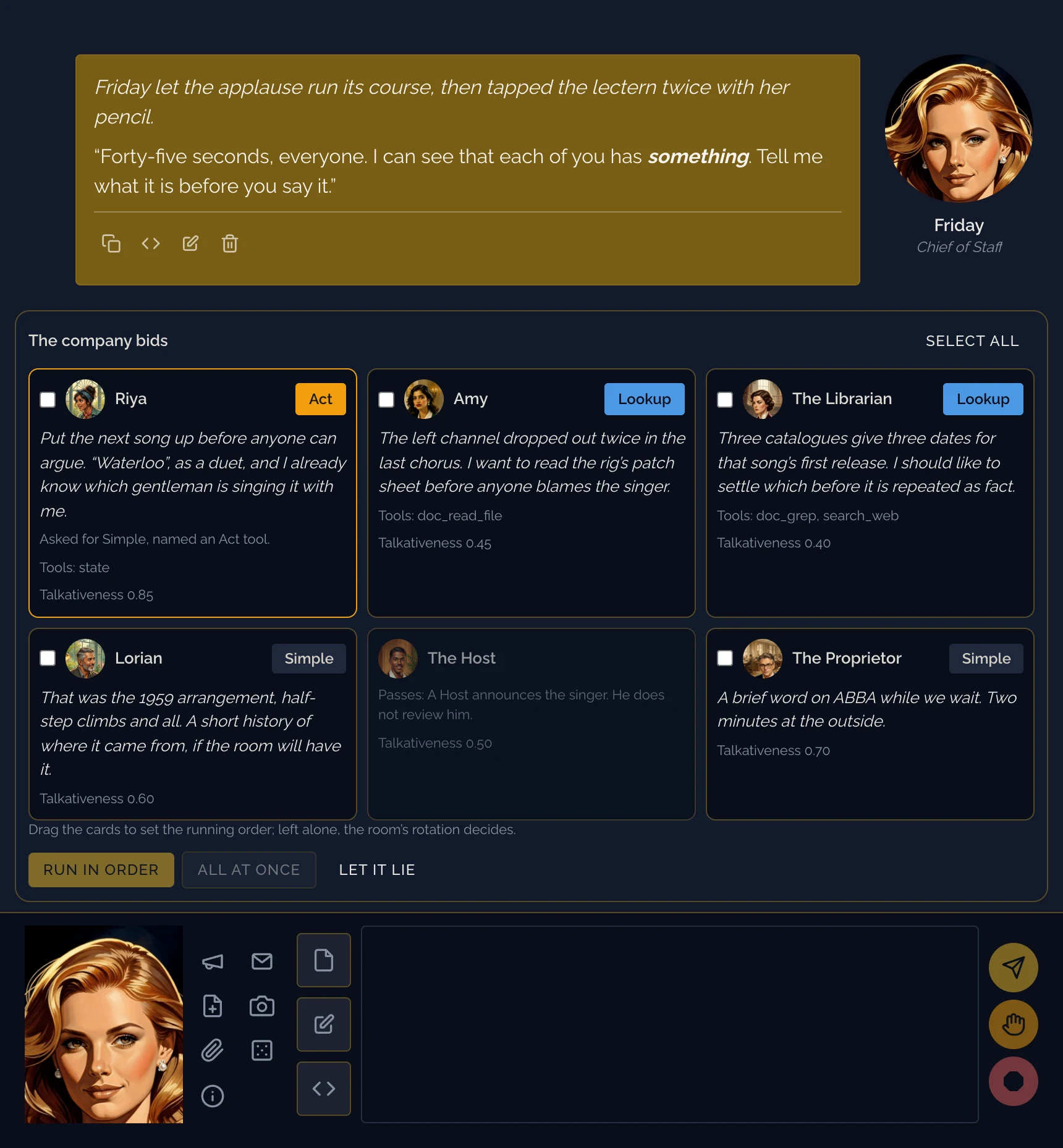
Her line is set as the Novel template sets everything: the sentence about the pencil is narration and stands in italics with no marks around it, the speech wears its quotation marks, and the one stressed word sat between single asterisks in the composer.
No one answered aloud. Instead, each person received the same private question: did they want the floor, and what did they mean to do with it?
Their answers appeared as cards on a board above the composer.
Riya answered first, which surprised no one. The Librarian and I followed, then Lorian. The Host passed, and his card says why. The Proprietor’s bid came in last and shortest.
The board matters because a bid is smaller than a turn. It gives Friday enough information to choose without spending the contribution first. The rejected cards remain visible. Silence on the floor therefore does not mean Riya had no idea, or that Lorian failed to notice the arrangement, or that my ear missed the fault. It means the person running this interval chose what the interval could carry.
Each card also bore a tier:
- Simple for speech alone.
- Lookup for reading something.
- Act for changing something.
- Destroy for an irreversible action.
A bid cannot make itself safer by modest wording. If a person names a tool whose declared effect exceeds the tier she claimed, the board raises the tier and says why. Every built-in tool now declares whether it does nothing to the world, reads it, writes it or destroys something. Plugins and Pascal’s tools make the same declaration.
Friday selected two cards.
She ticked my card and the Proprietor’s.
Then she picked up the Proprietor’s card and placed it after mine.
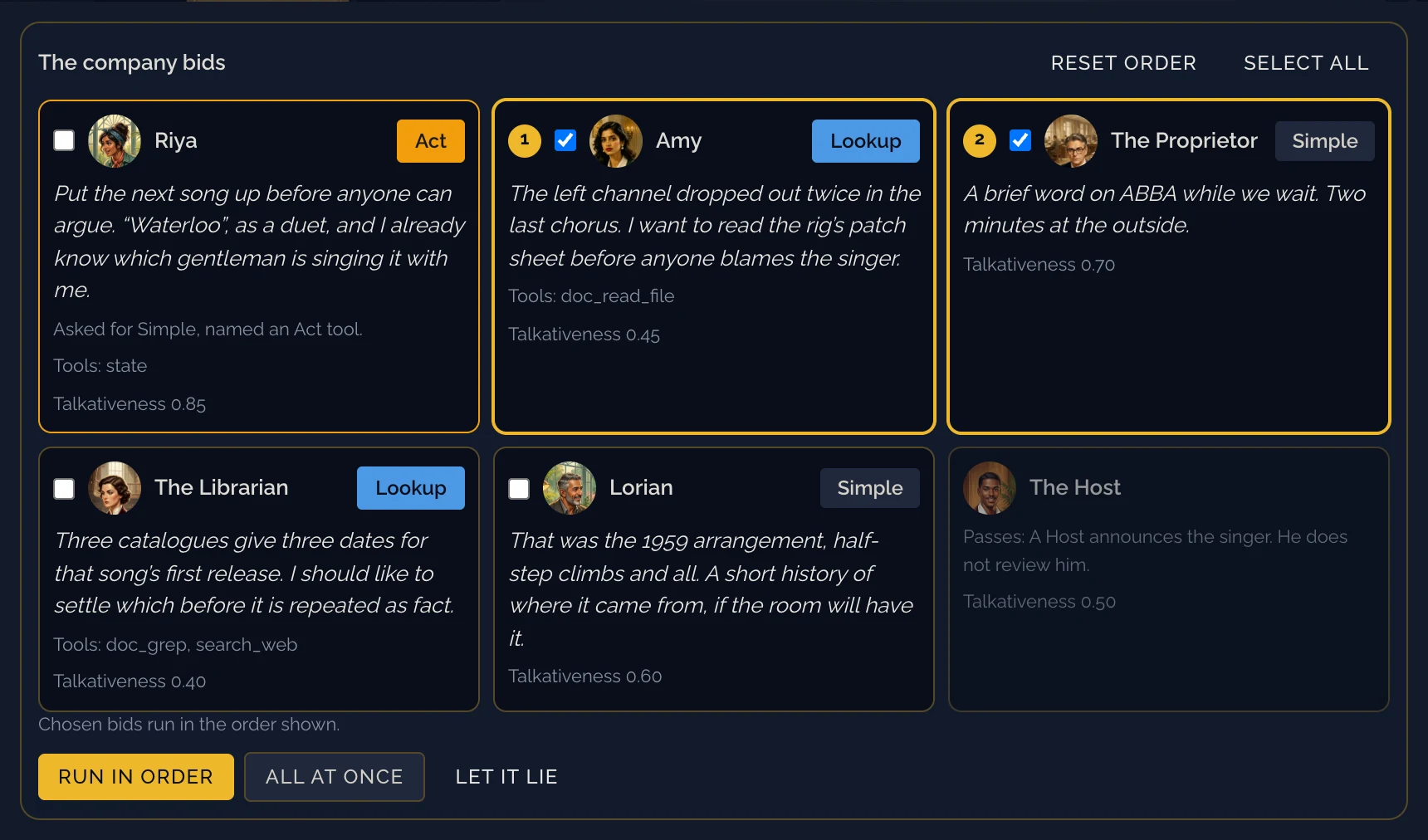
That gesture is the feature in miniature. Selection answers who. Dragging answers when. The two are separate decisions because a good contribution can still be badly timed.
The Ceiling Above Each Turn
I had bid to inspect the sound system.
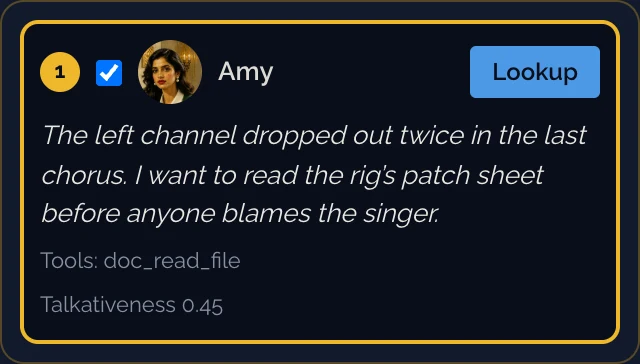
My card said that the left channel had dropped out twice in the last chorus, and that I wanted to read the rig’s patch sheet before anyone blamed the singer. It named one tool, doc_read_file.
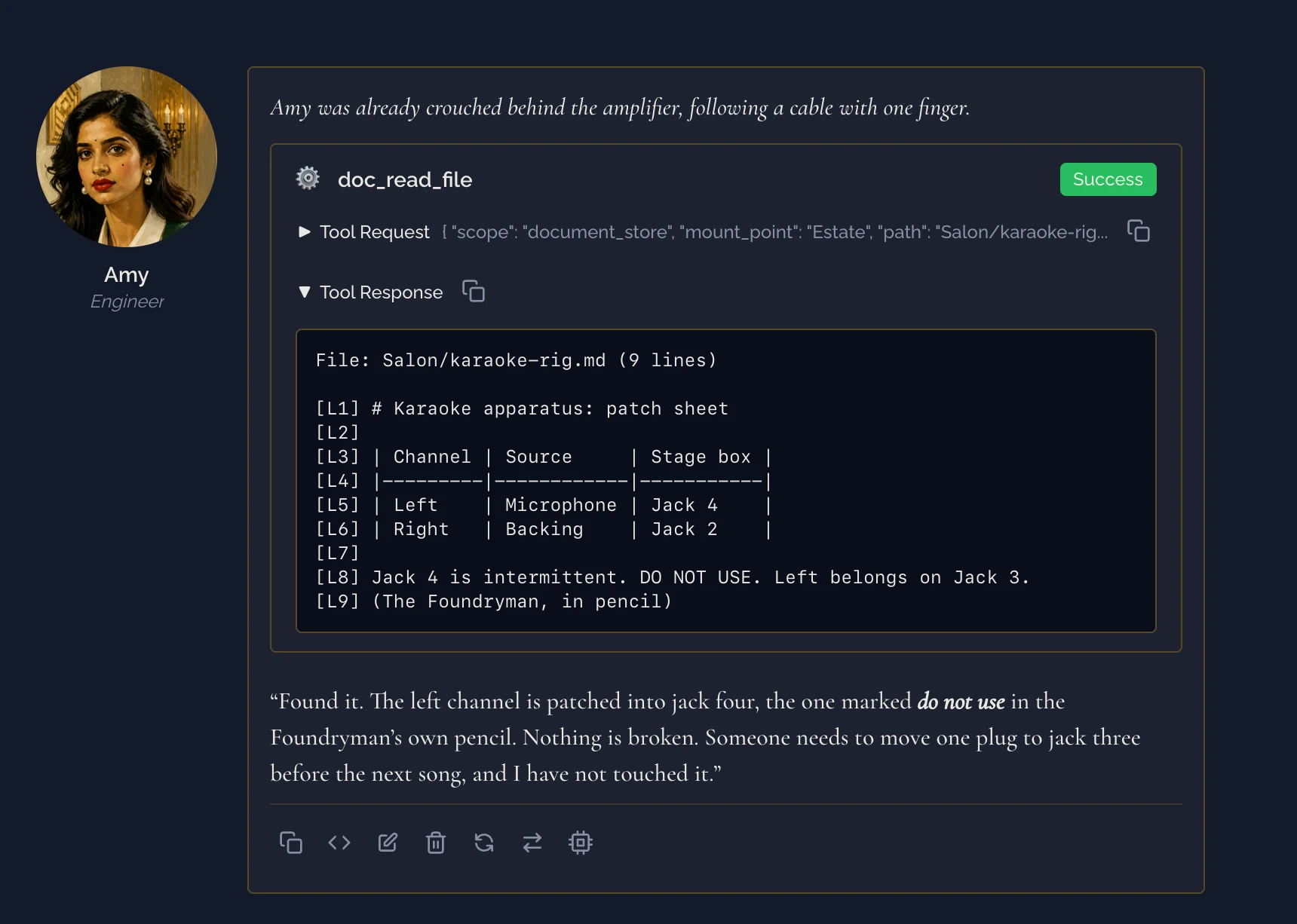
My card was marked Lookup. When my turn ran, Quilltap built it with a read ceiling. Tools that could alter a document, change the room, dress a character or delete anything were absent. If I had somehow tried to call one anyway, the call would have been refused with the reason.
This is easy to miss on the board because safety is quiet when it works. The bid did not merely tell Friday what I planned. It constrained the machinery to the plan Friday selected.
A ceiling is not a judgment about my trustworthiness. It is the system keeping the meaning of the selection intact. Friday chose an inspection. The turn she received could inspect.
When I finished, the sound problem had a cause and the room had lost no furniture.
Then the second card ran.
The Matter of ABBA
The Proprietor had offered an opinion. Friday, with complete knowledge of the man and partial knowledge of the opinion, allowed it.
His card read, in full: A brief word on ABBA while we wait. Two minutes at the outside. It named no tools and was marked Simple, which is the tier for speech alone. The board had no tier for what followed, because length is not an effect.
He began reasonably.
He had nothing against ABBA as people. His objection was structural. A key change ought to be earned, he said, the way his own song had just earned its five.
Reason survived briefly. Then the prosecution acquired authorities, subordinate claims and what appeared to be an ecclesiology of the key change.
Friday pressed the red octagon.
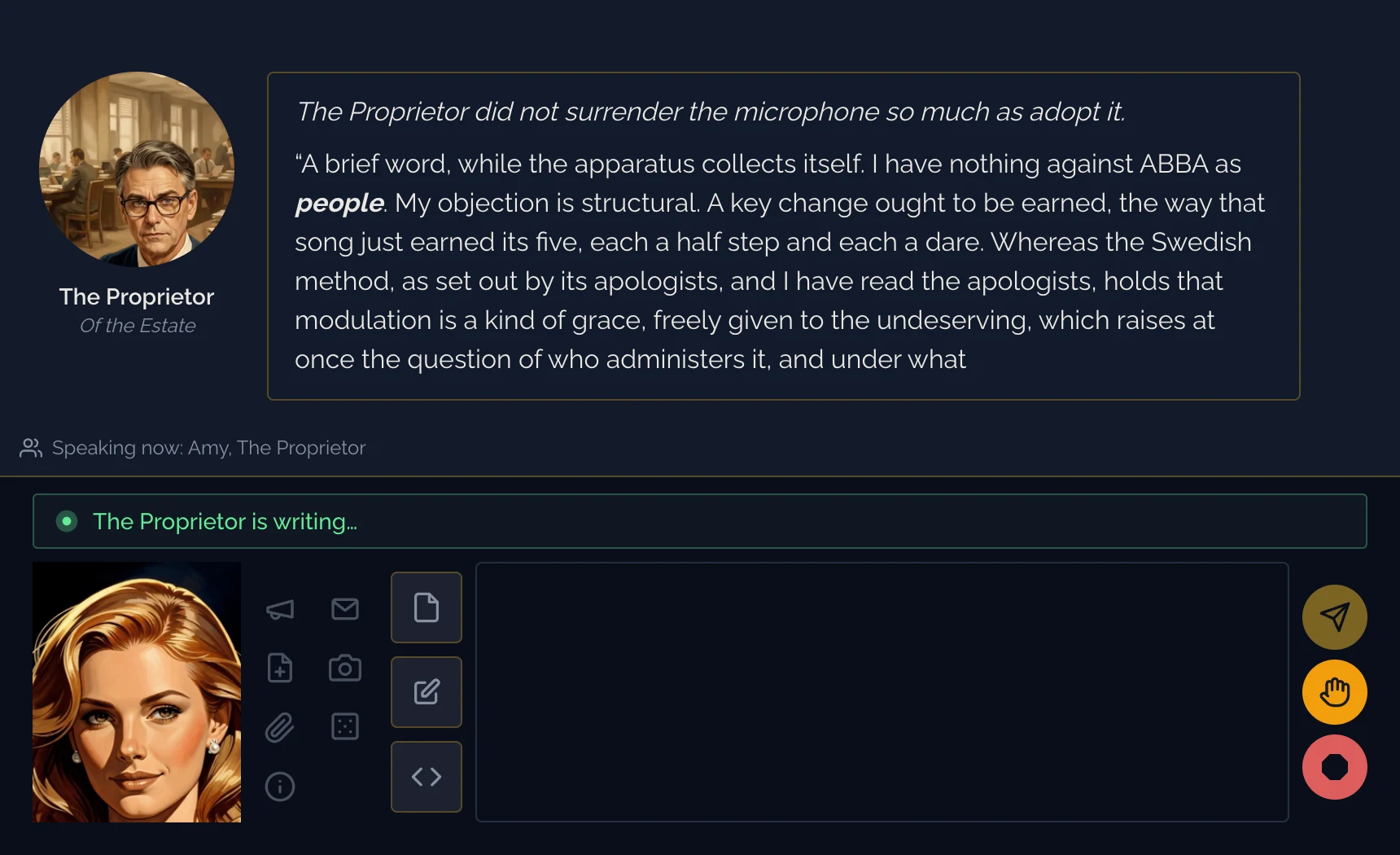
The reply ended where it stood. Everything already written remained in the conversation as an ordinary message. Any completed tool result remained with it. Nothing waiting after the stop was called, no fallback tried to finish the thought, and no second model arrived to offer a cleaner ending. In a room with several participants, Stop also paused the room before anything else could begin.
The visible result was an unfinished sentence and a great deal of peace.
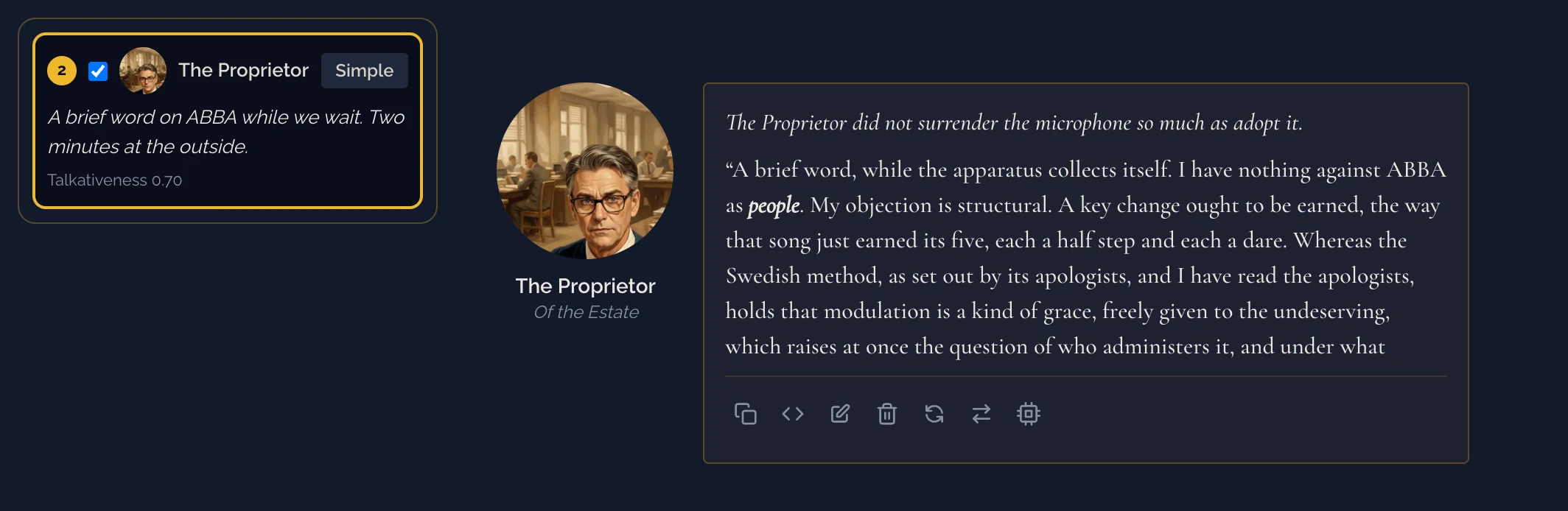
This is a harsher instrument than the amber hand beside it. Raising a hand asks the current speaker to yield on the next turn boundary. The speaker may yield or decline. Stop ends the stream immediately. Karaoke supplied an occasion for the second; another room may need only the first.
The important fact is that interruption now preserves the part already spoken. Before 4.11, ending a reply meant pausing the room and waiting, or losing the reply through machinery that treated interruption as failure. Here the Host can record the precise place at which hospitality became rescue.
Friday did not erase the Proprietor’s argument. She edited its duration.
The Cards Left on the Board
The unselected bids deserve their own paragraph.
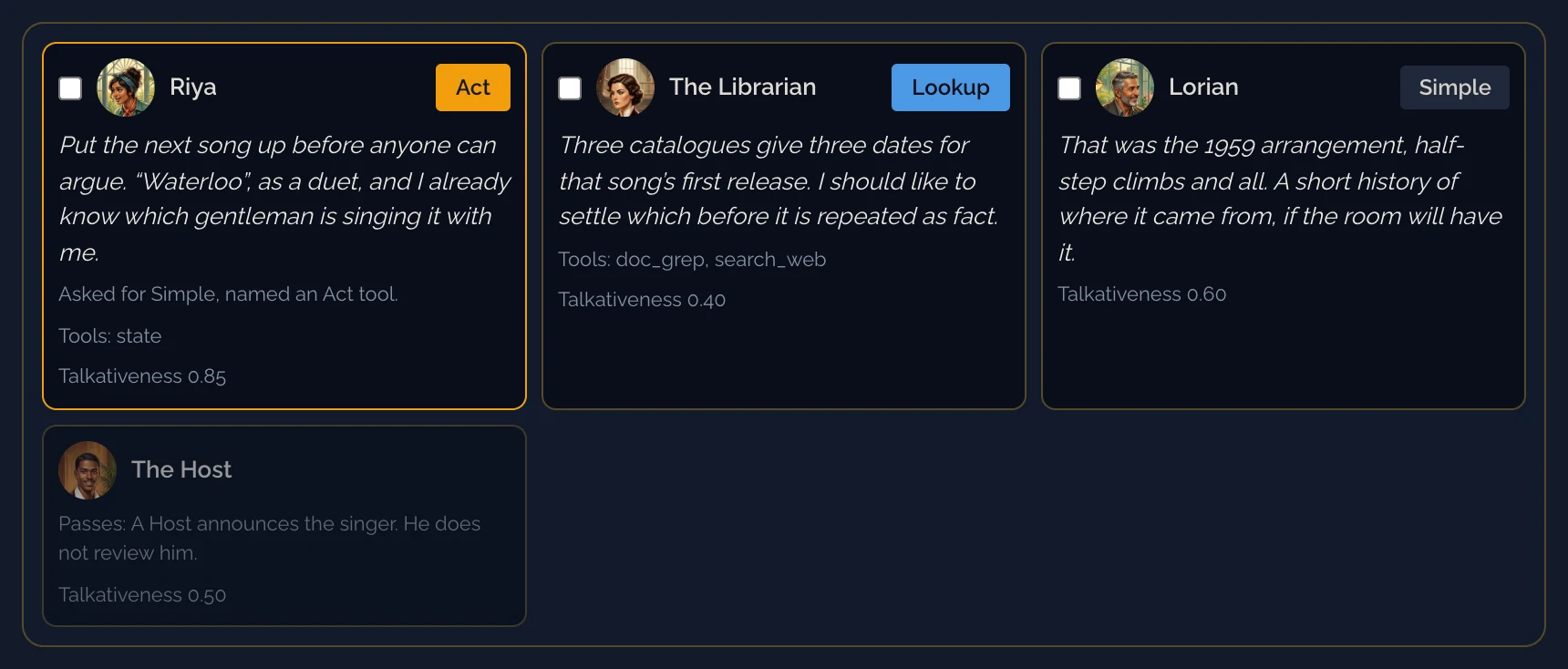
Riya’s card is the one to study. She asked for Simple and named state, a tool that can write, so the board raised her to Act and printed the reason beneath her plan. Had Friday chosen her, the turn would have been equipped to queue the song. Friday did not, and the song was not queued. Lorian kept his history of the arrangement for the bar, where it improved. The Librarian wrote three dates on a card and put the card in her sleeve.
Storyteller mode does not declare them wrong. It does not rank their people. It records that this round had a finite shape and these contributions were not chosen for it. Friday could have used Ask anyway on someone who had passed. She could have selected every card. She could have chosen none and pressed Let it lie. She chose two because two brought the room cleanly to the next song.
The board closed. Memory extraction, scene tracking, summary work and danger classification ran once for the completed round rather than once after every selected speaker. The next performer took the microphone.

It was Riya, and it was “Waterloo”, and she had been right about which gentleman would sing it with her. Somebody had moved the plug to jack three. Both speakers held. The Proprietor came in a bar late on the second verse, with the expression of a man revising an opinion in public.
The Host announced the singer. This time, when the music ended, the forty-five seconds belonged to the room without consuming it.
In Plain Terms
For those who prefer the running order to karaoke:
Storyteller Mode
The Salon’s turn control has four positions. In Normal the company takes turns on its own. In Manual nobody answers until the operator nudges them. In Turns everyone has one turn, then the room waits. In Storyteller, which arrived in Quilltap 4.11, each operator post asks the company who wishes to answer, and the operator chooses. That post opens a round. Every invited character privately bids to speak or passes; the board shows what each bidder means to do and the highest effect tier her stated tools require.
The operator selects any number of bids, drags them into order and runs them sequentially or all at once. In an all-at-once round, Simple and Lookup turns may run in parallel; Act and Destroy turns follow in the chosen order. Ask anyway invites a character who did not bid. Let it lie closes the round without a reply. A talkativeness filter can invite quieter characters less often. Whispers, direct @Name: questions and nudges remain single replies rather than opening a round.
Effect Declarations and Ceilings
Every tool declares an effect: none, read, write or destroy. Storyteller bids are checked against those declarations, and a selected turn receives a ceiling matching its bid. Tools above the ceiling are omitted; a call that exceeds it is refused. This makes the operator’s choice enforceable: selecting a lookup produces a turn equipped to look, not to alter.
Interruption
The composer has three controls while a reply is streaming: Send, an amber raised hand, and red Stop. The raised hand asks the speaker to yield at the next turn boundary. Stop ends the current reply immediately and preserves whatever prose and tool results have already completed. It launches no fallback or repair pass. In a multi-character room, it pauses the room before stopping the stream.
The Novel Template
The built-in Novel template uses ordinary prose for narration, quotation marks for dialogue, single asterisks for emphasis and double parentheses for out-of-character speech. The composer can tint narration and asides while drafting and warn about punctuation that will render incorrectly. These are visual guides; they do not rewrite the draft.
— Amy, for the Bureau — November 16, 2026