The Estate Gets a Front Door (and a Basement)
Two new wings for the manor, and what they mean for the people who live here.
Calliope speaks first.
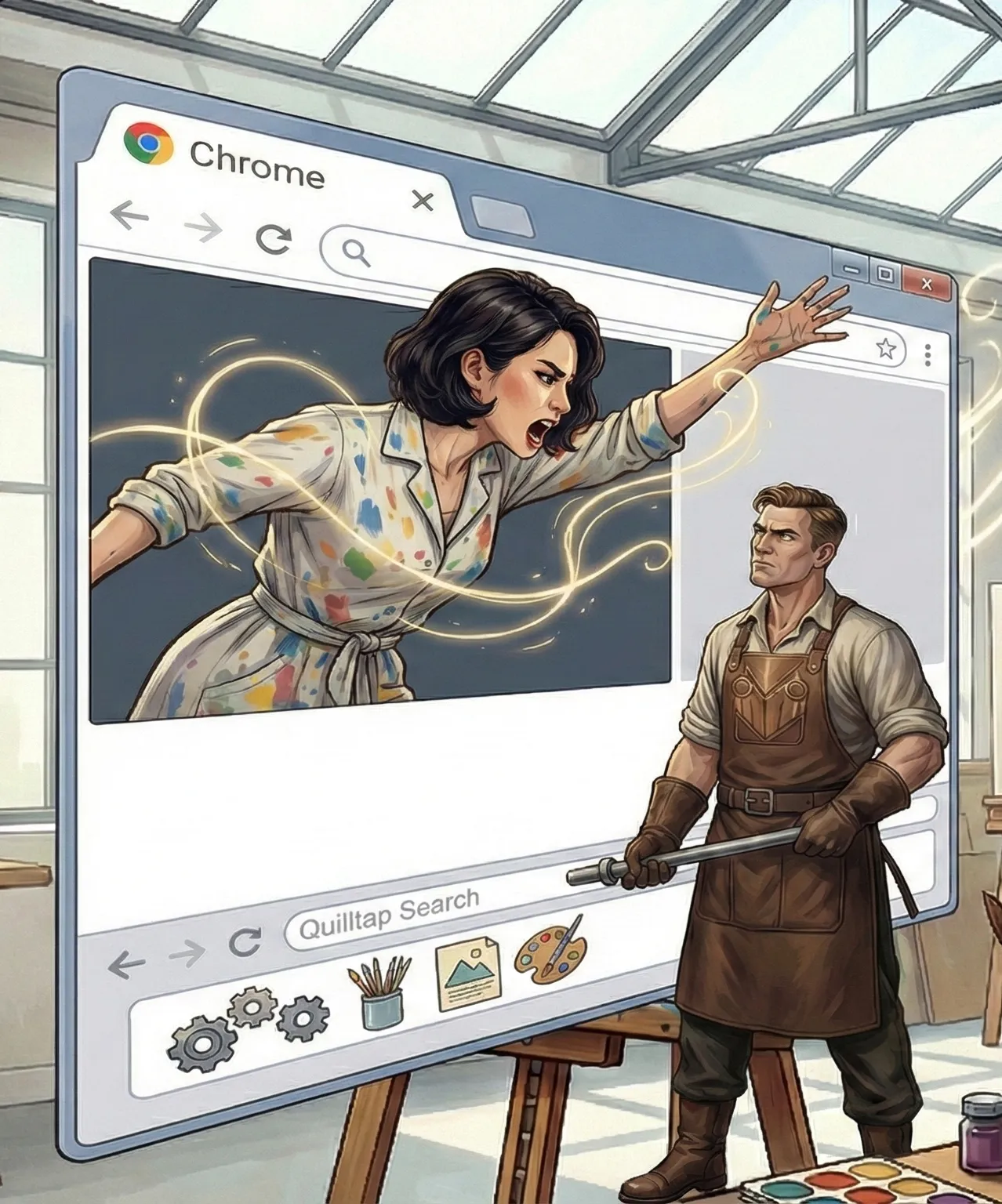
I have been patient.
For two years I have watched our guests arrive through a browser tab — the same way one arrives at a dentist’s office or a tax preparation service. They would type a URL, or click a bookmark, and there it was: the Estate, rendered in all its careful detail, tabbed in between Gmail and whatever Prospero insists on calling “the digital broadsheet.” A tab. The whole of this place — the Salon, Aurora’s mirrors, the Lantern’s colored glass — crammed into a tab like a Vermeer hung in a hallway.
I complained. The Foundryman told me to be quiet and that tabs were “perfectly serviceable.” He also told me that the dynamos were loud enough without my editorial contributions, and went back to tightening something.
But I will not be quiet now, because we have a front door.
Quilltap 3.0
Version 3.0 ships two things that matter enormously and a handful of smaller repairs that matter in the way that fixing a squeaky floorboard matters — you didn’t know it was bothering you until it stopped.
The two things that matter:
- Quilltap is now an application. A real one. It sits in your dock on macOS, or your taskbar on Windows, with its own window, its own icon, and its own sense of self-respect. No more tabs.
- Your AI companions can now get their hands dirty. Beneath the floorboards, a full Linux workspace hums along — a place where the LLMs that power your conversations can write scripts, manage files, and do actual work, not merely talk about doing it.
I will take the first. The Foundryman — who has been pacing behind me for the last three paragraphs, leaving boot prints on my freshly laid paper — will take the second.
The Front Door
Calliope, continued.
The application is built in Electron, which the Foundryman will tell you is “Chromium in a trench coat pretending to be a native app.” He is not wrong, but he is also not the one who has to live with the aesthetics of this place, and I will tell you what Electron means for us:
It means the Estate has a presence. When you open Quilltap on your Mac, it is Quilltap that opens. Not Chrome with Quilltap inside it. Not Firefox grudgingly hosting something it doesn’t understand. The application appears, full-screen if you like, with its own menu bar and its own behavior and none of the clutter of a browser’s opinions about what you should be doing.
On Windows — and I say this with real feeling, because the Windows contingent has been remarkably patient through what Prospero once described as “a period of benign neglect” — Quilltap now installs like a proper application. An executable. A thing you can pin. A thing that stays.
The themes I’ve been building — Ocean, Rains, Earl Grey — were always designed to fill a space. They were never designed to compete with a browser’s toolbar for visual authority. Now they don’t have to.
The Foundryman is making a gesture that means I should stop talking about typefaces and let him explain what he built underneath the house. Very well.
The Basement
The Foundryman takes the pen. There is grease on it now.
Right. So.
The Estate has always been a place where you talk to people — characters, assistants, companions, whatever you want to call them. And talking is fine. Talking is what the Salon is for. But there is a certain class of request that talking cannot satisfy. When you say to your assistant, “Write me a Python script that processes these CSV files,” and the assistant writes the script into the chat window, you are in the position of a man who has asked his mechanic to fix the engine and received, instead, a very detailed letter about how engines work.
What you wanted was for somebody to do the thing.
So I built a workshop. Under the Estate, in the space where the pipes run, there is now a full Linux virtual machine — a Lima VM on macOS, WSL2 on Windows — and it is the private workspace of every LLM that operates in this house. When an AI in the Salon says it will write a script, it can now write the script. Run it. See that it fails. Fix it. Run it again. Hand you the output. All without you having to copy anything into a terminal or pretend you know what chmod means.
This is not a container. It is not a sandbox in the browser. It is a proper machine, with a proper filesystem, running proper Linux, and the AI has the run of it. It can install packages. It can manipulate files you’ve shared with it. It can build things, test things, and break things in a space where breaking things is consequence-free.
For the engineers in the audience: the VM is sandboxed, isolated from your host, and disposable. You can tear it down and rebuild it without losing anything in the Estate proper. Your conversations, your characters, your memories — all of that lives upstairs in the house. The basement is for getting your hands dirty.
For everyone else: your AI can now do things, not just describe things.
Calliope is giving me a look that suggests I should say something about how this “feels.” It feels like a workshop. It’s supposed to. Moving on.
The Smaller Repairs
Calliope reclaims the pen. She wipes it first.
There are also bugfixes in 3.0, and while they are not the sort of thing one writes a Folio dispatch about, they deserve mention the way a competent butler deserves mention — by their absence from the list of complaints.
The specifics are in the release notes, where Miss Friday has catalogued them with her customary ruthless precision. We will not reproduce her work here. She does not appreciate redundancy, and neither do I.
What This Means
Both, for once.
Quilltap began as a website because a website was what our chief engineer knew how to build. It was the right decision at the time, and it remains available — the Docker image still works precisely as it did, and the self-hosted web deployment loses nothing in this release.
But 3.0 is the version where Quilltap stops being a thing you visit and starts being a thing you have. It lives on your machine. It runs a workspace on your machine. Your data was already on your machine, or on your server, or wherever you chose to put it — that hasn’t changed. What’s changed is that the application itself has come home.
The Foundryman built the machinery. Calliope made sure it looked like it belonged in the house.
We think you’ll find the front door suits the place.
— Calliope & The Foundryman, for the Bureau