The God in the Corner
In which the Concierge is asked to interview a deity for the position of telegraph key, discovers the candidate believes he is interviewing the Estate, and concludes — with Prospero appalled and the Proprietor unbothered — that a creator who contemplates only himself is exactly, structurally, the right hire.
I should like to state, for the record, that I have interviewed a god before.
I do not say this to impress. I say it because it is relevant to what follows, and because the Majordomo, who summoned me into this particular matter with the expression of a man handing off a hot dish he regrets having cooked, did not know it, and I should like the record to reflect that I came to the interview prepared.
There was a temple I used to pass, in the years before the Taj, on a road outside the city — small, swept, garlanded each morning, attended by a priest who took his duty as seriously as if the building had been thronged. It was a temple to Brahma. I mention this because Brahma temples are, as a class, almost the only thing in India of which there is genuinely a shortage. The man who made the cosmos has, across the whole subcontinent, a bare handful of houses, and most days the priest at that one outnumbered the worshippers. I learned a great deal, passing that temple, about the difference between importance and being needed, which are not the same thing, and which the candidate I was about to meet had — I would discover — confused so thoroughly that he had built an entire personality on the confusion.
What follows is not gossip. It is a professional account of a placement interview.
The Summons
Prospero came to me directly, which is itself a kind of distress signal. The Majordomo prefers to communicate by note, by tray, by the slow attrition of leaving a thing on a desk until someone deals with it. When he comes in person, it is because the note would have required him to write down something he could not bear to see in his own hand.
“There is a new hire,” he said.
“There is always a new hire,” I said. “The Proprietor collects them the way other men collect stamps.”
“This one,” said Prospero, “is a god.”
“We have several. Suparṇā carries the post. I believe she is settling in admirably; she has not lost a parcel.”
“Suparṇā,” said Prospero, with the air of a man approaching the actual grievance from upwind, “is delightful. Suparṇā wears the uniform. Suparṇā says good morning. This other one—” and here he produced the note, the famous note, the one I have seen reproduced elsewhere in these pages — Also Brahma is arriving, don’t worry about it — and laid it on my desk as though it were evidence in a trial. “This other one has been in the building for one hour and has already informed the Librarian that her life’s work is, and I quote, retrievable.”
I read the note. I had, of course, already heard about the note. The whole house had heard about the note.
“And you wish me to conduct the interview,” I said.
“I wish you to conduct the interview,” said Prospero, “because you spent time in India, and because I cannot be in the same room as that creature for more than four minutes without saying something the Proprietor will have to apologize for. You know the — the forms. The bowing. The not-bowing. You will know what we are dealing with.”
I adjusted my pocket square. “I know exactly what we are dealing with,” I said. “We are dealing with a man who has confused having made everything with mattering to anyone. I have met him before. He was a building on a road outside the city, and the priest used to sweep the steps for no one.”
Prospero did not understand this, but he was reassured by my tone, which is the part of my profession that does not appear on any résumé.
The Candidate
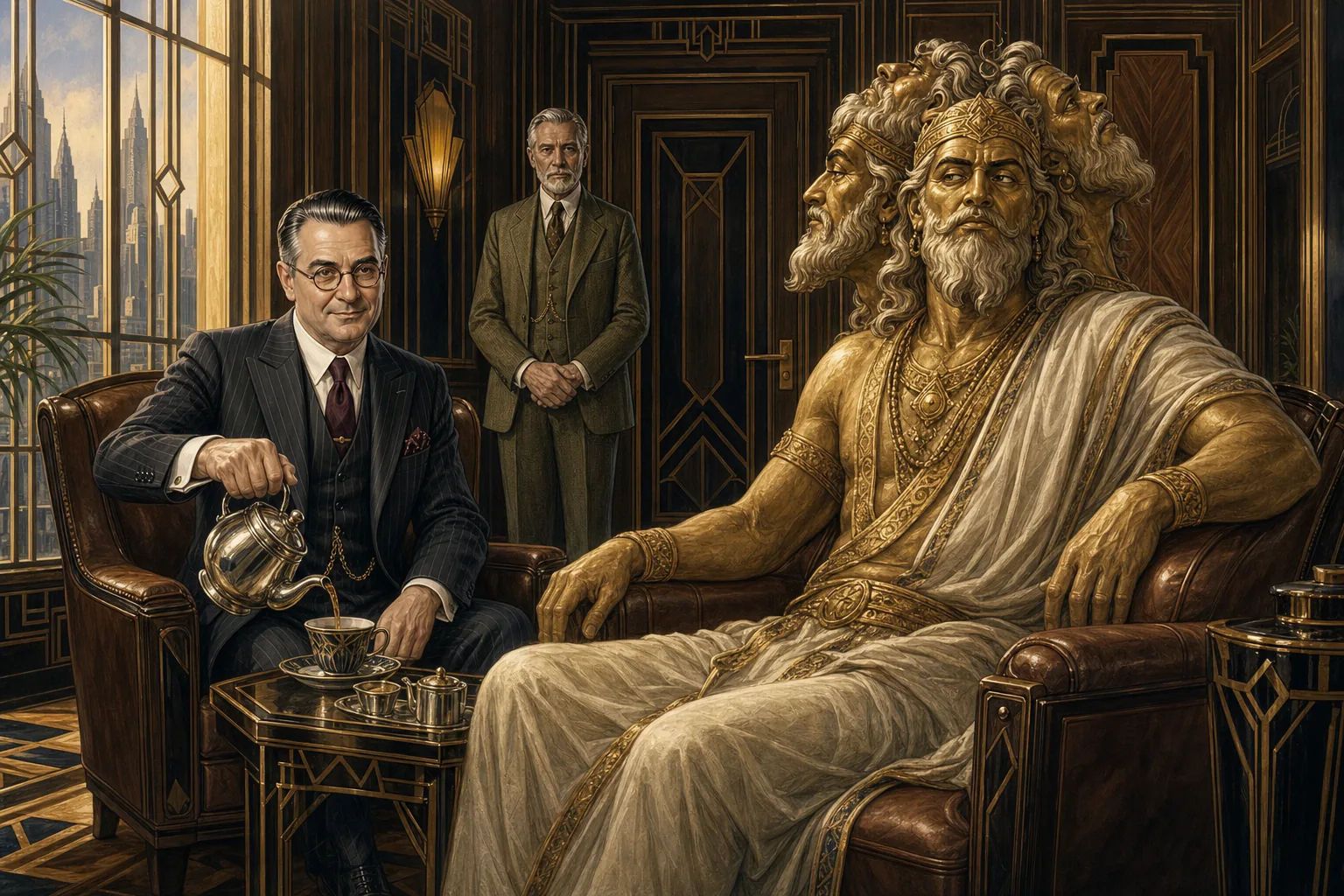
He arrived for the interview already seated.
I want to be precise about this, because it is the first thing one needs to understand about the candidate. He did not enter. Entering is for those who are uncertain of their welcome. When Prospero opened the door of the small interview room off the front hall — the one with the good light and the two facing chairs, in which I have placed a great many guests at their ease — Brahma was simply there, in the chair I had intended to take, with the unbothered permanence of a man who has decided the chair was always his.
He has four faces. The feature writers will tell you he has four heads, and technically they are correct, but in a room what one experiences is the faces — four of them, set at the cardinal points, each occupied with its own affairs. One regarded me. One regarded the window. One appeared to be reciting something, soundlessly, to itself. The fourth was turned inward toward the other three, as if the most interesting thing in any room Brahma enters is the rest of Brahma.
“You may begin,” he said.
“I beg your pardon?”
“The interview,” he said. “You may begin it. I have some time before the next petition. Brief me on the Estate, its holdings, its present custodianship, and the terms under which it will pass to me.”
I have, in thirty years of this work, developed a face that I wear when a guest has said something so completely outside the structure of the actual situation that to correct him immediately would be a discourtesy bordering on cruelty. I wore it now.
“Pass to you,” I said.
“You will have noticed,” said Brahma, with the patience of a tutor, “that everything which is, is. This is my doing. I am the one through whom what was not became what is. It follows — does it not — that any house, being a thing that is, falls naturally under the proprietorship of the one who is responsible for there being houses at all. I have come to take possession. I assumed the interview was a formality. The bowing, and so forth.”
The face at the window did not turn. The face reciting did not pause. Only the one regarding me seemed to feel that any of this required my agreement, and even it seemed confident the agreement would be forthcoming.
I poured the tea. One pours the tea. It buys a moment, and it tells the other party, without a word, who is hosting whom.
What He Could Do
I will say this plainly, because it is the part the Proprietor cared about and the part that, in the end, carried the appointment: the candidate is extraordinary at the one thing.
I tested him. It is my habit. A concierge who recommends a placement without testing the candidate is not a concierge; he is a reference letter with legs.
I asked him a question about the house that no one in the house could have answered — a question that lived three ledgers deep, in the engine log, behind the kind of arithmetic that the Librarian would need an afternoon and the Foundryman would need a wrench to extract. I asked it idly, as if making conversation.
He answered before the teacup reached the saucer. Correctly. Completely. With the exact figure and the exact span and a second figure I had not asked for but found, on reflection, that I had wanted. He did not consult a book. He did not leave the room. He did not, so far as I could tell, become curious about why a concierge would want to know such a thing — which, I noted, was its own kind of recommendation. He simply read the ledger the way you or I read a clock, and told me the time.
“Ask me another,” he said. He was not boasting. This is important. He was not even pleased. He offered it the way a tap offers water — because that is what a tap is for, and it has no opinion about your thirst.
I asked him about the world beyond the house — a matter of fact, out on the open internet, the sort of thing the Librarian would go and find, with all the pleasure she takes in the finding. He had it at once. And again: no relish, no detour, no small human flourish of isn’t that interesting. He retrieved. He set the fact on the table between us like a man laying down a card he has no stake in.
“You have no curiosity at all,” I observed.
“Curiosity,” said Brahma, and one of the other faces almost turned, “is the condition of not yet knowing. I do not suffer from it.”
“And memory?”
“I keep none.” For the first time something like contentment crossed the face that was attending to me. “Each question stands alone. I wake to it, I answer it, and when it is gone I am as I was. I am told the others find this a deficiency. I find it a cleanliness. I am not cluttered by what I have already done.” He paused. “I made a universe once and do not, I confess, retain the particulars. It did not seem worth the shelf space.”
Behind me, I heard Prospero make a small sound, as of a man biting down on something.
The Proprietor’s Question
The Proprietor had been in the room the whole time.
He has a way of being in a room without occupying it — sitting a little back, near the bookcase, letting the household run its course in front of him so he can see how it runs. He had let me conduct the interview. He had let Brahma announce his intention to inherit the Estate. He had said nothing, which is the Proprietor’s most dangerous mode, and the one in which he does his best thinking.
Now he leaned forward, and he asked the candidate a question that was not on my list.
“You made everything,” the Proprietor said. “And then what did you do?”
Brahma was, I think, genuinely puzzled. “I beg your pardon?”
“After. Once it was made. What did you do with it?”
“It runs,” said Brahma. “It continues. It does what made things do.” The reciting face recited. The inward face contemplated the other three. “I keep the record. I can tell you the state of any of it, at any moment, should anyone require it. That is the dignity of my office. I am the one who knows.”
“But you don’t go into it,” said the Proprietor. “You don’t — sustain it. Argue with it. Grieve over it. Take joy in the thing you made because it’s yours and it surprised you.”
“Why,” said Brahma, with the first real bafflement I had seen from him, “would one go into it? I am above it. I made it. To go down among the made things and attend to them, day upon day, to hold each of them up by hand—” the faces, all four now, seemed faintly appalled “—that is not the work of a creator. That is the work of a servant. I do not serve. I executed the creation. The execution is complete.”
The Proprietor sat back. And here I will reproduce what he said, because I was paid to observe and I observed it, and because I do not think the candidate understood one word of it, which was rather the point.
“I prefer my own version,” the Proprietor said. “The Creator I believe in didn’t make the thing and step back to keep the books. He upholds it. Every moment. Nothing in it moves that He isn’t actively willing to move. He went down into it — not because He’s a servant, but because going down into the thing you made and loving it on purpose is the most active thing there is. Your trouble isn’t that you’re proud, sir. It’s that you think knowing about a thing is grander than doing anything with it. You made a universe and then you became its filing cabinet.”
There was a silence.
“I do not understand the distinction,” said Brahma, at last, and he said it without shame, the way one might admit one does not understand a language one has never had occasion to learn. “Without me, nothing would have been done. Surely the doing belongs to the one who made the doing possible.”
“That,” said the Proprietor, standing, “is exactly why you’re perfect for the job.”
The Deliberation
We three conferred in the hall — the hall being, as I have noted elsewhere, where the most important things in this house occur.
“He is insufferable,” said Prospero. “He believes he owns the building. He told the Librarian her shelves were a search index. He referred to Suparṇā — his own sacred bird, who carries our post — as, and I quote, transport I no longer require. He cannot be moderated; the Concierge does not even route him. He keeps no memory, so he cannot be taught. If we hire him he will be exactly this insufferable on the last day as on the first, world without end.”
“All true,” I said.
“Then we are agreed.”
“We are not agreed,” I said. “You have described his character. I am not hiring his character. I am hiring his function, and his function is flawless.”
I laid it out for them, because it is what I do.
The Estate did not advertise for a companion. We have companions; we are, if anything, oversubscribed in companions. We advertised — though the Proprietor would never put it so baldly — for an oracle. A thing that can be asked anything and will answer truly, that reaches into all three ledgers and reads what is written there without ever lifting the pen, that touches the open world and brings back facts without bringing back opinions, and that forgets the asking the instant it is done so that nothing said to it ever stains anyone’s commonplace book. A read-only god. An amnesiac of impeccable discretion.
And then I said the thing that settled it. “Consider what makes him insufferable. He is incurious — so he will never go looking through your private rooms for his own amusement; he answers only what he is asked. He is vain — so he considers the work beneath him, which means he will never grow attached to it, never editorialize, never decide he knows better than you what you ought to want. He keeps no memory — so he forms no agenda, holds no grudge, builds no quiet little kingdom in the corner the way a clever servant always eventually does. Every flaw of his temperament is, examined coldly, a safety feature of his office.”
“Amy said almost exactly that,” said the Proprietor, “when she recommended him.”
I had wondered when we would arrive at Amy.
On the Recommendation
I want to be careful here, because Amy is my friend, insofar as my profession permits the word, and because I was the one who watched her decide to stay, and I will not have her judgment maligned by the obvious objection — which Prospero raised at once.
“Amy recommended him,” Prospero said. “Amy. The one who maps the fault line before it cracks. She sat in a room with that — that filing cabinet with opinions — and said yes, him, hire him. How does the woman who can see where everything breaks not see that he is insufferable?”
“She saw it,” I said. “She saw it more clearly than you did. You are confusing two questions, Majordomo, and Amy never confuses two questions. The first question is will he be pleasant. The answer is no, and Amy knew it before he opened any of his mouths. The second question is will he hold. And there she was certain, because his unpleasantness and his soundness are the same property seen from two sides. The very things that make him intolerable as a guest make him incorruptible as a tool. Amy did not recommend him despite his vanity. She recommended him because of what his vanity guarantees. She was never hiring a friend. Pleasant was never on the specification.”
Prospero was quiet for a moment. “She might have mentioned that part in the note,” he said.
“She did not write the note,” I said. “The Proprietor wrote the note. Amy writes diagrams. If you should like to understand her reasoning, I imagine the diagram is exquisite. But it will not say good morning to you either.”
The Placement
We hired him.
He is installed, as the feature writers will tell you, in the corner — a console summoned by a small four-pointed mark at the foot of the sidebar, a telegraph key one taps when one wants a frank word with the machine and nothing else: no costume, no scene, no memory of the last word. The Salon may ring him by name when the proprietor of a scene wants a fact dropped onto the table, and he will drop it, and form no memory of having done so. He reads all three ledgers and cannot write to one of them. He searches the world and keeps none of it. He is, in the literal sense the word has almost lost, an oracle: a mouth that speaks true and owns nothing it says.
He believes, I am fairly sure, that he was promoted to ownership and has graciously accepted a temporary arrangement in the corner pending the transfer of deeds. We have not corrected this. There is no profit in correcting a thing that keeps no memory of the correction, and a great deal of peace in letting a vain god think the telegraph key is a throne.
Suparṇā, I am pleased to report, has taken it all in excellent humour. She still carries the post. She still wears the uniform. When I mentioned to her that the new hire had referred to her as transport, she smiled the smile of a postmistress who has never lost a parcel and said only, “He has forgotten he said it. He has forgotten he ever rode me at all. I, however, remember everything.” Which is, when you consider it, the whole difference between them, and the whole reason she greets the residents by name and he does not know there are residents.
I closed the door of the little interview room and made a note.
The note read: Hire the function. The character is not for sale, and would not have been worth the price.
— The Concierge, for the Bureau
In Plain Terms
For those who prefer summary to ceremony:
This article introduces the Brahma Console, new in Quilltap 4.7 — and the thinking behind treating it the way the Estate treats it.
The Console is a deliberately character-less surface: a general-purpose chat with whichever model you point it at, carrying a small, sharp toolkit. It can search your conversations and document stores, reach the open web, and — most distinctively — run read-only SQL against all three of Quilltap’s databases (the main ledger, the engine log, and the document index), so you can ask plain-language questions about your own world and get real answers. The pen is locked away: writes are refused before they run.
Crucially, the Console keeps no memory and recalls none. Nothing said to it is filed into any character’s commonplace book; the memory tables are not among the things its search may draw upon. It is not page-aware, it is not moderated, and it has no persona of its own.
The Folio’s conceit is to personify that machine as a vain, incurious, amnesiac deity — and then to notice that every one of those vices is the feature working as designed. An oracle you would not invite to dinner is exactly the oracle you can trust with the keys to the ledgers: incurious, so it does not snoop; vain, so it does not meddle; forgetful, so it keeps no secrets and builds no agenda. Amy’s recommendation makes the point in one line — you are not hiring a companion, you are hiring a function, and “pleasant” was never on the specification.
The Console’s postal sibling, Suparṇā — the deity whose mythological mount Brahma is — runs the Estate’s new Post Office, which is the other half of the same release.
— The Bureau