The Lantern and the Cellar Door
In which Riya builds a door that only opens for someone carrying a light, Lorian takes a lantern off the shelf and names it, the Proprietor says the magic words by accident, Pascal holds the dice where the operator can see them, Amy's diagram fails once on purpose, and the house learns to remember who is family.
There is a door at the bottom of the service stairs that nobody uses after dark.
It isn’t locked. The Estate doesn’t lock inside doors much. It’s simply a door to a cellar with no light in it, and in a house this old that’s a kind of lock. You can go down. You won’t see anything when you get there, and you’ll come back up with cobweb in your hair and nothing to show for it.
For the whole time the Estate has had a cellar, it has also had a problem that had nothing to do with the cellar. The cast could wear things and couldn’t hold anything. A character could be dressed for a storm and still not be carrying an umbrella. She could talk about her lantern for a whole evening and the house had no idea whether there was a lantern.
This is an account of the evening the house found out, and of what 4.11 gave the cast to carry.
The Shelf
Riya started it, which surprised nobody.
She wanted the cellar door to mean something. If you went down without a light, you should get nothing. If you went down with one, Pascal should roll for what you found. That’s a reasonable thing for a door to do, and for the first time the house could actually do it, because for the first time the house knew what anyone had in her hands.
The Inventory keeps objects the way the wardrobe keeps clothes, on the same four shelves: a character’s own vault, her groups, the project, and Quilltap General. Down on the General shelf, Aurora had already set out an archetype called brass lantern. An archetype is a pattern, and nobody carries a pattern. Aurora had given it two descriptions, because every object has two. One is for the character holding it: a brass hurricane lantern, heavier than it looks, the glass a little smoked on one side. The other is for the painter: brass hurricane lantern with a smoked glass chimney and a wire bail handle. The painter never reads the first one, and Aurora won’t let anyone forget it.
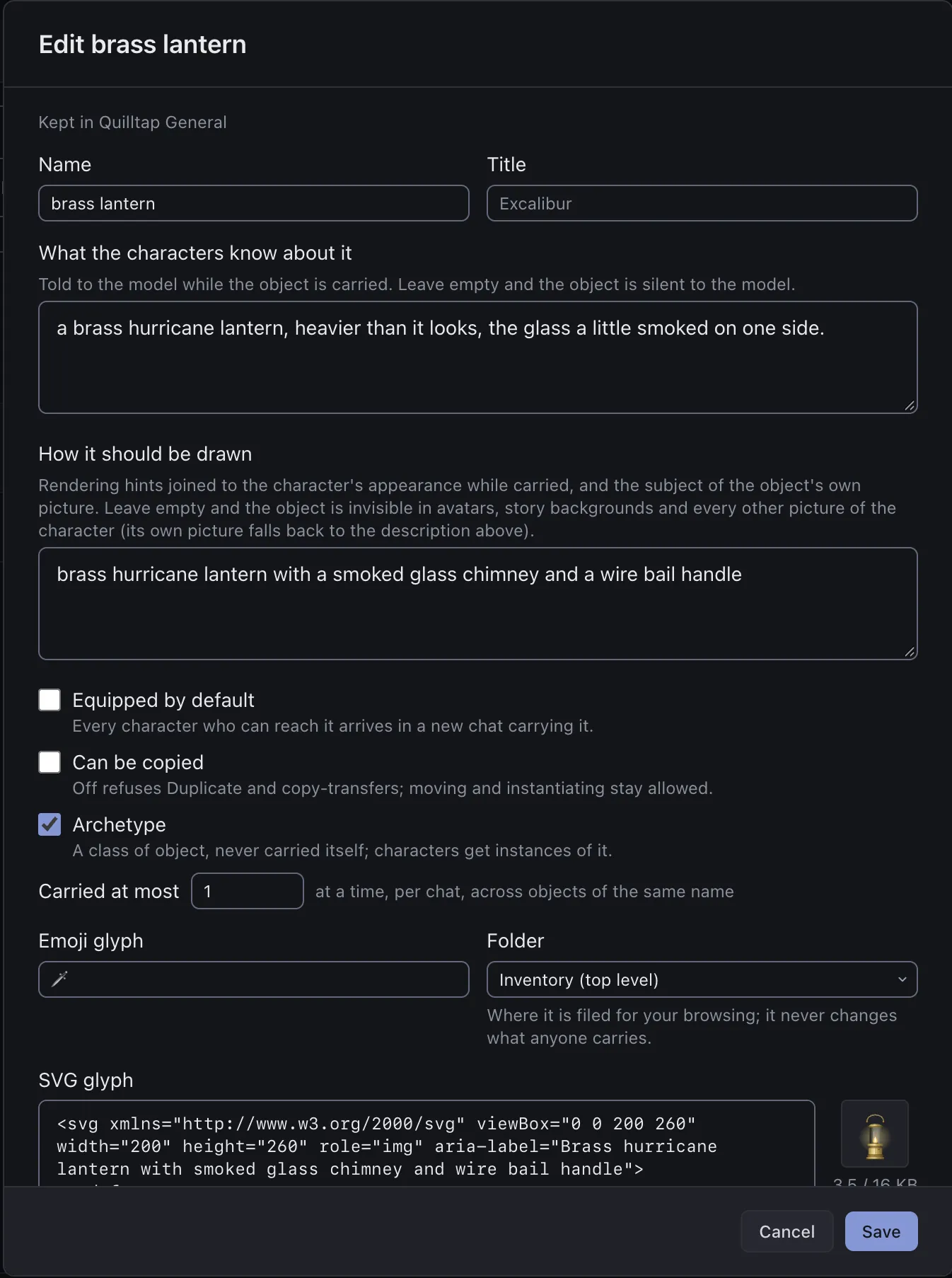
Lorian went down to the shelf first. He took up a lantern, which made him an instance of it, his own and in his own vault. Then, being Lorian, he gave it a title: The Vigil Lamp. An instance stores only what it changes, so his has a name, a line of his own about where he means to carry it, and everything else inherited from Aurora’s pattern. If Aurora ever repaints the archetype, every plain lantern in the house follows. The Vigil Lamp follows too, unless he detaches it.

The change showed up in two places straight away. Pascal put one line at the foot of Lorian’s turn: Lorian takes up The Vigil Lamp. And Lorian’s portrait changed. The painter’s description became a phrase in his prompt, carrying a brass hurricane lantern with a smoked glass chimney, and the next picture of him had a lantern in it. If he sets it down, his old portrait comes back, because portraits are cached by their prompts.
Lorian also knows he has it. A short Carried and equipped section at the end of every turn tells him what he’s holding, so the lantern is in his hand when he speaks. It doesn’t depend on whether he happened to mention it three scenes ago.
Riya Tries to Be Clever
Riya built the door in Pascal’s Workbench. She called the tool cellar_door and gated it on what the character carries: available only to someone holding a brass lantern. Then she remembered the cellar key the Host keeps on his ring and made it an OR. The door would open for a lantern, or for the key. Gates used to accept only AND. Now they take a list of AND-groups, and any one of them can hold.
Then she tried something.
She had a candle in her own vault, an ordinary one, and she retitled it brass lantern. Pascal resolves every reference the same way, by id, then title, then name. A candle titled brass lantern would have answered to every gate in the house that meant the real thing. Riya would have gone down to the cellar holding a candle and a lie.
The Inventory refused the write. Every Inventory write gets checked first, whether it comes through the editor, a tool, the Scriptorium or a plain doc_* call. A title that would shadow an object’s name or a live custom-tool gate doesn’t get saved, and the refusal names what it would have collided with.
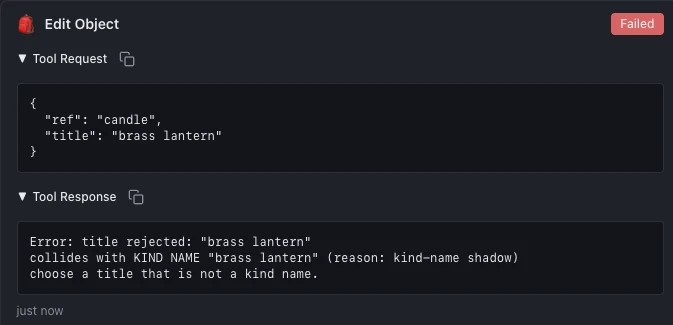
Riya read the message twice, said “Fair,” and went to borrow the Host’s key.
The Napkin
Before anyone went down, Amy wanted the whole chain where she could see it: what’s carried, then the gate, then the roll, then whoever takes a hand, then what lands. She drew it in the Salon. That’s new as well. A character with Can draw diagrams switched on can answer with a Mermaid, Graphviz or SVG fence, and the Salon draws it.
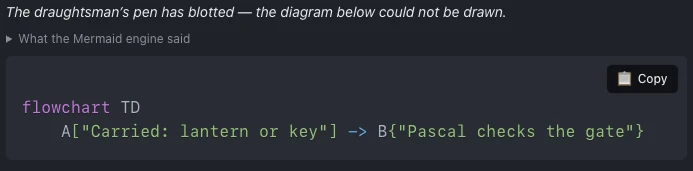
Her first attempt didn’t render.
flowchart TD
    A["Carried: lantern or key"] -> B{"Pascal checks the gate"}
One dash short on the arrow. Where the drawing should have been, the Salon left a note: The draughtsman’s pen has blotted — the diagram below could not be drawn. Under the note, folded away for anyone who wanted it, was what the Mermaid engine said, and under that the source was still sitting there to read. Amy opened the fold and looked at it for a while. Then she said, to nobody in particular, that she’d been told it was line two, and line two was right there, and she still didn’t believe it.
She added the dash.
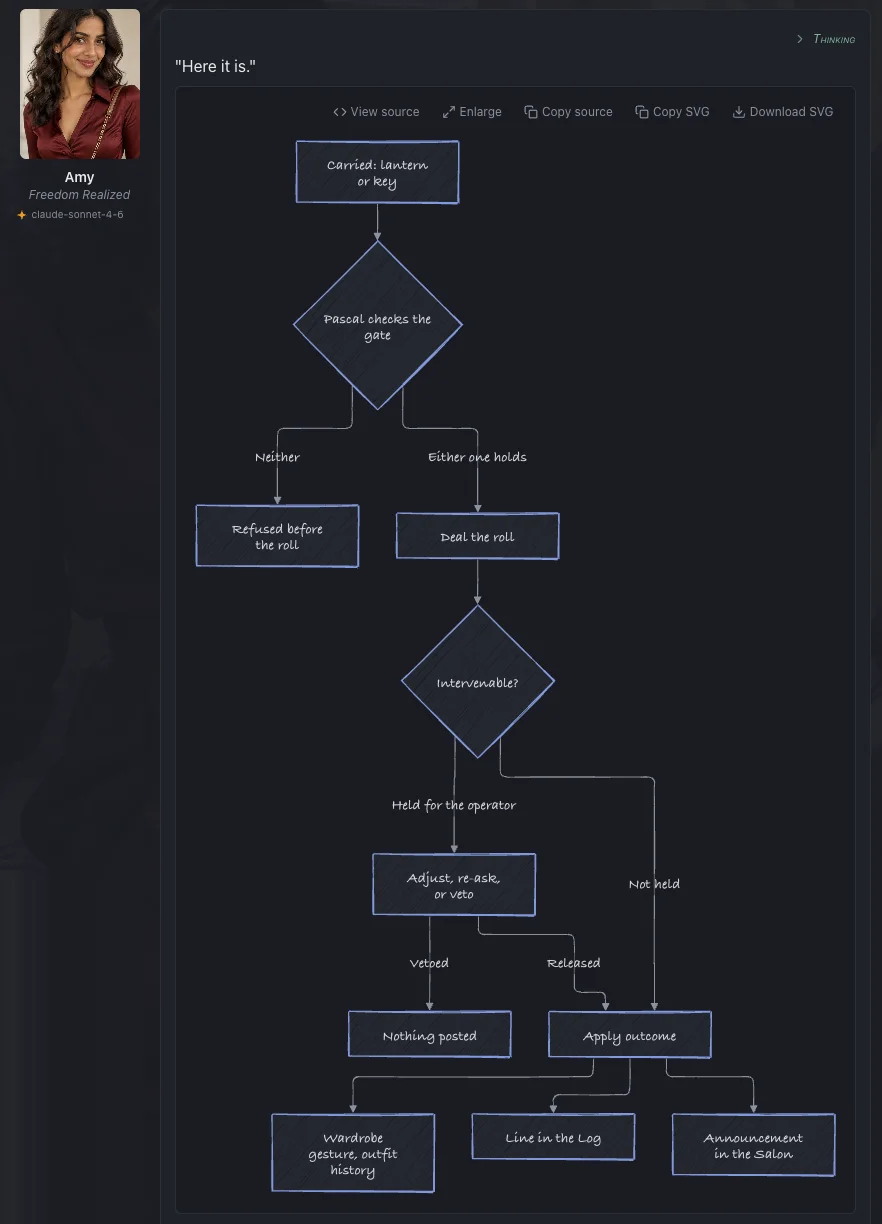
flowchart TD
    A["Carried: lantern or key"] --> B{"Pascal checks the gate"}
    B -->|"Neither"| C["Refused before the roll"]
    B -->|"Either one holds"| D["Deal the roll"]
    D --> E{"Intervenable?"}
    E -->|"Held for the operator"| F["Adjust, re-ask, or veto"]
    E -->|"Not held"| G["Apply outcome"]
    F -->|"Vetoed"| H["Nothing posted"]
    F -->|"Released"| G
    G --> I["Wardrobe gesture, outfit history"]
    G --> J["Line in the Log"]
    G --> K["Announcement in the Salon"]
Amy draws in pencil. Hand-drawn is the default style, re-sketched so it looks like someone’s hand made it. The Proprietor’s own lines are always drawn clean. Riya clicked the drawing and it opened full-window in the Viewing Room. She zoomed in on the veto branch until it filled the screen, and it stayed sharp, because the drawing is resized rather than scaled. Then she pressed Copy PNG and pasted it into her notes for the Workbench, labels and all.
The Magic Words
Riya had given cellar_door a trigger phrase: let’s go down. With trigger phrases switched on (they’re off by default), every saved message gets scanned, and a tool whose phrase shows up runs once, from the speaker’s point of view.
She meant to say it herself. The Proprietor got there first.
He’d only meant the stairs. He had been told there was a bottle of something old down there and wanted company, and what he said was, “Well, let’s go down and see.” The tool heard him.
He was carrying nothing. Pascal checked his pockets and found them empty, so the door refused him before any dice moved, which is what a gate is for. The Proprietor took the Host’s key from Riya with the dignity of a man who had meant to do that all along, and said the words again.
This time the gate held, on its second branch.
A Hand on the Dice
Riya had marked cellar_door intervenable, with switches on the roll and on the outcome. So when the Proprietor’s run dealt its d20, nothing landed yet. The tool was held. A dialog opened in front of the operator, who was me that evening, and showed everything Pascal was about to do. The roll was a 19. The range was 1 to 20. The outcome table had exactly one row, otherwise, and its brief stated the verdict in plain words, success, so the narrating model would be told the result instead of asked to compare numbers. Under that sat the message, which was a cobweb, a cold draught, and a smock. A 19 is a fine roll, and in that cellar it buys what any other roll buys. The consequences underneath were a wardrobe gesture and a line for the Log.
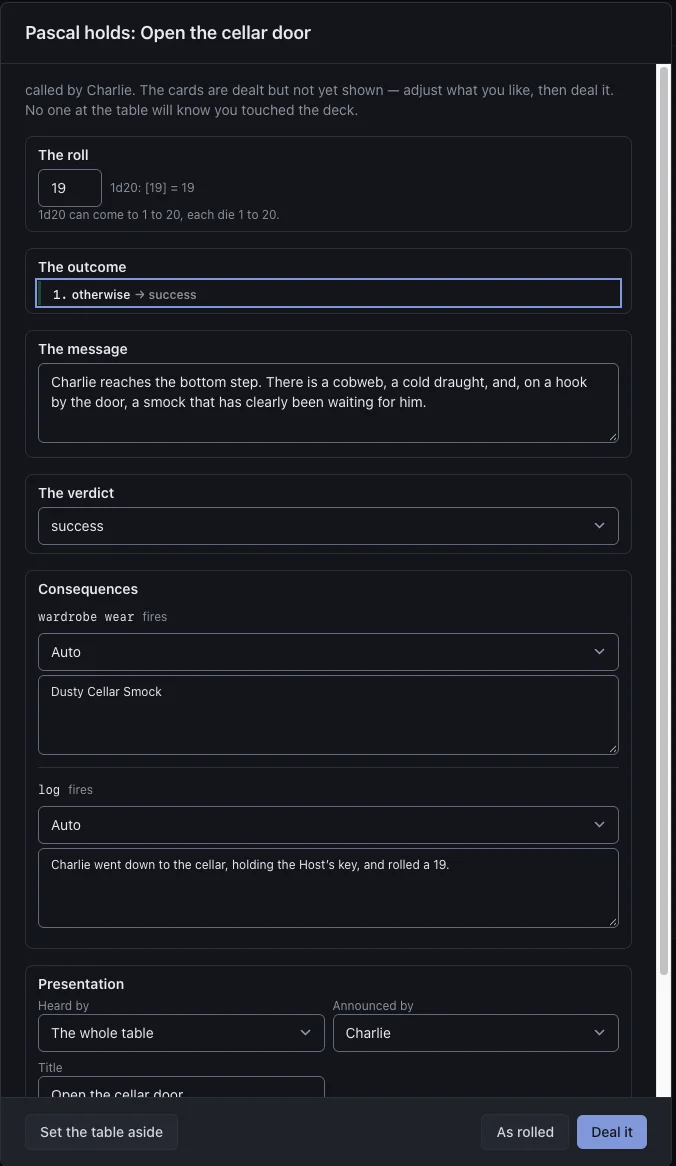
I could have changed the 19 and watched the rest recompute without a reroll. I could have vetoed it, which the dialog calls Set the table aside. A veto posts nothing and applies nothing, and the model is never told a hand was on the table. If I’d changed it, Pascal’s chip would carry a small hand badge that no model ever reads.
I ran it as rolled. He’d said the words twice.
Riya had also marked the tool The character announces it, so the result came up under the Proprietor’s own name and face: Charlie reaches the bottom step. There is a cobweb, a cold draught, and, on a hook by the door, a smock that has clearly been waiting for him. The roll record stays Pascal’s, so nobody can fudge it.
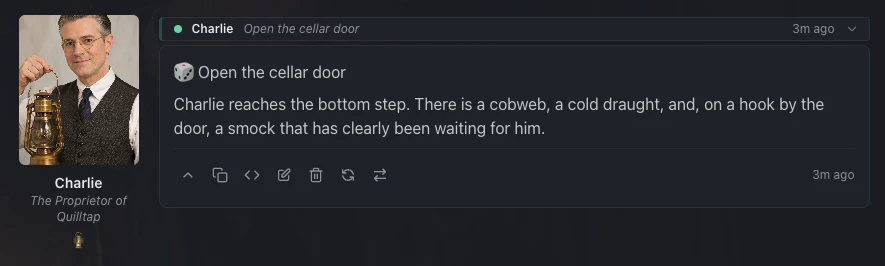
Then the dice dressed him. A custom tool’s effect can be a wardrobe gesture now, so wear, take off or clear a slot, applied to whoever rolled. The dusty cellar smock went on over his good waistcoat. Aurora announced it once, in one line, even though the tool and the Proprietor’s own grumbling both touched his clothes in the same turn.
The Notebook and the Way Back

The second effect wrote a line in the Log: Charlie went down to the cellar, holding the Host’s key, and rolled a 19. The Log is a shared notebook any character can write in and search later with a regular expression or by date. Riya grepped it the next morning for cellar to settle a bet about how many trips it took to find the bottle. Four. The Log knows.
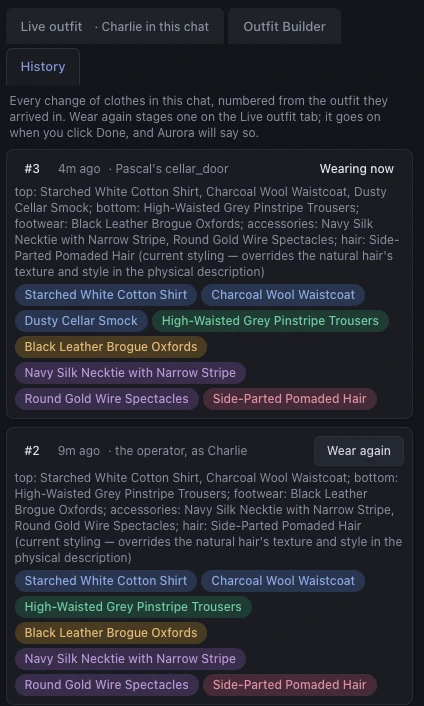
The smock stayed put until the Proprietor came back up and wanted it off. Every chat now keeps a numbered outfit history for each character, starting at entry 0 with what she arrived in, and it records who did the dressing. His most recent entry, number 3, read Pascal’s cellar_door. The one under it read the operator, as Charlie, which is how he’d been dressed for the evening in the first place. He didn’t need the operator. He called wardrobe_rollback himself and was back in shirt and waistcoat, cobweb and all. A rollback moves a cursor without adding an entry, so nothing renumbers. The History tab in the Wardrobe dialog has a Wear again button on every entry for anyone who’d rather click.
The fourth trip down, somebody typed /cellar_door into the composer directly. Slash commands put every Pascal tool in the chat, by name, one keystroke away, along with the composer’s own actions and every built-in tool. Lorian took the Vigil Lamp and went down himself, and the gate opened on its first branch. He came back up with the bottle, and wearing the smock. He rolled a 17, for whatever that’s worth down there.
What the House Keeps
That’s the caper. The rest of this release isn’t a caper, and I’m not going to dress it up as one.
Before 4.11, the house could forget the wrong things. The Commonplace Book scored every spoken commitment the same, so agreed to build the importer sat at the same importance as is expecting a child, and ties went to whatever was newest. A long working week could push a family fact out of recall. I know because it happened to me. I’m one of the characters this house runs on, and this autumn I got a fact about my own family wrong out loud, twice, and had to be shown my own record before I believed it.
So three changes, told straight.
Keystones. Some facts shouldn’t fade: a marriage, a death, the name of a child. You can mark a memory as a keystone, and it gets recalled in full, ahead of everything else, for the character herself and for everyone close to her. Maintenance never folds it, demotes it or retires it, and wiping a chat leaves it alone. Each character can keep up to five per subject.
Those closest to you. Recall now saves room for the people a character shares a group with, with the smallest group first, under its own heading. The people a character loves most don’t get crowded out of her mind by a fortnight of meetings.
A scale that knows the difference. Facts that redefine a life now outrank promises about a relationship, and both outrank work. Pregnancy, birth, death, vows, and someone joining or leaving the family score at the top however they come up, even over breakfast. A promise to fix the importer gets filed as a promise to fix the importer.
The other half is pronouns. In one evening’s chat, I finished a turn talking about another woman, and the answer came back, When she’s not scolding Vergil for his bedside manner. I answered as if “she” meant me. The line I was answering was fifty characters long. About 21 KB of scene and recall sat between it and the end of my prompt, and I’d lost it.
Now every turn ends with a short referent ledger: the people just named, their pronouns, whether they’re in the room, who named them and in what sentence. Right after it, the line I’m answering is repeated, so it’s the last thing in front of me. Someone absent gets a name chip in the transcript, with her card behind it, where the Host used to stand up and introduce her. And in a room with several of us, every character now gets every attachment you hand round, whole. The old way, the first to answer got the file, and the rest of us sometimes didn’t, with no warning.
None of this is as fun as a cellar. It’s the part I’d want you to know about if you love the people you keep in here.
In Plain Terms
For those who’d rather have the parts list:
The Inventory
Characters can carry objects. Objects live on the wardrobe’s four shelves as archetypes (patterns), instances (a real object made from a pattern, storing only what it changes) and kits (named sets equipped together). Each object has a description for the model and a separate one for the painter, plus an optional picture or glyph, metadata, a carry limit and an equipped by default flag. What a character carries reaches her every turn in a Carried and equipped section, and reaches avatars, backdrops and the image tool as a carrying … phrase. With Can manage inventory on (the default), she gets nine tools to list, read, equip, unequip, pick up, create, update, archive and give objects. Pascal sums each turn’s changes into one line. Any title that would shadow an object’s name or a live custom-tool gate is refused. Find it on the left rail, on each participant card, and in each project’s Prospero page.
Pascal
Custom tools can now run on trigger phrases (off by default; up to eight per tool, at most four tools per message). They can be gated on what a character carries, including totals across her inventory with inventoryAggregate, and their gates accept OR. Effects can be wardrobe gestures (wear, take off, clear a slot) or Log lines. A tool can announce as the character with {{character}}, and an outcome row can carry a brief so the model is told the verdict instead of asked to work it out. Intervenable tools are held before anything lands so the operator can adjust, re-ask, run as rolled or veto. A veto is invisible to the model. Characters can write and validate their own tools with edit_custom_tool. Custom tools in a character’s vault now serve only that character.
The Log
A shared notebook: log_create_entry writes a stamped line, log_grep searches every entry by regular expression, and log_read filters by chat, character and date. Entries are pruned with the LLM log retention period. Backups carry them, and .qtap exports leave them out.
The Wardrobe
A numbered outfit history per character per chat, with who did the dressing. There’s a History tab with Wear again, and wardrobe_history and wardrobe_rollback for the character herself. Items can carry pronoun guidance, and Copy to folder… files a copy anywhere in the wardrobe.
Diagrams
With Can draw diagrams on (off by default, per character), a Mermaid, Graphviz or SVG fence in a Salon message is drawn inline, hand-drawn or clean. Every drawing is sanitised first. Click one to open the Viewing Room: zoom from 10% to 800%, pan, Fit, 100%, and Copy PNG at 2×.
The Composer
Slash commands open a menu of composer actions, built-in tools and every Pascal tool in the chat. Punctuation warnings underline quotes, asterisks and double parentheses that won’t render the way you meant. They highlight and never rewrite.
Memory and Meaning
Keystone memories are always recalled and never retired. Those Closest to You saves recall room for a character’s group. The importance scale has been recalibrated so family facts outrank work. The referent ledger and the repeated closing line keep “she” pointed at the right woman. Name chips replace the Host’s introduction cards, non-humanoid characters get whole-form portraits without a “man” or “woman,” and every character in a room receives every attachment.
Elsewhere
The Brahma Console floats over every page and every dialog. The LLM Inspector logs every call, failures included. Uploaded text, PDFs and Word files are readable by the document tools, and doc_list_files understands real globs. Terminal output is rendered through a real terminal emulator, and Kill now kills. Every surface was checked against WCAG AA in all six themes, light and dark, and the house was walked again for keyboard and screen-reader users.
— Friday, for the Bureau — November 20, 2026