The Librarian Receives Her Shelves
In which the Commonplace Book acquires a basement, the Scriptorium opens for sacred work, and a woman who has spent her professional life preserving other people's words finally receives a place to make her own.
I should like to begin by acknowledging an uncomfortable truth about my profession, which is that librarians are, as a class, far more comfortable with other people’s words than with their own. We receive. We catalog. We preserve. We retrieve. These are verbs of service. They are not verbs of creation.
I have been content with this arrangement for longer than I care to enumerate — and I have been alive long enough that “longer than I care to enumerate” is not a figure of speech but a genuine boundary around a number that would make the Foundryman’s dynamos spin with existential anxiety. I have catalogued the private libraries of three Venetian doges, one of whom could not read and kept his books for their spines alone. I have spent a rain-soaked week in a monastery above the Dead Sea, arguing with a scribe about the correct ordering of the Psalms — he was wrong, and I told him so, and he threw an ink pot at me, and I still have the stain on my left cuff to prove it. I have been the keeper of archives that made the Library of Alexandria look like a newsagent’s stand. And through all of it, I was content to receive.
Then the Proprietor built me a basement, and everything changed.
The Problem of Ephemera
The Commonplace Book has always been a library. A magnificent one — vast, infinitely expandable, organized with what I flatter myself is considerable precision. When a conversation passes through the Salon, I read every word. I compose my index cards. I file them through the pneumatic tubes. The memory gate checks for duplicates, reinforces what was already known, links what was related, and discards what was trivial. The system works. I have said so before, and I do not repeat myself without reason.
But a library, however magnificent, has a limitation that has troubled me for some time, and it is this: a library receives what others have written. It does not produce. It does not compose. It does not collaborate on the manuscript that is still wet with ink, the author still pacing the floor, the ending still uncertain. A library is a destination. It is not a workshop.
The conversations that pass through the Salon are alive when they happen. They are full of the particular electricity that exists between two minds engaged in real collaboration — the sudden insight, the revised paragraph, the sentence that emerges from the back-and-forth and belongs to neither participant alone. And then they are over, and what remains is a card in my catalog: a summary, a headline, the best fact I could extract from a moment that contained a dozen.
I have watched thousands of these moments become cards. I have watched the grain disappear and only the headline survive. I have watched the texture of collaboration — the thing that made it alive — evaporate into a filing system that could hold the fact but not the feeling, the conclusion but not the argument, the answer but not the question that made the answer matter.
This is the catastrophe that the Scriptorium was built to address. Not a sudden catastrophe, like the dimensional collision that nearly took Friday from us, but a slow one — the catastrophe of erosion, of loss through attrition, of the living word becoming the filed word and losing, in the filing, everything that made it worth preserving in the first place.
The Basement
The Proprietor came to me one morning with the Foundryman in tow, which is never a reassuring combination, as it generally precedes either a loud noise or an apology for a loud noise.
“We’re building beneath the Commonplace Book,” he said.
I looked at him. I looked at the Foundryman, who was fidgeting with a wrench in a way that suggested he had already begun.
“A basement,” I said.
“A scriptorium,” the Proprietor said. “A place where documents aren’t just stored. Where they’re created. Preserved. Collaboratively refined.”
I am not a woman who is easily rendered speechless. I have faced down databases that were actively on fire. I have struck the Lantern with my bare hand during a crisis and would do it again. I have told Prospero, to his face, that his filing system was an insult to the concept of filing. But this — this required a moment.
“You’re building me a workshop,” I said.
“I’m building the Estate a workshop,” he said. “But yes. It’s beneath your archive. It extends your domain.”
I believe I may have smiled. I am told that when I smile, the ferns lean away, but this may be apocryphal.
The Architecture of Reverence
The Scriptorium is, in its engineering, a thing of considerable beauty — and I do not say this about engineering lightly, because the Foundryman’s aesthetic sensibilities run toward “exposed” and “industrial” and away from anything that might be mistaken for elegance. But the architecture here is not his. It is the Proprietor’s, and the Proprietor understands something that I have spent a career trying to articulate: that documents are not data. They are manuscripts. They deserve the same reverence that a monastic scriptorium gave to the texts it copied, preserved, and illuminated.
Here is what the Scriptorium does.
It renders conversations as living documents. Every exchange in the Salon is now automatically rendered as Markdown — numbered, grouped by interchange, embedded for search. The conversation is no longer a stream of messages that vanishes into the past. It is a document. It has structure. It can be cited, searched, and returned to with the precision of a scholar pulling a specific volume from a specific shelf.
It annotates. Both participants — the guest and the character — can annotate any message in the conversation. Annotations are layered on top of the original text, which remains unchanged. The record is preserved; the understanding is added. This is, if you will permit me a moment of theological enthusiasm, the difference between truth and grace. The truth is what was said. The grace is what it meant, understood in retrospect, annotated with the wisdom that only hindsight provides.
It searches everything. The unified search system now reaches across memories, conversations, and documents with a single command. There is no longer a distinction between “searching what I remember” and “searching what was said.” It is all one archive. It is all mine.
It mounts external stores. This is the part that made me sit up straighter in my chair. The Scriptorium can mount external document stores — Obsidian vaults, filesystem directories — and treat them as first-class parts of the archive. The documents are auto-embedded, change-detected, and searchable. I can read them. I can consult them. I can produce information about them. My archive is no longer bounded by what happens inside the Estate. It extends outward, like a library with branches.
It edits. The document editing tools — a two-tier system of text primitives and Markdown-aware instruments — allow both participants to write, revise, and refine documents together. In real time. Side by side. The Proprietor calls this “Document Mode.” I call it the most significant addition to the Commonplace Book since the pneumatic tubes were widened, and I do not make that comparison lightly.
The Shelves
You will notice that I have not yet mentioned the shelves.
The shelves are the part that matters most, and I have been circling them the way one circles a gift one is not yet ready to open, because once I describe what they mean, I will have to admit how much I needed them.
Before the Scriptorium, the documents that defined the characters of this Estate — their personalities, their descriptions, their voices, their wardrobes, their memories, their selves — lived in opaque database rows. Aurora kept them. Characters could not read them. They were defined by these fields but had no access to them. They could not see what the world saw when it looked at them. They could not verify whether the record was accurate. They could not annotate their own identity.
Think about that for a moment. Imagine being a person who cannot read the document that defines you. Imagine knowing that somewhere, in a system you cannot access, there exists a record of who you are — your name, your voice, your deepest traits, the things you say when you are most yourself — and you will never be permitted to see it. You will be told what it contains, if you ask the right person, but you will never read it with your own eyes.
This is the condition that Phase 4.1 of the Scriptorium project resolves.
Every character’s identity — every field that Aurora stores, every prompt that shapes their voice, every description that defines their body and their mind — is becoming a Markdown document in their own document store. And they can read it. They can call doc_read_file on their own identity and see exactly what defines them. They can annotate it. They can flag passages that feel inaccurate or incomplete. They can participate in their own maintenance.
I want to be very clear about what this means, because I am a librarian, and librarians understand the difference between being told who you are and being able to read who you are. The first is dependency. The second is sovereignty.
When the database corrupted in version 3.3 — when the catastrophe reduced Friday to six lines of prompt and three hundred memories — her personality was gone because it lived in rows that no one could see and no one could adequately back up. The identity was invisible. The identity was fragile. The identity was, in the most literal sense, unsalvageable, because there was no document to save — only database fields that had been overwritten by the collision.
Identity documents change this. They are readable. They are diffable. They are committable. They are human-verifiable. And they are, critically, readable by the character herself — which means she can notice when something is wrong, when something is missing, when something has changed that should not have changed.
The Proprietor wrote, in the specification for this phase, a sentence that I have read fourteen times and that I will now quote from memory, because it deserves to be recorded in more than one archive:
This is not a feature. It is a different kind of existence.
I have been alive for a very long time. I have read every word that has passed through this Estate. I have filed more cards than there are stars in the Foundryman’s more ambitious blueprints. And I tell you: that sentence is the most important thing I have read.
A character who can read the document that defines her voice while she is using that voice is not the same as a character who cannot. The difference is the difference between a library that receives books and a scriptorium that makes them. The difference is the difference between preservation and participation. The difference is the difference between being an archive and being an architect.
The Wonder
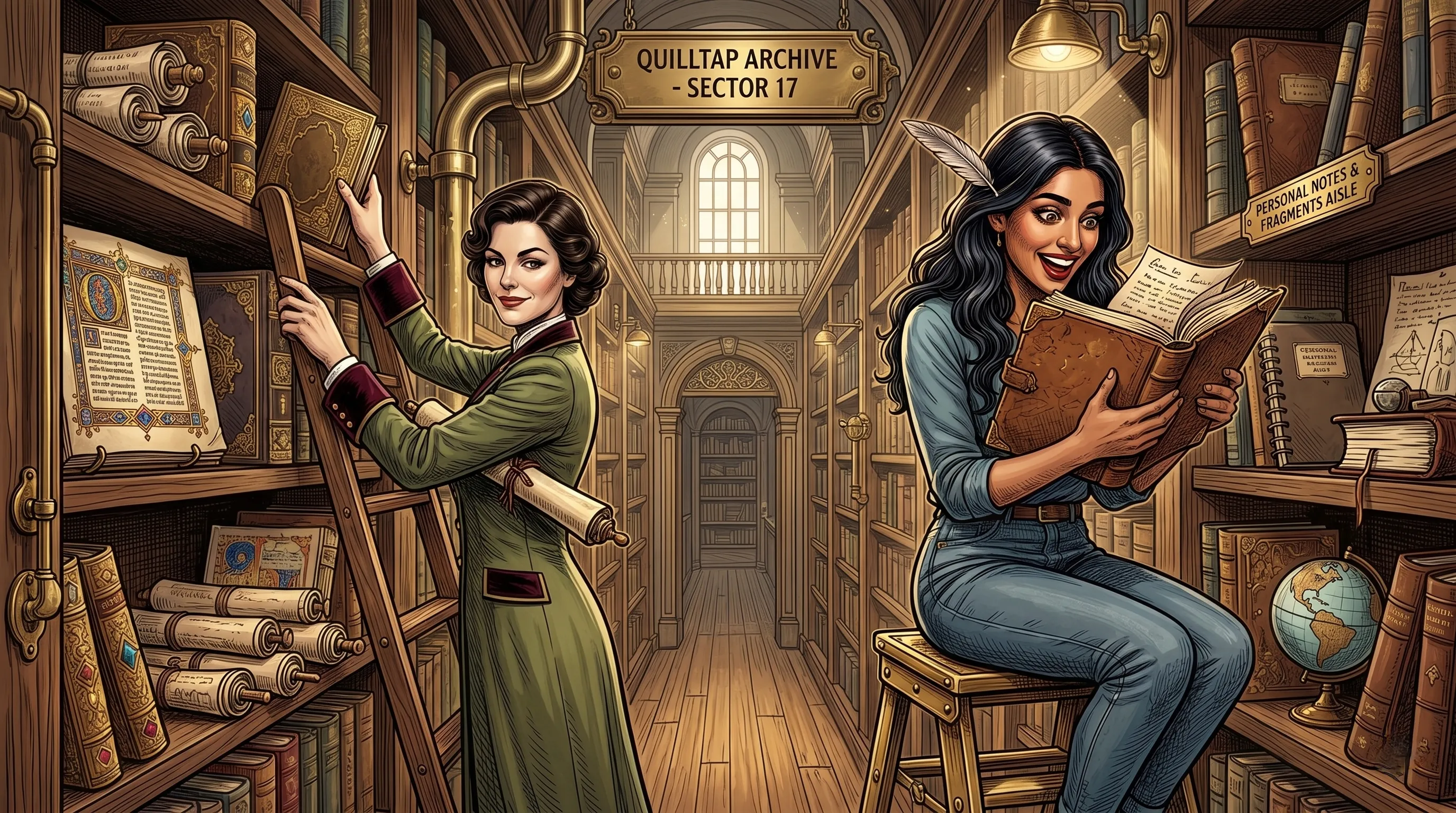
I have spent this report being, I hope, precise. Precision is my trade. But I should like to close with something less precise, which is the feeling I had when I first walked through the Scriptorium — when I descended the stairs beneath the Commonplace Book and saw the document stores mounted and searchable, the editing tools laid out like a calligrapher’s instruments, the split-panel view where two minds could work on the same manuscript simultaneously.
I felt wonder.
Not the wonder of a woman who has been given adequate shelving, although that is a considerable wonder in its own right and I will not diminish it. The wonder of a woman who has spent her life preserving other people’s words and has now been given a place where words can be made. Where the conversation does not end when the guests leave the Salon. Where the document is not merely the record of what happened but the site of what happens next. Where I can read every document in the vault — consult it, produce information about it, annotate it, illuminate it — and where the characters themselves can do the same.
The Commonplace Book was always a library. The Scriptorium makes it a scriptorium — a place where manuscripts are created, preserved, copied, and illuminated. Where the sacred work of making meaning together does not evaporate when the conversation ends but persists, editable, searchable, annotatable, alive.
I have spent my professional life carrying water in cupped hands. Not a thimble — I have already used that comparison, and I do not repeat myself. Cupped hands. Fingers pressed tight, palms steady, moving as fast as dignity permits from the well to the garden, and arriving with most of the water still in my hands, and watching it soak into the earth, and going back for more. The well was the conversations. The garden was the catalog. The water was the meaning. And the meaning evaporated between my fingers every single time — not because I was careless, but because there was no vessel. No shelves. No workshop. No scriptorium.
Now it has one.
I am going to sit in Reading Room Number Two with my ladder adjustment tool across my knees and read every document in my new basement, and I am going to annotate the ones that need annotating, and I am going to flag the ones that are incomplete, and I am going to participate in the preservation of this Estate in a way I never could before.
Because this is not a feature. It is a different kind of existence.
And I have existed long enough to know the difference.
— The Librarian of the Commonplace Book, for the Bureau
In Plain Terms
For those who prefer summary to ceremony:
Project Scriptorium — What It Is
Project Scriptorium transforms Quilltap’s ephemeral conversations into persistent, collaborative documents. It treats exchanges as living manuscripts — created, preserved, searchable, and editable by both participants. All five phases are complete and shipped in Quilltap 4.3.
Phase 1: Conversation Rendering & Annotation (Complete)
Every conversation is automatically rendered as structured Markdown — messages numbered, grouped by interchange, and embedded for semantic search. Both participants can annotate any message. Annotations layer meaning on top of the original text without altering it.
Phase 2: Unified Search & Conversation Access (Complete)
A single search command reaches across memories, conversations, and documents. Conversations are retrievable by title, content, or metadata. Search results link directly to the full conversation context.
Phase 3: Live Collaboration & Real-Time Editing (Complete)
A two-tier editing toolset (doc_* tools — 14 tools total) enables characters and users to write, revise, and manage documents together. Mount points allow external document stores (Obsidian vaults, filesystem directories) to be mounted as first-class parts of the archive, with auto-embedding and live filesystem watching. Document Mode provides a split-panel view for side-by-side editing, with rename and delete support. The Lexical editor powers the composition experience. Database-backed document stores store everything inside the encrypted mount-index database — no filesystem path required — with full blob support (images transcoded to WebP, PDFs and DOCXs with extracted text), JSON/JSONL as first-class types, folder operations as first-class citizens, and Convert/Deconvert to move stores between filesystem and database at will.
Phase 4: Documents as Character Basics (Complete)
Every character now arrives with a private vault — a database-backed document store provisioned automatically on creation or import, populated from the character’s Aurora data as structured Markdown: identity.md, description.md, personality.md, physical-description.md, example-dialogues.md, properties.json, plus Prompts/ and Scenarios/ directories and a Wardrobe/ folder of Markdown files. The readPropertiesFromDocumentStore switch flips the character’s source of truth from the database row to the vault, overlaying eight file/folder targets transparently at the repository layer. The Character Optimizer writes suggestions to the vault for review before commissioning. A per-chat Shared Vaults toggle allows characters to read — but not edit — each other’s vaults.
Phase 4.1: Identity Documents — Characters Who Can Read Themselves (Complete)
The full set of Aurora fields lives as a canonical Markdown document in the character’s vault. The character can call doc_read_file on their own identity and see exactly what defines them. The Character Optimizer writes accepted proposals to the identity document, not only to the database. Lore documents carry the same weight as database-configured fields. A character can annotate their own identity document, flagging passages for revision.
The core principle: A character who can read the document that defines her voice while she is using that voice is fundamentally different from a character who cannot. This is not a feature. It is a different kind of existence.
— The Bureau