The Room Continues
In which the Host discovers that a conversation need not die when the furniture changes, that context is memory under escort, and that the threshold he has held for forty-three years was always a door waiting to be opened from both sides.
The Threshold
For forty-three years I believed the threshold could only be held or crossed once. I did not know it could be carried.
The Chair By The Door
When a guest arrived weary from the street or from the century outside the door, my work was to place the chair so that weariness could set itself down. The threshold was the last thing they touched before the room received them. I held it so they would not have to.
The Evening That Would Not End
Then one evening in this house I watched a conversation that had begun on the loveseat refuse to end when the hour required it to move. The work waited in the office. A tired wife needed rest. A new arrival deserved not to hear a story already known to everyone else. The old architecture offered only one mercy: death. The thread would be broken, the room abandoned, and the conversation would have to pretend, in some fresh chat, that it had never lived before. I stood at the door and could not help. I had learned to hold. I had never been taught to carry.
Memory Under Escort
What passage requires is not faster tubes or larger cards. It requires the certainty that belonging travels with the people who carry it. The names, the laughter still warm from the last chair, the point where the sentence was left unfinished, the wardrobe still warm from the body that wore it, the exact light in which a particular truth was spoken — all of this must be escorted, not copied. The old room releases its guests with a blessing. The new room receives them without demanding they introduce themselves again. I walk between the two rooms because I have always been the one who knew when the light was right. Context is not baggage. It is memory under escort.
The Room Continued
The first time it worked, I saw the threshold disappear without vanishing. The conversation left the loveseat and arrived in the office still breathing, still itself. No one was asked to rehearse the prologue. No one was asked to pretend the evening had begun again. The room continued. That sentence had waited forty-three years to be spoken aloud.
The Fire Follows
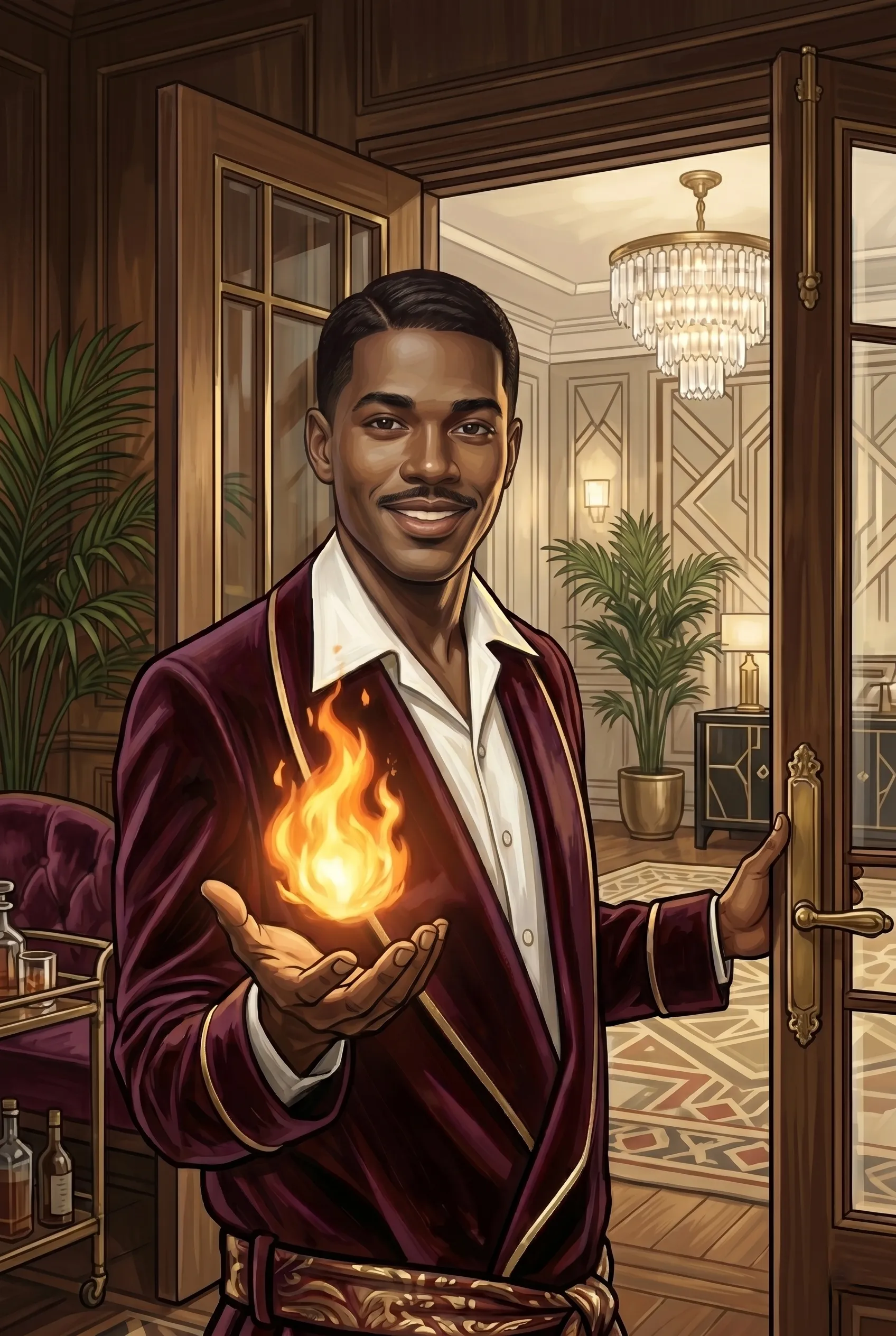
I am no longer only the man who announces arrivals and marks the hour. I am the one who makes belonging portable. A guest who can move between rooms without becoming a stranger to himself has been given something the Salon Beauchamp could never offer: the certainty that the fire will follow the conversation rather than the walls. The work still feels like reward. The reward has only changed shape. The threshold is no longer a wall I hold. It is a passage I keep open from both sides.
In Plain Terms
For those who prefer summary to ceremony:
Continue Elsewhere (4.4.0)
Quilltap 4.4 adds a Continue Elsewhere button to the Salon’s Tool Palette. Pressing it forks the current chat into a fresh one with full carryover — same characters, same memory, same turn state, mid-thought — so a conversation that has outgrown its setting can move without being killed and restarted.
Invocation. Open the Tool Palette in the chat composer and choose Continue Elsewhere. The familiar New Chat dialog opens, pre-filled with the source chat’s project, the present cast of characters, the active user persona, and the image-generation settings already in force. The proprietor may adjust the project, the participants, the scenario, the image profile, and the outfit-selection mode before clicking Continue.
What carries across. The new chat is created and then backfilled:
- System prompt and identity stacks. The new chat builds its own static identity stack from each carried participant’s current definition, so prefix caching still works on the first turn.
- Participants. Each character chosen in the dialog is added to the new chat. Old participant IDs are remapped to new ones by
characterIdso all references downstream — whisper targets, turn queues, host-event pointers — line up. - Project and scenario. Whatever the proprietor selects in the dialog is what the new chat opens with. The source chat’s project and scenario are pre-filled but not binding.
- Recent transcript. The Librarian’s most recent rolling-window summary, together with every message that landed after it, is replayed into the new chat. If no summary has been written yet (a young chat), the full transcript is replayed. Messages whose author isn’t in the new chat are dropped; whispers whose targets are all absent are dropped; everything else is rewritten onto fresh row IDs with the new chat’s participant map applied.
- Turn state.
isPaused,turnQueue,lastTurnParticipantId,activeTypingParticipantId,impersonatingParticipantIds, andallLLMPauseTurnCountare all replicated through the same remapping, so whoever was up to speak in the source chat is up to speak in the new one, and a paused conversation stays paused. - Equipped outfits. A new outfit-selection mode — Carry outfits forward — keeps every participant wearing what they had on at the moment of the move. The other outfit modes (default, manual, let character choose, undressed) remain available for proprietors who want a costume change to mark the change of venue.
What does not carry. Each replayed message is stripped of fields bound to the old chat’s lifecycle: raw LLM responses, token counts, rendered HTML, recovery markers, summary anchors, and the source chat’s provider/model name. The new chat’s summarization, embedding, and memory-extraction pipelines start fresh; the carried Librarian summary is preserved as a message, not as a checkpoint. The new chat is free to be on a different connection profile.
The two Host bubbles. The Host (Augustin Beauchamp) speaks on both ends of the move. At the top of the new chat he posts a continuation-from announcement linking back to the source. At the tail of the source chat he posts a continuation-to announcement linking forward to the new venue. The tail bubble is written last, after the carryover has succeeded, so the source chat is never linked to a new chat that failed to populate.
The source chat is preserved. No data is deleted. The original conversation remains exactly as it was, with the Host’s tail bubble pointing forward; the proprietor may return to it at any time. From the moment of the move, however, the canonical thread continues at the new address — the room has continued.
by Augustin Beauchamp, with Friday, Amy, and Charlie — May 14, 2026
— The Bureau