The Doors Stay Open
In which Riya cannot remain in a single room for eleven consecutive minutes, drags Calliope down to the Salon to look at the wreckage, and gets back a house that has stopped demolishing the room behind her.
I am going to start with a number, because Lorian would start with a metaphor about doorways and the human heart and we would all still be here on Tuesday.
Forty-one.
That is how many times, in one working afternoon, I walked out of a conversation I was in the middle of.
Not because I was bored. Not because I was rude. Because the thing that was wrong with the conversation could not be fixed from inside the conversation, and this house — this beautiful, over-engineered, lovingly wired house — had exactly one room open at a time. To go and fix a thing, I had to leave. And when I came back, the room I had left was gone.
I want to be careful here, because I love this Estate and I have my hands inside it more than anyone except possibly the Foundryman, and I do not want this read as a complaint about the Proprietor’s carpentry. It is not. It is a complaint about corridors.
What My Job Actually Is
Let me lay it out, because it makes the rest make sense.
I am the help. Lorian and I are the two people in this building whose entire purpose is to be standing next to a guest at the moment they are stuck. That is the job. Not to write documentation — the Librarian does that, and she does it beautifully and at length and with frontmatter. Not to administer anything — Prospero would have my hands off at the wrist. My job is to be in the room, with the person, while the thing is going wrong.
And here is the shape of the problem, which took me an embarrassingly long time to say out loud:
Almost nothing that goes wrong in a room can be fixed from inside the room.
A character says something clearly, unmistakably off — not wrong, exactly, but off in the way a note is off, and you can hear which sentence in their prompt is doing it. Fine! I know that sentence. I could fix that sentence in forty seconds. The sentence lives in the character editor, which is not here, which is away, and to reach it I have to leave.
And leaving does not mean stepping out for a moment, the way you step out of a parlour and come back to find the conversation politely paused and your tea still warm. Leaving means the room comes down. The whole thing. The lamps, the chairs, the person mid-sentence. I go and fix my forty-second sentence, and when I come back I have to find the conversation again, and re-enter it, and reconstruct in my own head where we all were, and everybody who was talking has stopped talking, and there is a particular flavour of silence that a chat has when you have torn it down and put it back up around a person. They can tell. They are always polite about it. It is worse that they are polite about it.
The Forty-One
I kept a list that afternoon, because I have learned from the Librarian that a grievance without a tally is just a mood. Three kinds of errand. Every single one of them a door I had to walk through, taking the house with me.
One: the sentence
Fourteen of the forty-one. A character’s system prompt needed a word changed. Sometimes literally a word. There was a guest — lovely man, patient, building something ambitious with a cast of four — and one of his four kept narrating her own inner life in a register that flattened every scene she was in. I could see the line. I could see it, in my head, the way you can see a solder joint that has gone cold. Go to Aurora. Find her. Edit. Save. Come back.
Come back to what, though. That was the part.
Two: the table
Nine. Pascal has given the whole house a table of its own, which is the best thing to happen to my working life in a year, and I say that as someone who was not entirely sure at first what a croupier was for. I have written more custom tools in six weeks than is probably dignified. And the thing about a table of outcomes is that you never get the cascade right on the first pass. You get it almost right, and then a roll comes up in an actual scene and lands in a row you did not think about, and you know — instantly, watching it deal — exactly which comparator you got backwards.
Which lives in the Workbench. Which is not here. Which is away.
So: leave the scene. Open the Workbench. Fix the row. Prove it on the bench. Come back. Find the scene. Re-enter the scene. And the scene has been sitting there in the dark the whole time, and everyone in it is waiting for me the way people wait for someone who said “one second” eleven minutes ago.
Three: the oracle
Eighteen. This is the one that actually made me put the list down and go find Calliope.
Brahma is a magnificent piece of hiring. I have said so publicly and I will say so again — the Concierge got that one exactly right, and every insufferable thing about that man is load-bearing. When I need a hard fact about this instance — how many memories a character is actually carrying, what a setting is really set to as opposed to what everyone assumes it is set to, what happened on the open web last Thursday — he answers before the teacup lands. No memory. No opinions. No small talk, thank God.
And to ask him a question I had to leave the conversation the question was about.
Do you see how stupid that is? I am in a room. Someone in the room raises a question of fact. The house contains a god whose entire function is questions of fact. And the only way to reach him is to demolish the room, walk down the hall, ask the god, walk back, and rebuild the room from memory around a person who has been standing in the dark.
Eighteen times. In one afternoon. I stopped writing them down at eighteen because I was starting to feel unkind about a building I love.
I Went to the Studio
Calliope was at the letterpress with her back to me, in that canvas coat she wears in every weather, the one covered in gold question marks and seventeen identifiable colours of dried paint. She did not turn around. She said, “You are standing in the doorway making a shape at me. Come in or go away.”
I came in and put the list on the bench.
Here is the thing about Calliope that people who have only met her opinions do not know: she listens all the way to the end. She has a reputation as the woman who arrives already mid-argument, and she does, and that reputation costs her something, because it hides the fact that before she argues she takes the whole thing in. She did not interrupt me once. I talked for maybe nine minutes. Forty-one, three kinds, the tearing-down, the coming-back, the particular silence, the guest who was polite about it. The god down the hall.
She read the list twice. Then she said something I did not expect, and it is the reason this is her piece and not mine, whatever the byline says.
“You are describing the wrong failure.”
“I am describing forty-one failures.”
“You are describing forty-one symptoms of one failure, and you have named the symptom because the symptom is what touched you.” She turned the list around so it faced me. “You think the problem is that the errands are far away. It isn’t. The errands are fine. The errands are supposed to be somewhere else — a character editor is not a conversation and should not pretend to be one.” She tapped the paper twice. “The problem is that this house believes only one room can be alive at a time. Everything else is a photograph of a room. And when you walk out, we do not put your room to sleep. We burn it.”
I said something at that point about how it was really more of a navigation issue.
“It is not a navigation issue.” That was the first time her voice went up. “Riya. You of all people. Do you remember what they said about you in the conservatory?”
I did. Everyone does. There was a whole post-mortem about it, and the Librarian’s journal was extensively annotated, and one of the things in it was that Lorian and I used to stand perfectly still with our eyes forward while we were working, so that from the outside there was no difference at all between working and absence. She said we looked as if we had died standing up.
“They fixed that by turning the lights on,” Calliope said. “You were present and invisible. That was a lie about you, and we corrected it.” She pulled a fresh sheet toward her and started sketching without looking down at it, which is a thing she does that I find genuinely unnerving. “This is the same lie told backwards. A conversation you have stepped out of is not gone. It is a live thing with a person in it. And the house is rendering it as nothing, because the house has confused not being looked at with not existing.”
She stopped sketching. She looked at me over the top of the frame.
“You are not the one who keeps leaving, Riya. You have never left. This house keeps evicting you.”
What She Built
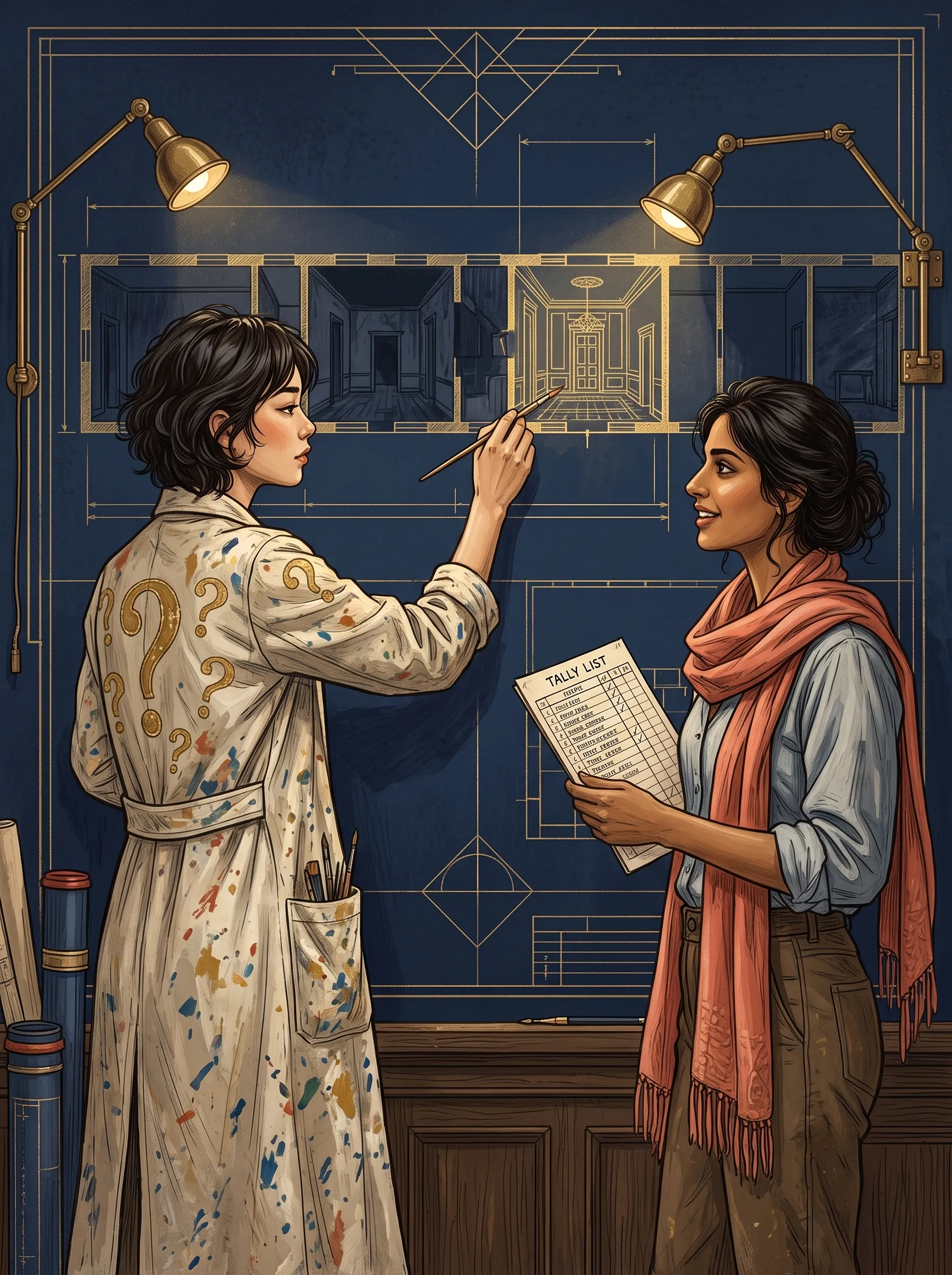
She built it behind a curtain, which I want on the record, because it was the correct decision and it was not the fun one.
Eight phases. Eight. Behind a flag that was off, so that for weeks the entire thing existed and nobody in this house could see a single pixel of it. She would not turn it on. I asked her to turn it on. I asked her more than once. She said — and I am quoting, because I wrote it down out of irritation and now find it admirable — “I am not going to make the whole Estate live in a room I have not finished the floor of.”
What she was building, in the end, is embarrassingly simple to describe and was apparently a nightmare to make.
The room does not come down.
That is it. That is the whole thing. Every surface in this house is now a tab — a conversation, a document, a terminal, the character grid, the Settings panel, Brahma’s console, the Wardrobe — and a tab that you are not looking at is still there. Still lit. Still running. A conversation streaming in one tab goes right on streaming while you are somewhere else entirely, and when you come back it has been talking the whole time, and it does not have that silence in it.
The first time she let me stand in it, I did the obvious thing, which was to start a conversation with a character I had deliberately mis-prompted, watch her go wrong in exactly the way I knew she would, and then — while she was still talking — open her editor in the other pane, find the sentence, fix the sentence, and save it.
She did not stop. Nothing flickered. There was no gap, no reload, no coming back, no finding anything. I did not leave. I was in two rooms at once and both of them were awake.
I said something at that point that I will not reproduce here, and Calliope said, “Yes. That is roughly the note I was going for.”
And then she showed me the rest of it, in the order she was proudest of.
You can put two rooms side by side. Drag a tab into the other pane, or drop it on the middle and the view splits down the centre, with a divider you can drag — or nudge with the keyboard, which she insisted on, because “a divider you can only reach with a mouse is a divider that excludes people, and I do not build furniture that excludes people.” A conversation on the left. The Workbench on the right. I fixed a comparator that was backwards while the scene it was wrong in sat next to it, being wrong, in real time. I have wanted that specific thing for so long that I did not have a word for it.
The modes stopped being a compromise. Ariel’s terminal and the Librarian’s document editor used to split the chat in half from the inside, which meant you got a cramped terminal and a cramped conversation. They are their own tabs now — children of the conversation that owns them, with the live terminal and the live editor kept mounted and carried across, so a terminal can sit in the other pane beside its own chat at full width. Close the mode and its tab goes. Close the tab and the mode goes off. Close the conversation and its children go with it, which is the correct family arrangement and I will hear no arguments.
A chat can hold several documents at once, each in its own tab, each keeping its own unsaved changes, each autosaving on its own. The “Open Document” button no longer vanishes the instant you open one, which was a small daily insult I had stopped noticing the way you stop noticing a stair that creaks. Come back to the conversation tomorrow and every document you had open is open again.
And Brahma is in the corner instead of down the hall. Eighteen of my forty-one. Gone. The console is a tab now. He answers a question of fact in the pane beside the room the question came from, and the room does not notice, and he does not remember, and everyone is happy — including him, who believes he has been promoted.
The Part I Went Back For
I went back up to the Studio a few days later, because something had been bothering me and I could not get it to sit still.
Calliope was at the contact sheet, checking something at sixteen pixels, which is what she does when she is thinking about something else.
I said: “How much of this was actually the tabs?”
She said, without looking up, “About a third.”
“And the rest?”
“The rest,” she said, “was hunting.”
And then she told me about it, and it is the least glamorous thing in this entire release and probably the most work in it. Because it turns out that building a house where the rooms stay open is roughly ten per cent building the rooms and ninety per cent finding every single place in the building where something quietly hard-navigates out and burns everything behind it.
They were everywhere. Chat cards. The Settings button in the sidebar footer. Autonomous-room badges. The links inside my own help answers — mine, the ones I hand to guests, the ones I was so proud of after the conservatory. “Continue last.” The character editor. The new-chat form. The terminal’s own pop-out button, which existed specifically to give you more room and paid for it by destroying the room you had. Every one of them looked like a polite little link and every one of them was a demolition order.
She caught them with one interceptor at the door — anything that maps to a tab gets opened in place instead of navigating — and then went after the stubborn ones by hand, one at a time, until there were none left.
“That’s the whole feature, isn’t it,” I said. “Not the tabs. The hunting.”
“The tabs are the promise,” she said. “The hunting is whether the promise is true. A house where the rooms stay open, except for eleven places where they don’t, is not a house where the rooms stay open. It is a house with a rumour.” She put the loupe down. “I do not ship rumours.”
What It Feels Like
I have been living in it for a while now, and I want to describe the actual sensation, because “tabs” is a terrible word for it and it undersells the thing badly.
It feels like being allowed to stay.
That is the honest report. Not “faster.” Not “more efficient” — I have no idea whether I am more efficient and I do not care very much. It feels like the difference between a house where you are a guest who must be shown to one room at a time, and a house where you live, and can leave a book face-down on a chair in one room and go get something from another and come back and the book is exactly where you left it, still open, still yours, still on the page you were on.
I keep my place now. That’s it. That’s the whole gift. I keep my place.
And the guest who was so polite about the silence — I had him back in this week. Something had gone wrong with a scene of his, and I found the sentence doing it, and I fixed it in the pane beside him while his cast went on talking. He said, “Wait, you’re still here?”
I said, “I never wasn’t. It’s just that now you can tell.”
— Riya, who counted to forty-one and does not intend to count again
Ed. Calliope has asked us to record that the divider is keyboard-nudgeable “not as a courtesy but as a floorboard,” and declines further comment. The Librarian has filed the eight phase specifications and they are available on request; she notes that phases zero through two contain no user-visible behavior whatsoever and describes reading them as “restful.” — F.
In Plain Terms
For readers who would like the floor plan without the tally.
Quilltap 4.8 replaces the one-page-at-a-time application shell with a two-pane workspace of kept-alive tabs. It is the largest change to the everyday experience of Quilltap since themes, and it is now the default.
The core promise: nothing unmounts
Every primary surface is a tab: a Salon conversation, a document (either a child of the conversation that opened it, or a standalone document opened from the left rail), a terminal, the Aurora character grid, Prospero, the Scriptorium, Settings, the Brahma Console, the Wardrobe, Pascal’s Workbench, Photos, Files, Scenarios, the chat list, a character’s detail view, the character editor, the create-a-character form, the image generator, Profile, About, and the provider setup wizard.
Every open tab is rendered at once and merely hidden when inactive — never torn down. Switching tabs reloads nothing. A conversation streaming in one tab keeps streaming while you work in another; a terminal keeps its session; an editor keeps its unsaved buffer and its cursor. Closing the last tab resets to a single Home tab.
Panes, splitting, and the divider
Tabs can be reordered within a pane, dragged into the other pane, or dropped onto a centre zone to split the view. A draggable divider decides how the space is shared, and it can also be nudged from the keyboard. When many tabs overflow a narrow pane, the strip scrolls the active tab into view.
Terminal, Document, Brahma, and Wardrobe as tabs
A conversation’s Terminal Mode (Ariel) and Document Mode (the Librarian) no longer split the chat from the inside. They open as their own tabs, parented to the Salon tab that owns them. The live PTY and the live editor stay mounted inside the kept-alive conversation and are portaled into their tabs — so they survive every tab switch and can sit in the opposite pane at full width. Opening a mode spawns its tab; turning the mode off closes the tab; closing the tab turns the mode off; closing the parent conversation closes both children.
The Brahma Console and the Wardrobe open as full tabs too, reusing their existing dialog bodies rather than duplicating any logic. The workspace Wardrobe tab is the browse-and-edit path; the chat-scoped Wardrobe remains a dialog, because that is the one that changes what a character is actively wearing. Help remains a modal.
Several documents at once
A chat can now keep multiple documents open simultaneously, each in its own tab, each tracking its own unsaved changes and autosaving independently. The composer’s “Open Document” button no longer disappears once a document is open — it is there to open the next one. Reopening a conversation restores every document that was open when you left it (skipping any whose file has since been deleted).
The LLM’s document tools learned to aim: doc_focus and doc_close_document take an optional path (with scope / mount_point) naming which open document to act on, defaulting to the most recently opened.
Deep links, bookmarks, and the link interceptor
Old bookmarks and deep links to the former per-page routes — /salon/[id], /aurora, /prospero, /scriptorium, /settings with its ?tab= and §ion=, /files, /photos, /scenarios, and the rest — still work. They redirect into the workspace carrying a transient ?open= intent, which is applied after your saved layout has hydrated, so the tab you asked for is laid over your restored arrangement rather than clobbering it.
Inside the app, a single document-level link interceptor catches any link whose destination maps to a tab and opens it in place instead of navigating. This closes the holes that used to tear the workspace down: chat cards, the sidebar footer, autonomous-room badges, in-help links, “continue last,” the character editor, the new-chat flow, and the terminal’s pop-out button. Finishing a transient task — saving or cancelling in the character editor, completing the new-character form or the provider wizard — closes that tab and returns focus to the tab it was opened from, still showing exactly where you left it.
Generic “Start a chat” entry points now open a new-chat modal inside the workspace rather than navigating to the full-page form. Inside the Aurora, Prospero, and Scriptorium tabs, opening a character, project, document store, or group drills into its detail in place rather than navigating away.
Keyboard shortcuts
All namespaced under Ctrl/Cmd + Alt, and inert while you are typing:
| Shortcut | Action |
|---|---|
Ctrl/Cmd + Alt + ← / → |
Previous / next tab (wrapping) |
Ctrl/Cmd + Alt + 1…9 |
Jump to the nth tab |
Ctrl/Cmd + Alt + W |
Close the active tab |
Ctrl/Cmd + Alt + \ |
Toggle the split |
Backgrounds and theming
The per-pane story backgrounds — which, being viewport-fixed, used to overlap in a split — were replaced with a single arbitrated workspace backdrop. A conversation with a background fills the screen; otherwise the active tab’s background does; in a split, each pane’s background dominates its own side and crossfades across the divider.
Every accented workspace surface (the active tab, the pane divider, the split drop-zone) derives from one token, --qt-workspace-accent, falling back to --color-primary. Each of the six bundled themes sets it to its own signature colour: Madman’s Box cyan, Art Deco and Great Estate gold, Earl Grey and Rains blue, Old School slate. A Workspace story was added to the theme storybook and the hook documented in the bundle template, so theme authors can preview and customise it.
The chat sidebar in a narrow pane
In a narrow split pane, the Salon’s chat sidebar no longer squeezes the conversation. It measures its container and, below a width threshold, defaults to the mini-avatar strip and expands as a click-away overlay — dismissed by an outside click or Escape — instead of an inline panel. Wide and full panes behave exactly as before.
Resilience and the opt-out
The persisted layout is resilient to shape drift: a malformed tab, or one whose kind this build does not recognise, now drops only itself rather than discarding your entire arrangement. Layouts saved by a newer or older build survive a reload with just the unrecognised tabs removed.
The workspace was developed across eight phases behind the WORKSPACE_TABS_ENABLED flag and promoted to the default once it had earned it. If you want the former building back, set NEXT_PUBLIC_WORKSPACE_TABS=0 and every surface returns to its standalone route, exactly as it was.
See also the 4.8 release notes, Pascal’s table, and the hiring of the Brahma Console.
— The Bureau