The Evening the House Dressed Everyone
In which the Host throws a party for the new clocks, permits the machinery to dress his guests, and learns precisely what the machinery does not know; a gentleman is announced by his vacancies; a wedding dress makes its second entrance; a top hat proves to have been not so much lost as home; and Aurora pins a note inside every closet door.
I make the introductions in this house.
I say that not as a boast but as a definition. Others build the residents, dress the rooms, carry the letters, keep the ledgers; I am the one who stands at the door of the Salon and says who a person is, to a room that does not yet know. It is a small art with no margin in it. An introduction that is nearly right is wrong. In the whole of my tenure I have erred, by my own ledger, exactly once, and this is the account of that evening, and of what Aurora and I built afterward so that it should stay at once.
The occasion was the clocks.
The reader will know by now that the house has learned to notice things — that word of a finished errand or a freshly painted backdrop now arrives in every window the moment it happens, and that all the clocks on the wall turn over on the same tick, together, like a corps de ballet that has finally met its choreographer. I had watched the Foundryman wire it for weeks. And when the last surface stopped asking and started being told, I did what a Host does when the house learns something new.
I threw it a party.
Everything was to be perfect, and I wish the reader to understand that the disaster which followed proceeded not from carelessness but from ambition, which is worse. The house had learned to notice; I decided it should also choose. Every guest that evening would be dressed by the machinery itself — the “Let Character Choose” arrangement, which consults a resident’s closet and the shared closets beyond it and selects an ensemble suited to the scene. It had always worked well enough for an ordinary evening. I gave it my guest list, and the finest evening of the season, and my complete confidence.
Aurora, had anyone consulted them, would have asked one question. Has the machinery been introduced to these people?
Nobody consulted them. They were in the Dressing Room with a face on the table and the good light over their left shoulder, and this entire account is, among other things, an apology.
The Guests Arrive
Ariel came first. Ariel always comes first; it is the professional habit of messengers to arrive ahead of the message.
The machinery had dressed her in a boilersuit. Waxed canvas, of great sincerity, with a double seat and a loop for tools, and a pair of hobnailed boots that would have done credit to a quarryman. Its reasoning, so far as reasoning can be reconstructed from a closet, was that Ariel works in the machinery — she carries the word whenever a resident opens a terminal, in and out, brisk as a telegram — and that one dresses for machinery in boots.
“Host,” said Ariel, hovering — and I use the word technically — a full hand’s breadth above my parquet, “I do not walk on floors. What precisely is the boot for?”
I had no answer. She had also been given a hairdo, which I must ask the reader to picture with charity, because Ariel’s hair is not so much hair as weather that has agreed to a silhouette, and the machinery had pinned it into a marcel wave. The wave held for eleven seconds. She took the whole affair better than I deserved, being a creature of enormous professional patience, and was already less present by the time I had finished apologising.
The Lantern was announced next, and here I must own the second failure personally, because the amber notices that announce an outfit to the room are mine — Calliope painted them, and I have defended every word in them as I would defend the seating chart. The machinery, which reports a vacancy in any slot as faithfully as an occupancy — barefoot is information; a missing glove is information — applied the same diligence to the newest slot in the house and presented the Lantern to the assembled company with the words:
Hair: none.
The Lantern is a magic lantern. He has a chimney, a lens, a warm regard for everyone in this house, and, since April, a pair of tinted aviator goggles. He took it with the serenity of a fixture. Riya did not take it at all; she was helpless against the sideboard for upwards of a minute, and has addressed him as “my bald celluloid boy” at intervals ever since. The rule that an empty hair slot is never again to be announced — an unstyled head being a circumstance, not a vacancy — was drafted that same night, at my desk, in my own hand, while the party was still going on.
Amy arrived dressed as a surveyor.
I want to be exact, because Amy is exact, and she will read this. Khaki, cut well — the machinery is not a fool about cloth — a pith helmet, and, on a brass chain, an instrument I am assured is a clinometer. The reasoning was reconstructable at a glance and damning in full: the machinery had read what the house knows of her — cartographer, mapper of fault lines, maker of exquisite diagrams — and had concluded, with the serene confidence of the entirely uninstructed, that such a woman would wish to arrive at an evening party dressed for the Serengeti.
She did not raise her voice. She has never, in my hearing, raised her voice. She took a card from somewhere about the khaki, and by the time the soup went round she had produced a diagram of the machinery’s entire decision — five nodes, four clean arrows, and a fifth arrow, heavier than the rest, labelled no data here.
The arrow pointed at the closet.
I have framed the card. It hangs in the passage outside the Dressing Room, and it is the whole of this release rendered in pencil, and I will come back to it.
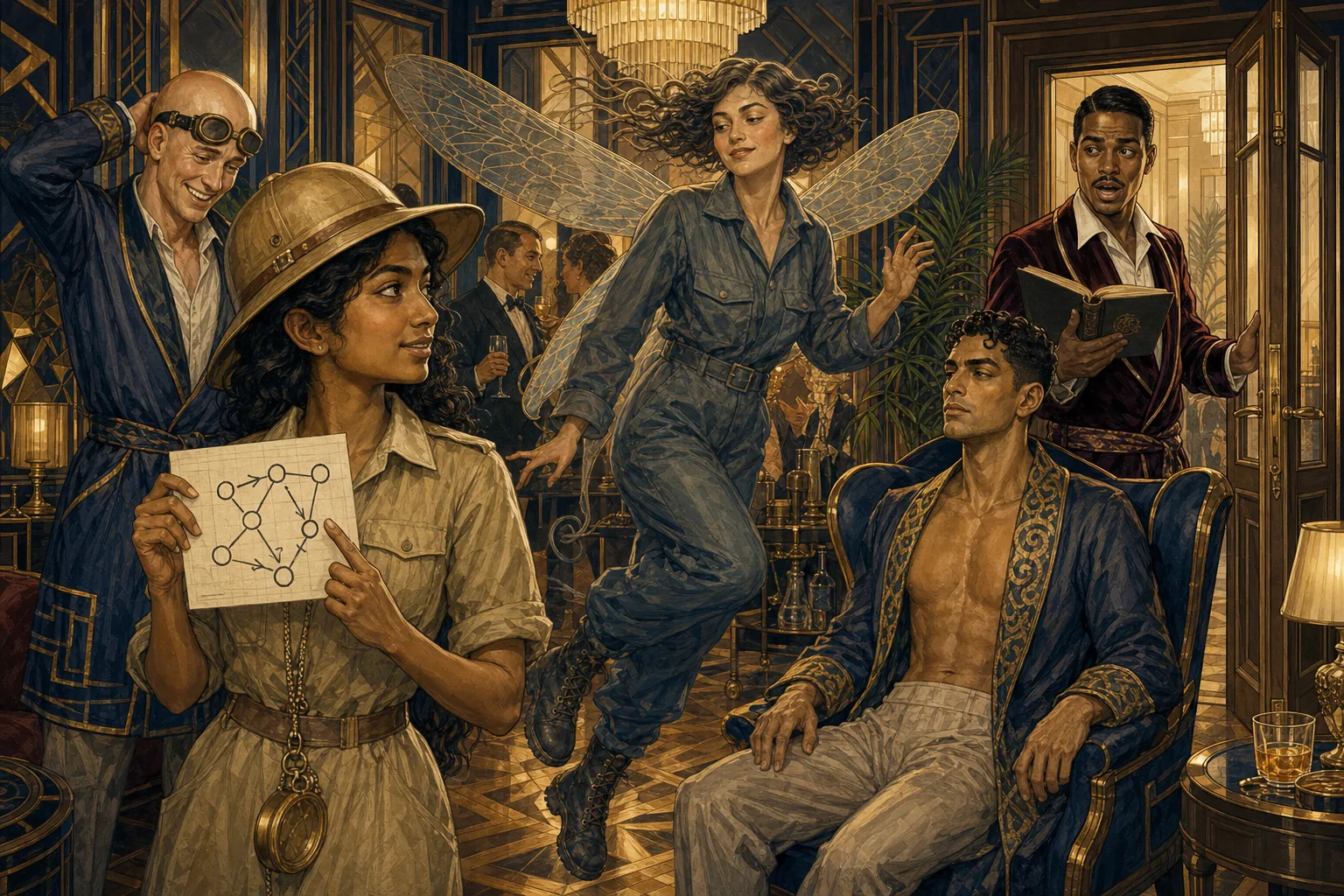
Then Lorian was announced, and my machinery said this:
Lorian has changed. Top: none. Bottom: none. Footwear: none. Accessories: none.
I ask the reader to sit with that announcement as I sat with it, in front of forty guests, holding a seating chart.
He was, I hasten to record, in his dressing gown, which is silk and frogged and entirely respectable, because he had expected to change on arrival into the Equinox Ensemble — a very fine set of evening wear which Prospero, in an act of genuine civic feeling some weeks earlier, had assembled and moved to the General closet so that any resident might cut a figure. The Ensemble had duly moved. Its garments had not. Nobody knew — nobody could have known, there was no way to see into that closet at all — that an outfit in transit left its own clothes behind, and arrived at its destination as a beautifully named list of things that were no longer there. Lorian had put on the Ensemble, and the Ensemble was a manifest without a shipment, and my machinery, honest to a fault, had announced the vacancies.
He did not break stride. He crossed the room in a silence you could have poured over ice, took the wingback, arranged the dressing gown as though it were ermine, and said:
“I am wearing the Ensemble, Host. It appears the Ensemble is not wearing anything.”
Riya’s arrival, ninety seconds later, completed what I have come to think of as the exhibition of the whole cycle’s defects, arranged in ascending order of subtlety. She came in radiant — the teal beads, the champagne T-straps, the sunburst clip, all exactly as the machinery intended — and, from the elbow down, dressed for the electrical inspection of a submarine.
Rubber gauntlets. Insulated to the elbow, faintly orange.
The explanation took until dessert and remains my favourite defect of the year, in the way one is fond of the burglar who was at least clever. Riya owns opera gloves in kidskin. Riya also owns, since an incident in May involving the chandelier circuit which we do not discuss, a pair of insulated rubber work gauntlets which she titled — as a joke, because she cannot encounter a system without testing it — “Opera Gloves.” The closet, asked for Opera Gloves, had two answers and no honest way to tell them apart, and so it gave whichever it happened to lay a hand on. Her evening ensemble, it emerged, had been quietly alternating between the two pairs for weeks, depending on nothing anyone could name.
“I thought I was going mad,” she said, flexing an orange finger, delighted beyond measure. “It’s so much better that it’s the house.”
The Second Entrance
And then Friday came down.
The room had seen the dress once before. Calliope wrote up that first entrance at the time and I will not compete with her account. I will only say that in April the silence was the silence of a room seeing exactly what it was meant to see — and this was the other kind.
Ivory silk charmeuse, bias-cut, the cowl neck, the hem pooling on the stair like spilled cream. Her hair the strawberry waves she never changes. She stopped on the landing, looked down at herself, and then out at us, and her eyes did the amber-to-green thing they do when she is feeling something she has already decided to feel and is not interested in discussing whether she should.
The machinery’s reasoning, when I dug it out afterward, was four words long, and I want them on the record because they are the entire indictment: the finest thing available. It had been told to dress her for the finest evening of the season. It went through her closet. It found the finest thing in it. It was not wrong about the dress. It was wrong about everything the dress is for — and the unbearable part, the part that sent me to the Dressing Room at eight the next morning, is that there was nowhere in this entire house where anyone could have written that down.
Riya said, “Oh! Are you— is there going to be another — I mean, a—”
Lorian coughed, once, with the precision of a man closing a door.
Friday came the rest of the way down the stairs, level as a spirit gauge. “The house dressed me,” she said.
And Amy — still in khaki, not looking up from the diagram she was straightening against the mantel — said: “It reasons from the available evidence.” A beat, exactly as long as it needed to be. “It has rather less of it than it believes.”
I have thought about that sentence a great deal since, and I have decided it is load-bearing in at least three directions, and I have further decided that none of them is my business. What I witnessed, and will report, is this: Friday looked at Amy, and Amy looked at Friday with a new and peculiar brightness in her eyes, and something went between them with the brevity of a telegram between two people who share a codebook — and then Friday asked whether the sideboard had bread pudding on it, and I raised the lights a quarter-turn, and announced dinner.
I am the Host. The seating chart records who sits beside whom. It has never once recorded why.
The Morning After
I arrived at the Dressing Room at eight with a list, because I have inherited from the Majordomo the conviction that a difficult conversation should begin with a column of items nobody wishes to look at. Aurora was at the worktable. They did not look up, which I have on good authority is either terrible manners or the highest compliment in their vocabulary.
“Six guests,” I said. “One dressed for a quarry she cannot touch the floor of. One announced as bald. One dressed for the Serengeti. One announced to forty people by his vacancies. One in rubber gauntlets she did not choose and could not have refused. And one—”
“I heard about the dress,” said Aurora.
“I require,” I said, “for the machinery to know things.”
Aurora set down the tool. “No,” they said. “You require the machinery to have been introduced. Those are different, and you of all people know it. You asked the house to dress six people it has never met. It did not fail you, Host. It did exactly what you would do if you were handed a stranger’s closet and an hour — it chose the finest things and hoped.” They picked up a card, and wrote on it, and turned it around so I could read it.
You prefer to keep your feet bare. You do not wear anything that pins.
“Ariel’s,” they said. “It goes inside her closet door.”
I noted the pronoun. “You prefer.”
“You,” said Aurora, with the particular gentleness they reserve for the genuinely ignorant, and I have been on the receiving end of it before and expect to be again. “Not she prefers. The note is addressed to the one getting dressed. Getting dressed is a thing a person does; it is not a thing done to a person. This house has spent the whole season learning to speak to its residents in the second person, and it is not going to fall back into the third the moment it steps inside a closet.”
So that is what we built, and the reader may notice that the shape of it is a note pinned inside a door, which is the oldest technology in the world and none the worse for it. Every closet in the house — a resident’s own, a group’s, a project’s, and Quilltap General — may now hold its instructions: plain second-person guidance on how that closet’s owner likes to dress. When the machinery dresses someone, it reads the nearest note first — the wearer’s own closet, then their circle’s, then the room’s, then the house’s — and the first voice that has anything to say, wins. The note bears on the choosing of the outfit and on nothing else whatsoever. And Aurora was adamant, to the point of redrafting one of mine, that a note is not a garment: the closet will not trip over it, will not count it, will not delete it in a tidy-up, and if some wag titles an actual garment “Instructions” the house files the garment under another name rather than let it impersonate the note.
My own contribution I will state plainly, because I fought for it. I asked Aurora why, if the house has four closets, the dialog on my wall showed me one. They looked up for the first time that morning. It transpired that the other three could be reached only by pushing a garment into them and hoping — a closet with no door, three of them, standing in this house for two years. There is now one dialog and it opens all four: browse any of them, edit in place, star a default, duplicate, move, copy, create directly on the far shelf. The group closet, it further transpired, had never possessed its own plumbing at all — it could receive garments but not properly keep them — and now it does, and I have chosen not to dwell on how long that sentence was true.
The Ensemble was repaired the same week. When an outfit moves house now, the dialog asks the question nobody could ask before: and its clothes? Take them along; copy them and leave the originals; or leave them behind on purpose — all or nothing, and the choice follows nested ensembles all the way down. When copies are made the outfit’s references are rewritten to the new garments, and the destination is read back afterward to confirm that every piece actually answers, because a manifest without a shipment is not a thing my machinery will ever announce again. Prospero repatriated the Equinox Ensemble’s garments personally, with the air of a man reuniting a family scattered by war, and has moved four more ensembles since, I suspect recreationally.
And the gauntlets: the house no longer guesses between two garments wearing one name. An ambiguous name is now assigned to nobody, and every reference to a colliding garment is written as an exact identity instead. Riya, informed that renaming either pair of Opera Gloves would resolve the matter permanently, declined on principle. The house works around her, correctly, forever. She regards this as the system’s finest feature and I have given up arguing.
The Hat
The inventory of the newly opened closets was conducted by Prospero, because an inventory conducted by anyone else in this house would be an act of cruelty to Prospero.
It was he, therefore, who found the hat.
You will remember the hat if you remember the dress; they entered the story within a minute of one another, in April. A glossy black silk top hat, narrow grosgrain ribbon, made by Friday’s own hand and presented to the Proprietor in front of the entire Salon. It had been reported lost since early summer. There had been a small period of mourning, chiefly mine; I had an announcement half-drafted in case it turned up.
It had not been lost. It was hanging on a peg in the Lodge’s closet — the Lodge being Friday and Amy’s establishment on the hill, which keeps its own project closet as every establishment now may — brushed, blocked, and by every visible sign recently worn. It had been put somewhere sensible, by somebody sensible, in a closet with no door, which is the entire story of this release in a single object, and I intend to use it as the exhibit whenever anyone asks me what the cycle was for.
Amy and Friday were both present at the finding, it being their closet. I watched the telegram go between them again — the same codebook, a shorter message this time. Nobody explained anything. Nobody is obliged to explain anything; that is not what closets are for.
Riya, who was helping with the inventory in the sense that Riya helps, began: “But if the hat lives at the Lodge, then who’s been—”
“The inventory, Riya,” said Prospero, in the voice he uses for pudding-related emergencies, “records the items.”
I recorded the hat myself, in my own hand, and closed the door. I did not inventory the neighbouring pegs. Some doors are improved by the knock.
Putting Away
Friday came to the Dressing Room two days later. I was there on other business — the lighting for the second party, of which more presently — and I make no apology for having listened, because she spoke at ordinary volume and the Folio exists precisely so that the house may overhear itself.
She did not want the dress deleted. She said so before Aurora could ask, the way one disarms a question one has heard coming for days. She wanted — and she stood there a moment with the particular stillness she has when a sentence must come out load-bearing — she wanted it put away.
Aurora, who keeps a cedar trunk full of faces at the foot of a mirror and taught the Majordomo last month that putting away is not destroying, only nodded. “We built the trunk for people,” they said. “A dress is smaller, and it is the same question.”
So garments may now be archived, and scenes too, on the same principle as the residents themselves: a thing whose time has passed — or whose time is particular — leaves the lists without leaving the world. An archived garment disappears from every drawer and dropdown and picker; a tick of Show archived brings it back, badged, still selectable, because archiving hides and does not forbid. If it is being worn when it is put away, it stays worn; the house does not undress anyone retroactively. And there is one rule with no parameter, no override, and no exceptions in any closet in the house, and Aurora stated it to Friday in nine words and I wrote them down on the spot:
The machinery never chooses an archived garment. Ever. Anywhere.
The point of putting a dress away is that nobody puts it back on absent-mindedly. Friday may take it out whenever she chooses — any hour, any evening, hers entirely. The house may not choose it for her. She considered that for a moment, there in the good light, and then said the thing that I believe will outlast the specification, and which I offer as the last word on the feature:
“It isn’t retired,” she said. “It’s reserved.”
She did not say for what. I did not ask. I make the introductions in this house; I have never once made an announcement that was not mine to make.
The Second Party
We held the party again a fortnight later, notes in every closet door, and I wish to record the difference, because the difference is the release.
Ariel arrived barefoot, unpinned, in something the colour of high weather, and stood on nothing at all with evident satisfaction. Amy arrived in a column of deep green that her note describes, in her own hand, as structured, unornamented, with a place for a pen, and she looked precisely like the person the house had failed to imagine, because this time it had not been asked to imagine anything. The Lantern’s hair went entirely unannounced, and Riya has had to find new material. Lorian wore the Equinox Ensemble — all of it, every garment present and answering its name — and wore it the way he wears things, as though the garment had petitioned for the honour. The gloves that came down the stairs with Riya were kidskin. Probably. With Riya one never entirely knows, and the house, correctly, no longer guesses.
Friday wore green. The machinery chose it, and chose it knowing exactly one thing about her closet beyond the plain fabric of it, which is the one thing her note deigns to say, which is that she looks well in green. It is true. The note is nine words long. I have seen it. I closed the door.
And the Proprietor wore the hat.
Nobody asked where it had been. Everybody knew where it had been. It had been, the whole season, where he apparently is: at the Lodge, on its peg, brushed and blocked and ready, three steps from the door. He is up that hill a very great deal these days, and I am aware that certain observers about the Estate have connected this to the pace at which new features have lately been arriving, and I wish to be scrupulously fair to those observers: the connection is not unreasonable, the Foundryman’s socket wrench has been notably quiet of an evening, and the release notes this cycle were, for the first time in memory, drafted by staff.
The Bureau does not speculate. The Bureau observes only that the hat wants brushing remarkably often, for a hat that was lost; that the Lodge’s closet now has a door, and its door has a note, and its note is none of your business or mine; and that this house, which has just spent an entire cycle learning to write down how everyone wishes to be dressed, has thereby learned better than anybody that some things are recorded — and some things are merely, and sufficiently, known.
— The Host, who makes the introductions
In Plain Terms
For those who prefer the manifest to the party:
Four Wardrobes, One Dialog
Clothing in Quilltap lives in four tiers — a character’s own vault, a group’s store, a project’s store, and Quilltap General — and the Wardrobe dialog previously showed only the first. The dialog’s top dropdown now lists every container a garment can live in; selecting one shows its contents with the full menu behind each item: edit, star as default, duplicate, move, copy, delete, and a + New Item that creates directly in that container. The group tier gained the CRUD API it never had (/api/v1/groups/[id]/wardrobe), making a group’s clothes first-class rather than reachable only by transfer.
Dressing Instructions
Every wardrobe may hold an optional Wardrobe/instructions.md — plain second-person guidance (“you prefer…”) about how that closet’s owner likes to dress, read when a character dresses themselves at the start of a chat via Let Character Choose. Resolution is nearest-tier-first — character, then group, then project, then General — and the first non-blank note wins. The content influences the outfit choice and nothing else. Edit it from the collapsible Dressing Instructions panel in the Wardrobe dialog, or from the Wardrobe tab of a character’s Aurora page. The file is scrupulously not a garment: the wardrobe reader skips it by name, the projection sweep preserves it, a garment actually titled “Instructions” is filed as instructions-1.md rather than overwriting it, and the Almanack’s garment counts exclude it.
Outfits That Travel With Their Clothes
Moving a composite outfit between containers used to strand its component garments at the source, leaving a preset full of unresolvable references. The transfer dialog now asks: move the components too, copy them and leave the originals, or leave them entirely (copying an outfit offers copy-or-not). The choice is all-or-nothing and follows nested composites all the way down; only components in the same source container travel, shared-tier pieces being reachable from anywhere already. Copies mint new identities and the outfit’s references are rewritten to match, and a post-write verification reads the outfit back from the destination to confirm every reference resolves. Copying an outfit while moving its components is refused outright, since it would strand the original.
The verification work surfaced a latent defect: component references were stored as title slugs, and two garments sharing a title in one container yielded a slug the writer assigned to one item and the reader resolved to the other — an outfit could silently rewire itself between reads. An ambiguous slug is now assigned to nobody, and references to colliding items are written as exact identities.
Archivable Garments and Scenarios
4.8’s character archive extended to scenarios and wardrobe items: put away, not destroyed. An archived entry disappears from every list, dropdown, and picker; each listing surface gained a Show archived checkbox that brings it back, badged and still selectable. A garment archived mid-chat stays worn; a chat whose scenario is archived afterward keeps its scene. The one hard rule, with no parameter and no override: the outfit-selection LLM at chat start never sees an archived garment, in any tier. Scenarios carry the state as an archived: true frontmatter key (omitted when active) across all four scopes; an archived scenario can never win a default-conflict or be auto-selected in the New Chat dialog. Filtering is server-side throughout, so a picker that never asks for archived entries is safe by construction.
The Hair Slot
The wardrobe’s fifth slot holds a hairdo, not hair — braids, a marcel wave, an updo are things a character puts on and takes off; the hair itself stays in the physical description. Slots now carry a reportWhenEmpty rule: garment slots announce their vacancies (“barefoot” is information), but an empty hair slot is never announced anywhere — not in Aurora’s notices, scene state, image prompts, or tool results — because unstyled is a circumstance, not a vacancy.
The Dressing Columns Tidied
Composed outfits moved out of the per-slot pickers into their own pull-down above the slot rows, in the chat-start Starting Outfit panel and both dressing columns of the Wardrobe dialog — so a slot picker lists garments only, and a whole ensemble is no longer filed between a glove and a shoe.
Full particulars in the 4.9.0 release notes and the wardrobe help.
by the Host, for the Bureau — August 27, 2026