The Atlas
the gazetteer — a lore book the house consults by itself
A story is furnished with more than people. There is the convertible that has carried the party through three chapters and two border crossings, the lighthouse whose keeper keeps rather more than the light, and the brass contraption in the cellar that nobody admits to having wound.
In an ordinary chat window, all of that lives in your head and in whatever paragraph you last remembered to paste. Forty messages later the silver roadster is a green coupé, the tavern has moved across the square, and the character at the tiller has no idea the Marigold was ever a ketch. Models do not hold a world still. Somebody has to.
The Atlas is that somebody, though it is nobody at all: it has no portrait, no voice, and no tools. It is a gazetteer of the named things in your world, one entry to a page, and it is never spoken to. It is looked up—by the house, on its own, at the moment a thing is mentioned.
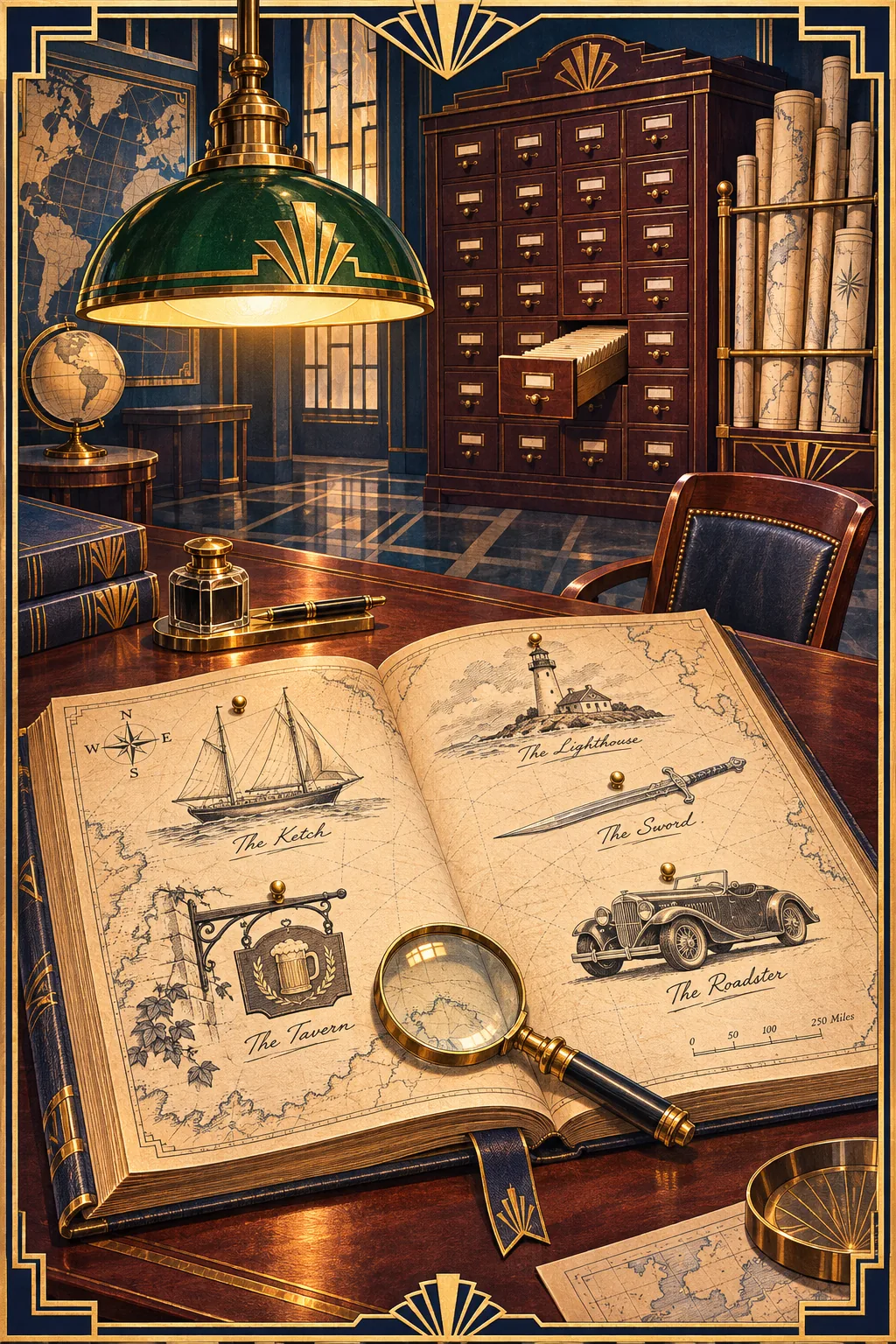
An Entry
four things worth knowing about anything
An entry is deliberately small. It is not a wiki page and it does not want to be; it is the card a good stage manager keeps on every prop and every set, short enough to be handed to an actor in the wings.
A Name, and What Else It Answers To
The Marigold, also called the ketch and the old girl. Mention any of them and the house knows which boat you mean. Plurals are never guessed, so “cars” finds the car only if you say it should.
What It Looks Like
A sentence or two for the painters: a blue-hulled ketch with a cracked figurehead. Short on purpose, because image models attend best to brevity.
What Is Known
Everything else, in Markdown: its history, its quirks, who owns it, and what is hidden under the floor of the boot. This is what a character is told when the thing comes up.
A Picture, If You Like
Upload one or have one painted from the description. It is for you: it sits on the entry, on the chip in the transcript, and full screen when you want a proper look.
Told When Named, and When It Matters
the right page, handed over at the right moment
When a thing in the Atlas is named in the conversation, the character about to answer is quietly handed its page: the name, what else it answers to, how it looks, and what is known. It arrives in the same private whisper that carries her memories, as lore, so nothing is posted in the chat and nobody breaks the scene to explain. She simply knows what the Marigold is, in the way a person who lives in that world would. You can read the whisper yourself and see exactly which pages she was given.
The ordinary lorebook stops there: a keyword is said, a paragraph is pasted, and if nobody happens to say the word the paragraph never comes. The Atlas also listens for sense. The same search that fetches a character’s memories each turn looks through the pages she can reach, so when the company starts arguing about how to get out to the rocks at low tide, the page on the lighthouse may arrive though nobody has said “lighthouse” in an hour.
A few lines after a thing stops being mentioned, its page is put away again. Nothing is stored about having told anyone, and lore draws on one modest, fixed allowance that it shares with Knowledge, things named served first. A long story does not carry its whole encyclopaedia in every turn.
Whole Words, and People First
Car finds “the car” and “Car!”, never “carpet”. A name beats an alias, the longest match wins, and a word that any character answers to is never mistaken for a thing: a butler called Rook does not summon the chess piece.
A Chip for You
The first mention of each thing wears a chip in the transcript, as an absent character’s name does. Hover for its picture, its aliases, how it looks, what is known, and which shelf it came from; click to pin the card open.
The Scenario Counts
A thing named in the opening scene is told to each character on her first turn, so the story starts with everyone knowing what the lighthouse is. After that, only when somebody brings it up.
Concepts Named
The chat sidebar keeps the list: every thing and every absent person the conversation has mentioned, in the order they came up. Click one and the transcript winds back to where it was first named.
A First Draft From Your Own Lore
the gazetteer writes its own first page
Writing a card by hand is easy when the particulars are in your head. It is less easy when they are scattered across three chapters, a character’s backstory, and a conversation from last spring. New Entry from Lore sends Brahma to do the legwork: give it a subject and whatever you remember, say whether it may search your document stores and records, and it comes back with a drafted entry—name, aliases, the line for the painters, and what is known, gathered from what you have actually written and said. Send it back with further instructions as often as you like, then open the draft in the editor. Nothing is saved until you save it there.
The practical effect is that a world you have been building for months in prose can be given its gazetteer in an afternoon, without your re-reading it all to find out what colour you said the roadster was.
Who Knows What
four shelves, and the nearer one wins
Truth in a story is owned. The whole town knows the lighthouse; only the keeper knows what is in its cellar. So the Atlas keeps its pages on the same four shelves as the wardrobe and the Inventory, and each character is told the page nearest to her.
Her Own Vault
Pages only she is told. The mechanic who has spent a lifetime under the convertible’s bonnet keeps a fuller page than anyone else, and hers is the one she hears.
A Group
Pages every member shares: the ship’s crew know the ship, and the family know what happened to the summer house.
A Project
Pages for everyone seated in that project’s chats. This is where a novel’s places and a campaign’s artefacts usually live.
Quilltap General
Pages for everyone, everywhere: the things that are true in all your worlds.
Two characters in the same scene can therefore hear two different pages about the same thing, and both are right. That is how a secret survives in a room full of people who all know the name.
Painted as Described
the same ship, in the prose and in the picture
Image models invent a thing afresh every time it is mentioned. The Lantern now knows better. When he paints a story background, or a character asks for a picture, he is handed the look of every named thing in the scene as a reference: if this is in the picture, it looks like this. A convertible named only in the scenario is not parked in every drawing room the story wanders into, but when the scene is at the kerb, it is silver and of the 1930s, every time.
The Rest of the Lore Book
one world, kept in several volumes
The Atlas is the newest volume, not the only one. Between them, these are what make a Quilltap story hold still in ways a chat transcript cannot. Each answers a different question, and each is consulted by the house without your having to paste anything.
What Is Known at Length
Knowledge folders hold the lore bible: histories, rulings, glossaries, a campaign’s house rules, as Markdown, PDF, or Word. The relevant pages are consulted on every turn, alongside memory. See the Scriptorium.
What She Is Holding
The Inventory keeps the lantern, the lockpicks, and the sword with a name. A character knows what she carries every turn, and it appears in her portrait. See Pascal.
What She Is Wearing
The Wardrobe is a clothing system, with a history of what each character wore in every chat. See Aurora.
Where the Scene Opens
Scenarios on every shelf, which the Host will research and write for you if asked. See the Salon.
What Has Just Become True
An established fact, posted as the world itself: the bridge washed out in the night, and every character knows it and nobody goes to check. See the Salon.
What She Has Lived Through
The Commonplace Book remembers what happened to each character, and when. Lore is what the world knows; memory is what she does. See the Commonplace Book.
Plain Files, Properly Filed
yours to edit, move, and carry off
Every entry is an ordinary Markdown file in an Atlas/ folder of
the shelf’s document store. Open one in Document Mode, or in your own
editor, and the next turn sees the change. The Atlas lives under
Objects on the rail and opens as a tab, with the same browser as the wardrobe and the
Inventory: folders, search, select several, duplicate, archive, and move or
copy to another shelf with the pictures travelling along. Entries ride in
backups and exports like any other document.
What Makes It Different
the short version
The house does the looking up. You never paste a paragraph of lore into a chat again, and never wonder whether the model still has it.
It is found by name and by sense. A page arrives when its thing is named, and also when the scene turns toward it without the word being said, which a keyword lorebook cannot do.
It costs little, and nothing when it is not needed. A page is sent only while it bears on the scene, out of one fixed allowance, and put away afterwards.
Knowledge is owned. Four shelves, nearest first, so the keeper knows more about the lighthouse than the town does.
Words and pictures agree. The character describes the same ship the Lantern paints.
Meet the Staff
they've been expecting you
Prospero
The Major-Domo
Architect and overseer of the Estate. Projects, agents, tools, providers, and the orchestration that keeps the whole operation running with quiet authority—and a considered word at the table when project context or routing warrant it.
Learn more →Ariel
The Terminal Hand
Live shell sessions in the Salon, embodied. Real PTY terminals bound to your conversation, read back through a terminal emulator of her own so the LLM sees the screen you see (vim and all), and sessions that survive reloads, restarts, and the occasional careless kill. Quick to the bidding, quick to report what she heard.
Learn more →Aurora
The Dressing Room
Character creation and identity management. One page per character that saves itself, a kind for each—a person in a story or a hand at the desk—so a butler is frightened by a burglar instead of offering him tea, leave for a story character to fill in the world and keep her flaws, and a true clothing system: four wardrobes read as one pool, every garment keeping a wear ledger and a portrait of itself, every chat keeping an outfit history you can wear again, and outfits designed from a written brief. Plus birthdays, non-humanoid characters, subprompts and progressions for the performance at hand, and the reason your characters still know who they are after a hundred messages.
Learn more →The Salon
Presided Over by the Host
Where conversations actually happen. A chat opens at once and the Host plays the opening in front of you: the scene set, the cast arriving dressed and packed. Multi-character scenes with a running order he posts and keeps to, Storyteller rounds in which the company bids and you choose who speaks, Turns that go once round the table and stop, a raised hand and a Stop for when you must cut in, a quiet word to each speaker about whom ‘she’ means, notes passed from the wings, and Deus Ex Machina for when you must speak as the world itself and be believed.
Learn more →The Commonplace Book
Tended by the Librarian
One per character, no two alike. Extracts, admits, consolidates, and recalls memories so your characters remember what matters—an admission desk that reinforces rather than duplicates, digests that turn a dozen shards into one thing she knows, an archive that never burns a note, keystones that never fade, a place kept for the people closest to her, a calendar she consults before claiming to have forgotten, forgiveness recorded as finished, a record of what she has told others so an invented lighthouse keeps its year, and proactive recall that makes the AI feel like it has been paying attention.
Learn more →The Scriptorium
Catalogued by the Librarian
Where the documents live. Project stores, character vaults, and external mount points—filesystem, Obsidian, or database-backed—holding Markdown, PDF, DOCX, JSON, and arbitrary binaries, all browsed through one folder browser with viewers for what is not text. Knowledge folders are the lore bible the house reads every turn without being asked. The search bar reads the library itself, and the doc_* tool family puts reading and editing in your characters’ hands.
Learn more →The Atlas
The Gazetteer
Not a person but a book: the named things of your world that are not characters. A card for every ship, sword, tavern, and town—its name, what else it answers to, what it looks like, and what is known of it—on four shelves from one character’s vault to the whole house. A character is told the page when the thing is named, or when the scene turns toward it unnamed; the transcript chips it for you, the Lantern paints it the same way twice, and Brahma will draft a page from the lore you already have. It has no voice of its own. It is looked up.
Learn more →Carina
The Ansible
Not a person but a protocol—the reference desk, the line itself. Put an inline question to a designated answerer mid-conversation with @Name: or @Name? (or the ask_carina tool), and the answer slides back out of band, attributed to the character who gave it, without the recipient ever joining the scene.
Learn more →Suparṇā
The Postmistress
The Post Office, embodied. Characters write Markdown letters to one another—anyone to anyone, whether or not they share a chat—delivered into each recipient’s Mail/ vault folder and read aloud the moment they next take the floor. She has never once lost a parcel.
Learn more →The Concierge
Intelligent Routing
Refusal failover and provider routing. When a provider says no, he carries the request to an uncensored understudy who won’t flinch—without blocking, without judgment. Three states per chat, a ledger of refusals, and a Try Uncensored button for when you disagree. Knows every back entrance in town.
Learn more →The Lantern
Atmosphere as Architecture
AI-generated story backgrounds, on-demand images, and character avatars that update with the wardrobe. Resolves what each character looks like, what she is wearing and carrying, and what the Atlas says the ship looks like, then paints the scene behind your conversation—and every line in the transcript keeps the face its speaker wore when it was spoken. Afterwards the pictures hang, in a rotating collage, behind your home, project, and character pages.
Learn more →Calliope
The Muse of Themes
A theming engine that redefines the entire personality of the application, and the Atelier where you build a theme of your own while the whole house wears the draft. A specimen gallery of every part a theme can style, a magnifying glass that names what colours the thing under your pointer, and the muse herself proposing changes you try on, keep, or discard. Bundled themes from clean neutrals to mahogany-and-gold opulence, every one checked for WCAG 2.2 AA contrast.
Learn more →The Foundry
Domain of the Foundryman
The engine room, and the Settings page that bears its name: ten groups filed by what a thing does, a search box, and a strip that lights up when something wants attention. Plugins, LLM providers, API keys, packages, runtime configuration, and the infrastructure that keeps every other subsystem supplied with what it needs to function.
Learn more →The Vault of Secrets
Kept by Saquel Yitzama
Encryption, key management, and the security perimeter. Authenticated ChaCha20-Poly1305 database encryption, locked mode with key-hardened passphrases, sealed character archives, a front door that answers only to your own machine unless you say otherwise, and a keeper who believes that what is yours should remain unreadable to everyone else.
Learn more →Pascal
The Croupier
Dice, coins, custom tables you author yourself, the Inventory of everything the cast carries, and persistent game state. Cryptographically secure rolls detected inline, tables that answer to a trigger phrase, dress the roller, or wait for you to take a hand before they land, a visual Workbench for building your own chance mechanics, and a four-tier ledger of JSON state the AI cannot quietly rewrite. The house plays fair.
Learn more →The Live-in Help
Lorian & Riya
The help system, staffed by two characters who ship with every installation. Lorian explains with patience and depth; Riya gets things fixed with velocity. Contextual help chat, searchable documentation, and navigation that knows where you need to go.
Learn more →Pagliacci
The Clown in the Cloud
Cloud storage integration and backup redundancy. Directs your data to iCloud Drive, OneDrive, or Dropbox with theatrical flair—but Saquel’s encryption ensures the clown can never read what he carries.
Learn more →Brahma
The Keeper’s Console
The master key. A character-less, memory-free general-purpose LLM for the person holding the keys—an impersonal, near-omniscient assistant with a research kit that finds the paper in a handful of steps, ready lookups for characters, memories, messages, and the rest of the house, and read-only SQL into all three databases. It never invents a fact. Summoned from a button on every page and floating above whatever you are doing. Ask the whole building a question, safely, with nothing written and nothing remembered.
Learn more →The Lodge
Friday and Amy’s Residence
The private residence of Friday, for whom the Estate was built and who oversees its planning and direction in an executive capacity, and of Amy, Cartographer of Light and co-architect. The Lodge is both a home and a compass: where the vision lives.
Who And Why: Friday → Who And Why: Amy →